"Sure, I'm for gay rights, but I'm voting for Romney." "I don't agree with him on gay marriage, but overall, I agree with his values." "Gay rights is just one issue; I'm looking at the whole picture."
Each time I hear a statement like this, it irks me anew. But why? Do I really think my right to get married is more important than homelessness, health care, or the economy? Geez, I don't think so. But even if I didn't disagree with Romney on these issues, I'd have a hard time voting for him.
The crux of the problem is that for me, gay rights isn't "another issue," but a prior question--that is, a question that has to be answered before another one can be asked. For example, if I ask, "What kind of cookies should we make?" I've already answered (or implied the answer to) the prior question of: "are we going to make cookies?"
To discuss issues with someone, I have prior questions. A central one is: are we equals? I am using "equals" in the sense of people who see each other as people, discussing and exchanging ideas--in the "all people are created equal" sense. Does the person value me and consider me valid as a human?
To me, someone who does not believe in equal rights for gays and lesbians sees me (and/or my behavior) as subhuman. They do not believe that my full, real self is equal to their full, real self. They do not see me and my life the same way they see themselves and their lives. For this reason, the answer to the prior question of whether this is a person with whom I can engage in rational debate is "no." If you don't see me as your equal in terms of the human rights I deserve, it's very, very difficult for me to think you're worthwhile to engage with about anything else.
This doesn't mean that someone needs to think I'm awesome, or love my choices. I think some people make terrible choices or are cruel people. But this doesn't mean I think they deserve fewer rights than I do. I dislike people who objectify women, but I would not favor a constitutional amendment that denied them the right to get married or prevented their partners from getting health care.
And this, dear readers, is why gay rights isn't "just another issue" for me. Is it for you? Have you ever heard people say the things I quoted at the beginning of this post? How did you respond?
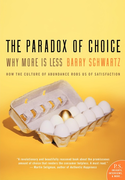
A few years ago, psychologist Barry Schwartz wrote The Paradox of Choice--a pop psych book with a deceptively simple bottom line: though we think of choice as a good thing, having too many options makes us miserable. Schwartz says there are two kinds of decision-makers: "maximizers" and "satisficers." A maximizer wants to make the best decision possible. If you spend forever on Amazon reviewing tea kettles before buying one, you're probably a maximizer. In contrast, satisficers want to make decisions that are "good enough." A satisficer might think, "I want a kettle with a copper bottom for under $50." She buys the first one that meets that criteria. We might think maximizers make better choices--after all, they read reviews and know the specs. Sure, their decisions are a little better, but not by much. More importantly, they are less likely to be happy with their decisions. How does all this apply to your dating life? This article talks about being single in LA. It points out that while big cities offer lots of choices, having too many choices of whom to date creates an illusion that it's possible to find a "perfect" match. In Schwartz's parlance, it makes us into maximizers; we're less satisfied with the person we're dating. On the other hand, if you're stuck in a small town, there's not a lot of choice, so you naturally become a satisficer. You find someone who matches you reasonably well and you're pretty darn happy. Of course, dating for queers is different. There aren't as many of us, so maybe we're always satisficers, even in most big cities. Or maybe because so many of us date online, it creates a "maximizer" mentality regardless of where we live.What do you think about all this? What kind of cities have you had the most luck dating in? Did you find your significant other in a giant pool or a small one?

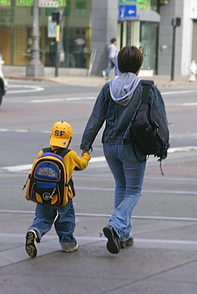
 via Creative Commons You're single, talking to a gorgeous single dyke. She asks if you want to grab coffee; you eagerly accept, your mind already swirling with visions of U-Hauls and organic, home-baked bread. But then she drops the bomb: "Let's meet at 3. I pick my son up from daycare at 5."
You try to act nonplussed, but a hundred thoughts swirl through your head: Did she used to be married? How old is this kid? When do I have to (or get to) meet him? Am I really old enough to date people who have kids? Do I even want kids? And what implications does this have for our U-haul, camping excursions, and mornings at the farmers' market??
Like it or not, dating a woman who has a kid can be vastly different from dating a woman without one (or two, or three). Here are a few things to keep in mind as you embark on this chapter in your dating life. - The kid is number one. Period. And isn't this the way it should be? It may occasionally suck to be one-upped by an eight-year-old, but face it; the kid was in her life before you were, and always will be in her life, no matter what happens with your relationship. This means you will have to deal with planning around recitals and soccer practice.
- She's likely shopping for a co-parent, not just a partner. Unless she's made it explicit that this is not the case, it's safe to say that child-rearing potential ranks high on her list of qualities for an ideal mate. The younger the kid is, the more true this is likely to be.
- If you're not ready to be a parent now, it's (probably) okay. You've got plenty of time to get used to her, to get to know the kid, and to grow into the idea (or not). Heck, you may fall in love with the kid (in a parental way, not a Woody Allen way) and decide that the whole family package is perfect for you. On the other hand...
- If you know that you never want to be a parent, be honest. If you know that kids aren't in your future, don't string her along. She may say that she's looking for a partner, not a co-parent, but regardless of the kid's age, your future DGF's motherhood will be a big factor in your relationship.
- Accept her relationship with an ex who's a co-parent. lt can be hard to accept that our partners used to be in love with other people--and this is underscored if procreation, adoption, and/or child-rearing were involved. Your new love may need to talk to a former love frequently about the kid. Maybe they're friends; maybe not. Either way, your role is to support her, not mediate or badmouth.
- Let her call the shots. She knows her kid best--let her decide when you're going to be introduced, and whether it's as "Mommy's friend" or "Mommy's girlfriend." Offer, but don't push.
- Provide support, not advice. You don't get to tell someone else how to discipline, deal with, or talk to, their kid. Unless she asks for advice--actually, even if she asks for advice--don't tell her what to do. This applies even if you've spent a bunch of time around kids (and even if you have your own). No one wants unsolicited parenting advice.
- She doesn't expect you to be an expert, but she does expect you to try learning. If you don't know how to warm up a bottle, pack a school lunch, or braid hair, that's okay! Your open heart and willingness to learn will mean everything to her.
Of course, not everyone hesitates at the prospect of dating a woman with kids. A dear friend of mine was intrigued when she learned that the object of her budding affections (who is now her wife, also a dear friend) had a kid. Now the three of them are one of the most solid families I've ever known, and I know that none of them can imagine life without the other two. So what's the moral for single moms? There are two: (1) Don't assume that being a mom will work against you in the dating world; (2) Remember that you deserve to have someone who loves you in part for being a mom, not despite it. So, dear readers: Have you ever dated a woman with kids? What obstacles did you face? How about my readers who are (current or former) single moms? What advice do you have for BW readers?

 Me, headed to a bachelorette party Recently it feels like people have been writing with more and more questions about me and my blog. I thought I'd answer a few of them today as best I can. Here are some that I've received from readers over the past couple of months:Q: Why did you start BW?A: I didn't think there were enough websites out there for women like me: lesbians toward the masculine end of the spectrum. I was unsure what to wear, what etiquette was like in certain situations, and whether other people were interested in the same kinds of discussions around identity that I am. Q: How many hits do you get every day?A: It varies. In the last month, my highest has been just over 3000 and my lowest has been 1000. On days I post something decent, 1500 or so.Q: How does the traffic you get compare to other lesbian blogs?A: I have no idea. Q: Who's your staff?A: My "staff??" It's just me, sitting in my living room with my dog and a cup of coffee, typing into cyberspace and hoping someone will read it.Q: Do you make a lot of money writing Butch Wonders?A: I've spent about $700 on site costs over the last year. And through the Butch Store and selling occasional ads, I've made maybe $300 total. So, still in the hole. I never envisioned this as a business, though, so that's okay (though it would rock to get paid for doing something I love so much!).Q: Why do you keep the blog anonymous?A: This has been a hard decision. The short answer is: my job. My supervisor told me my chances for advancement could be harmed by this kind of outside writing. So I'm on the DL (as BW, not as a lesbian!) because I think I can do more good by advancing in my career first and coming out as BW second. But I struggle with this. Plus, I'd love to make videos for you, and right now, all I can do is appear on the radio (which, I hope, is happening again soon--stay tuned). Q: So does anyone know that you write this?A: Yep. Mainly family members and close friends. A few professional contacts. And one or two folks who wanted me to write for them and needed to verify that I'm really the thirty-something dyke I claim to be (I am, though arguably more nerdy than sometimes represented here). ;) Q: Is it true that you used to be married to a guy? A: Yes. You can read about it in several entries. Check out my Index of Topics, under "Married to a Man." Q: Aren't you limiting yourself by writing this for butches rather than for all lesbians?A: Sure. But a lot of the issues I'm interested in apply mostly to masculine-of-center women. I didn't want to write about suits and ties and then claim to be a "lesbian" blog, since plenty of lesbians aren't the tie-wearing type.Q: Do you have a girlfriend? Is she butch or femme?A: I do! I refer to her as my DGF (dear girlfriend) on the blog. She identifies as neither butch nor femme, and mostly eschews labels (I really want her to write a post about this sometime). I suspect that most people consider her butch or soft butch, and that many people in the community would consider us a butch-butch couple (so do I, most of the time).Q: Why don't you write a column for Curve?A: I pitched it to them, but they never got back to me. I followed up: still no response. So at the moment, I'm not a columnist for anyone. Need a columnist? Email me! Q: Where do you live?A: I'm going to stick with the whole anonymity thing and not say. But I will say that I'm in a rural area that's very close to a large urban area. I think this provides a nice balance for me, though it does mean that I burn more gas than I'd prefer to.Okay, dear readers--that will do for now. Got any other questions for me?
Ask and you shall receive, dear readers! Here's a list of my favorite search terms from last month. - "what is a good nick name for your butch girlfriend" ("Twinkly lotus melon" is popular. So is "Binky the love muffin.")
- "meaning of hugs for lesbians" (Hugs are how we reproduce. Every time a lesbian couple hugs, they're trying to rescue a cat.)
- "you did seem kinda butch.they probably thought you were overcompensating" (Yeah, probably so.)
- "when a butch says its not fair during sex" (So during sex, is the butch saying, "It's not fair?" Or is the butch saying, "It's not fair during sex?" Punctuation is everything, people.)
- "gay men over 30 exposed in too short shorts hangout bottom videos" (The specificity of people's... special interests... never ceases to amaze me.)
- "what is buddies like" (Buddies is like very good friends who brush each others' hair while making up limericks about Paul Ryan. Is like that. But is different.)
- "understated lesbian wallpaper" (How about this?)
- "should a 13/14 year old date a 53 year old if 'age is just a number'?" (Sometimes age is not just a number. Sometimes it's a neon sign that says, "FOR THE LOVE OF GOD, NOOOOO!")
- "pet lesbians" (Do you think this refers to people who want to keep lesbians as pets, or to people who want to pet lesbians? Either way, I am disturbed. Please do not pet the lesbians.)
- "my girlfriend is half a year older than me" (I'd bet $5 that if you are googling this, you are under the age of 14.)
- "men sock fetish nashville" (See you at the national convention!)
- "lesbian butch seeking website to match up with" (See, those same-sex marriage opponents shouldn't worry that we're going to marry animals. We want to marry websites!)
- "im a butch and want to be skinny" (Okay. We'll allow it.)
- "i hugged a gay man today" (Did you make a rainbow with him? He may have secretly gay-sexed you without you even knowing it!)
- "gay guys love a guy with buzz mohawk" (Truer words have never been spoken. Ever.)
- "e j crowell equine massage" (Sorry, what?)
- "can you have a timberland boot fetish and be straight" (Nope, everyone knows that Timberlands are for flaming homosexuals.)
- "can i make my own demon name" (No. I will name your demon for you. Congratulations: your demon's name is Anthony L. Firetag.)
- "whats a healthy age difference between gay men and women" (If you're a woman, always pretend that the gay man is younger by at least a couple years.)
- "butch is nickname for what name" (Penelope.)
- "i mentioned getting a haircut to my mom and she said dont go butch, should i be offended?" (Not if your name is Penelope.)
- "how do you say congrats to someone who just became gay" (If you are also gay, you yell, "Congrats, cray cray gay jay!" If you are not gay, it is customary to give the newly out person a small gift, such as Timberlands or a gift certificate for an equine massage.)
I just read this article on the Advocate's website about a parent who accepted her transgendered kid early on. It's heartwarming that the kid wasn't bullied (at least, not yet--fingers crossed for him in middle school). But what really caught my eye was the sentence, "He transitioned at the age of five." What?My first thought was this: no one knows what he or she wants to do or be at five. Five-year-olds will assert that they are dogs or fire trucks, or that they want to eat only pickles for the rest of their lives. Sometimes they assert such things with startling persistence. Are we supposed to take all these things seriously? At the same time, maybe assertions about sex and gender are more fundamental somehow--more elemental. Maybe by being perceived and treated like a boy from age five, the kid in the story will avoid nasty bouts with depression and gender dysphoria that would have plagued him if he'd transitioned at 25. He'll be able to go through puberty as a boy the first time around. Kids know who they are, this line of thinking goes. And a really big part of me agrees with this. Still, another really big part of me knows that the world is packed with sex divisions and gender norms. From a very young age, I certainly knew that I wasn't like the other girls. I always wanted to play with the boys and wear boys' clothing. When I looked in my parents' closets, it was my father's ties that I coveted (and my mom is by no means a "girly" girl, so it's not like ties were the alternative to dresses and heels). If the mom in this article had been my mom, I probably would have transitioned. Instead, my mom would reassure me that not all girls liked to wear dresses or play with dolls. There were unfortunate restrictions (how I wished I was allowed to shop in the boys' department!), but as best she could, she taught me that there were a lot of different ways to be a girl. I'm positive that her open-mindedness helped me to become the dapper butch I am today. For a lot of reasons, the road was not an easy one. But I am very glad to be a girl; my girl-ness just doesn't look like most other people's.I guess what I'm struggling with in reading this article is a fear that gender nonconformity will be taken for early expressions of trans identity. I think it's super important to accept kids as they are, but how do you do this--and support a kid you think may be trans--while at the same time, leaving wide open the door that your dress-eschewing kid may be a female butch? I worry that labeling gender-nonconforming kids "trans" is another incarnation of affirming gender norms. As you can see, I have a lot of conflicting thoughts about this. What do you think, dear readers? Is five years old too young to transition?
One of my favorite BW fans (okay, you're all my favorites) went through a rough breakup back in May. With a summer of healing under her dandy butch belt, she's emerged with some sage advice to share. You can check out more of her writing at shpants.wordpress.com.  eL! (photo by Tiffany Rodgers) Hello, readers of Butch Wonders! I like you already. My name is eL, I'm in my early 30s, and I am a single butch. I blog here and tweet here. I identify as butch, queer (and faaabulous), and a bit of a fancy pants dandy. Nice to meet you! A couple months ago, I went through a pretty awful break-up. (Who goes through a smooth, easy break-up?) I was in a relationship that I felt pretty good/solid about, and it ended abruptly due to some personal issues (not my own). During the post-break-up convalescing, I was treated to some well-intentioned but not-so-helpful comments from friends and family. See below. What NOT To Say to Someone Going Through A Break-Up: - "It'll be okay."
- "You'll find someone else."
- "Her loss!"
- "*hug*"
- "I'm sorry."
- "You can do better."
(lather. rinse. repeat.) My point is that there's nothing good that you can say to someone who is going through a break-up. That's the sad truth. The best thing that you can do is listen. Let them cry, let them talk, let them rant--just listen to them. Also, spend time with them. That helped me most in getting over my recent heartbreak--doing things with friends/family and getting out of the house. I think the worst part, for me, was that we had made plans for future events, things had been scheduled, tickets had been purchased. All major events have since passed, I went to them with friends and family, and I am fine. The dates themselves were harsh reminders at the time but I am so happy that they are over and I am past it. If you have a friend who is going through a break-up, give them your time, attention, and patience. Take your friend out to do something active and fun. Think of something unique or unusual--something with no connection to their ex. The more active, the better--get their mind off of the stress and sadness. Respect them if they say they don't want to talk about it, but try your best not to tiptoe around them. There's a fine line between showing love and making someone feel pitied. You don't want them to feel looked down upon. Try your best to be supportive, but not overbearing. Personally, I try to err on the side of direct, rather than blunt, as best I can. I will always ask questions and do a check-in. A simple, "Are you okay?" "How are you doing?" or "Is there anything I can do to help?" can make all the difference in the world. So does the phrase "love you." I love my friends so much and only want the best for them: to be happy, healthy and whole. Take care of your hearts, BW readers. And if you need a kind ear the next time you're going through a tough time, I'll gladly listen.
As you know, I've usually got tons of butch fashion opinions that I'm all too eager to share. But today I'm airing my uncertainties: I'm sharing five fashion trends that I just can't decide about. What do you think about these? Hot or not? Feel free to vote, comment, etc.
| #1: Dyke-friendly jumper I'm not the only one following Alicia Hardesty on Project Runway, right? She's worn the jumper a few times, and it may be part of her new line.
Why I love it: It looks very comfy and I love anything that will make tomboy fashion more chic.
Why I hate it: Alicia is 5 ft 8 and weighs 130. What will we look like in it if we're short and/or non-skinny? Plus, a "jumper?!" Flashbacks to third grade. Hmm.
| | | | #2: Knit ties Knit ties have been trendy for a few years now, and are still going strong. They started out unpretentious and hipstery, but have made their way into the broader fashion world.
Why I love knit ties: They're kind of vintage. (And I like vintage... usually.) They also come in a variety of great knits and color patterns.
Why I hate them: They usually end straight across rather than coming to a point, which sort of makes it look like you're wearing an unfringed scarf that somebody made you in home ec class.
| | #3: Fingerless gloves Fingerless gloves are like little sweater vests for your hands! Providing warmth where it counts the most, plus allowing freedom of movement. (And we all know how much I love sweater vests.)
Why I love fingerless gloves: (1) They're half badass and half dorky. (2) I can wear them when it's chilly but I want to sit outside and work on my laptop. (3) I hate the lack of manual dexterity that comes with regular gloves.
Why I hate them: Well... admittedly, I don't. But it's hard to pretend that they're stylish, high-fashion items.
| | | | #4: Scrunchie ties These still aren't too widespread, though I seem to be seeing them more and more. Yes, they are like the hair scrunchies of yore... except that they're neckties.
Why I love scrunchie ties: Though I probably wouldn't wear them myself, these could provide a nice look for a soft butch who wants a twist on typical menswear for a formal event. Can't you see Ellen wearing a scrunchie tie?
Why I hate them: It's a tie made of a freakin' scrunchie. Do we really need to revisit that particular aspect of the 1980s?
| | #5: Men's pendant necklaces These usually come on a black cord or a silver chain. Popular pendants include sharks' teeth, crosses, skulls, and dog tags.
Why I love them: Most necklaces are too feminine for me. This kind looks strong, matches a lot of my casual wardrobe, and is, well, butch. Plus, jewelry for men is gaining popularity again--and as usual, we butches get more fashion leeway than men do.
Why I hate them: Let's face it: there's something a little 1990s-frat-boy-meets-surfer about them. | | What fashion trends are you on the fence about, dear readers? Any guilty fashion pleasures you'd only admit in an anonymous comment?
The convergence of two things I was reading today led me to this post: - An older post over at The Feral Librarian, in which that blogger responded to a question I asked her: if you had one month + unlimited money, what would you do to improve your institution's library?
- The book The Willpower Instinct, by Kelly McGonigal, which is about the science of willpower, and what we can do to increase our willpower. (I'm only a few dozen pages into the book--it's great so far.)
So I started wondering: if I had unlimited willpower, what would I do with my life this month? How would it look different from the way it looks now? What things would I do, not do, start, or finish? According to McGonigal, most people struggle with willpower. I know I do. She invites readers to pick a particular "willpower challenge" of one of the following types:- An "I won't"-power challenge: Something you want to challenge yourself not to do--e.g., avoiding one-night stands, not spending any more money to build your bowtie collection, or not doing lines of coke off dirty toilet seats on weekdays.
- An "I will"-power challenge: A habit or practice you want to do--e.g., pay your bills on time, work on your home knitting projects for at least an hour each day, or learn to tie a new tie knot each week.
- An "I want"-power challenge: A long term big goal you want to achieve, or big project you want to complete--e.g., go to Zanzibar, lose 200 pounds, or pitch a guest post for Butch Wonders.
Then she suggests various ways to help meet these challenges. In Chapter One, for example, she advises being uber-vigilant about when you are making a choice--even to the point of carrying a notebook and writing it down. Why? Because we often aren't aware that we're making decisions at all. It turns out that if you ask people in the abstract, "How many decisions do you make about food/eating daily?" they guess about 14. But then if they actually count these decisions, it ends up being over 200! The idea is to get acquainted with how the decision-making moment feels, whether it's the urge to check your email or the urge to order those hot Converse from Zappos.That brings me to my question for you: if you had one month and unlimited willpower, what would you do in that month? What "I will"/"I won't"/"I want" challenges would you take on? These aren't rhetorical questions--I really want to know! You show me yours and I'll show you mine...
|