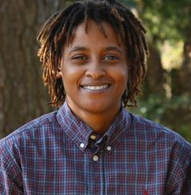
 Jameka Evans was a security guard at Georgia Regional Hospital in Savannah, Georgia. From the beginning of her employment in 2012, Evans was treated badly. She was harassed verbally and physically; she was criticized for wearing a "male" uniform and having a short haircut, and for not carrying herself in a "traditional woman[ly] manner." In short, she was being harassed for both her gender presentation and her sexual orientation.
Evans left her job about a year later, sick of the constant harrassment, and filed a complaint under a federal law known as "Title VII." Title VII prevents discrimination on the basis of sex, including sex stereotyping. The case went to a federal district court, where she lost because the court said that Title VII was intended to protect "sex," not "homosexuality." Evans then appealed to the next court up (the 11th Circuit, since she lives in Georgia), saying that Title VII prevented discrimination against her on the basis of sexual orientation and gender presentation. That court, too, ruled against her (and as a Slate article pointed out, the ruling was weird in a variety of ways). The court separated the gender nonconformity part from the sexual orientation part. They vacated (basically overturned, but without creating precedent) that part of the district court's order, saying that she could go back and try with that part of the case again. Evans and her lawyers then asked for something called an "en banc" hearing, which means that instead of the usual three-judge panel, all the judges on the 11th Circuit would have heard the case. This was denied, meaning that the ruling against Evans stands--at least, until the U.S. Supreme Court says otherwise. So Evans, represented by Lambda Legal, decided to petition the Supreme Court to hear the sexual orientation part of the case. The petition (which you can download from this site if you're interested) is terrific, clearly explaining why discrimination on the basis of sexual orientation is a form of gender discrimination. It states, "It cannot be that Title VII allows an employer to fire Sharon for exercising her constitutional right to marry her girlfriend while retaining her co-worker Samuel after he marries his." Will the Supreme Court take the case? Who knows. But I suspect it will, since nearly all the circuits have weighed in, there's a circuit split (thanks to the 11th Circuit), and it's an important issue. To go back to the gender nonconformity piece for a minute: it's kind of interesting: Title VII definitely applies to "sex stereotyping" (as the Supreme Court decided in a 1989 case called Price Waterhouse v. Hopkins), which is what courts rely on to explain that gender nonconformity is covered. Which would seem to mean that trans people are definitely covered, right? So if the Supreme Court ruled against Evans, a few things would happen that seem like sort of untenable outcomes:
Anyhow, it's an exciting case with huge implications. Keep an eye on this one, dear readers.
1 Comment
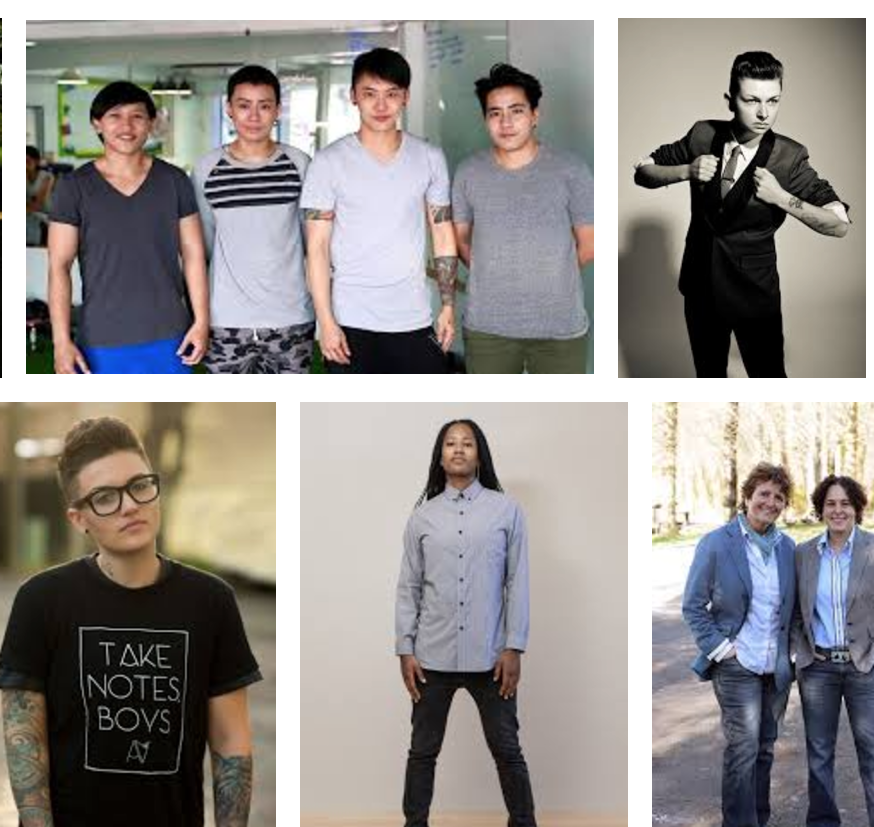 Some results of a Google image search of the words "butch" and "trans" Some results of a Google image search of the words "butch" and "trans" I was having drinks with a friend the other night, and as often seems to be the case with lesbians these days, we fell into a discussion about the relative prevalence of trans men now as compared to, say, 10 or 15 years ago.
My friend’s question was: why now? Why are there so many trans men, particularly young ones, at this moment in time? My first response was a version of the “backlog” argument I made a few years ago on this blog: trans men have always been around; it’s just that a more extensive physical transition was less available until recently, so many of them chose to live as butch lesbians. My friend didn’t buy it. Her arguments were: (1) It’s still expensive to transition, so it’s not like it’s that “available” now compared to 10 years ago, and (2) There have always been people born as women who identified as men and lived as men. She’s right about both, I suppose--although I'm certain that hormones, trans-positive therapists, etc., are a lot more prevalent than they used to be. (Maybe are we wrong and there aren't more trans men, just more trans visibility? But I don't think we're wrong.) Or, perhaps it is not about scientific or hormonal or surgical availability; perhaps it is about cultural availability. Perhaps it used to be the case that someone born a woman who identified as masculine didn’t used to have models for what a transition was like, or a community that would be accepting, or—and this is crucial—the internet as a trove of resources and potential connections. Perhaps this lack of “cultural availability” made it more difficult, because even though transitioning is hard now, maybe it was a lot more isolating back then. I feel like it had to have been. So I guess that's still a "backlog" argument, but a different kind of backlog argument. Another possible explanation is that there has been a resurgence of gender essentialism—maybe it just seems way more comfortable and plausible to live as a gender-conforming man than as a gender nonconforming woman. As my friend told me, “Lesbians have never been in fashion.” True enough (although we have our flashes of hip visibility every now and again—see, e.g., Rachel Maddow on the cover of Rolling Stone). But it’s not like trans men are “in fashion” in a mainstream sense either—I’m hard-pressed to think of trans men with Maddow-level visibility. Then again, trans men are men, and often pass as cis men to everyone around them—and men have always been in fashion. So maybe if you don’t have a strong sense that you were born in the wrong body (I know that many people do—I’m talking about those who don’t), but you know you’re masculine, it’s psychologically more comfortable to be a guy. I don’t know. I don’t have a good answer to my friend’s question, and I thought it was kind of an uninteresting question in the moment (duh—the backlog thing + scientific advances). But the more I think about it, the more I think it’s a good question. Why now? Happy Butch Wednesday! A few days ago, I received this email from a reader, and decided to share my answer on the blog. Here's the email (edited for length):
I came across your blog last night when I googled "can I be a transgender women and butch." I'm a transgender woman at the beginning of my transition to be true to myself. I started HRT a month ago during Pride. I smile when I say that because I am proud. I've spent the last several years trying to learn who I really am and where I want to go. I have some of the dysphoria most trans people talk about but sometimes I wonder why I'm not more bothered by it. I know that may sound crazy but what bothers me more is trying to understand why I feel like a woman but want to retain some form of masculinity. I prefer to wear the women's version of a masculine look. I'm athletic and a tomboy. My sexual preference is women. Can I actually be a butch lesbian and transgender? Is what I feel and the way I want to present myself accepted in the butch community? I feel like people will ask why I'm transitioning if I want to be masculine. I honestly feel like a woman. I'm no expert on transgender identity, and I hope some of my trans readers will weigh in and share their thoughts in the comments. But personally, I think the answer is an emphatic yes. Of course you can be a MTF butch, because trans women are women, and there are all kinds of women, and butch is one of these kinds. It makes perfect sense to me! You bring up some really good points, and I'll respond to as many as I can. The stickiest question, perhaps, is whether you will be "accepted" within the butch community. My responses are threefold:
The boundaries of the butch community, such as it is, seem more porous than ever. I've even gotten angry emails from people when I've defined butches as masculine women. These readers pointed out that I was excluding trans men, who might still identify as butches, just not as butch women. And, of course, there are plenty of nonbinary people who identify as butch, women who identify as genderqueer and not butch, genderqueer people who identify as butch but not as women--the list goes on. One result of this increasing porousness is that it can feel confusing and/or threatening to people w hoID as butch women. After all, a hallmark of butch womanness is masculinity. What does it mean if another woman starts taking testosterone, stops identifying as female, gains muscle mass and a square jaw, and still identifies as butch? A woman who also identifies as butch may then feel less masculine in comparison. In effect, she feels she has been "feminized" in comparison to her butch counterparts. And many butches do not like to feel feminized, so it creates all this policing--e.g., "Well, that person who takes T isn't really butch--they're in a different category now." I understand this policing, and I understand the person who doesn't want to abandon their butch identity simply because they're on testosterone or no longer use female pronouns. This is part of the reason there's sometimes tension between trans men and butch women . So this all means you're stepping into a bit of a quagmire. On the whole, I suspect that if they're concerned about trans people identifying as butches, most butch women are thinking about the FTM phenomenon, not the MTF phenomenon. There's this idea that butch women are disappearing. (Personally, I love the idea that even if we are "losing" butch women, we are also gaining them!) If you do meet resistance from butches, I suspect that it will have to do with some of your biologically "masculine" traits. Statistically speaking, you are likely to be taller, deeper-voiced, slimmer-hipped, etc., than most cis women. Butches might be jealous. Or they might read you as a cis man, even accidentally. Even though you're a masculine woman, you might have to find ways to accentuate your femininity to be read in the way you prefer. I don't mean that you need to wear a skirt or do something else dysphoria-inducing--certainly not! I just mean that until they see the strap of your sportsbra outlined beneath your T-shirt, other butches might not know how to read you. Dating may (or may not) be a little challenging. I don't know what your plans are for bottom surgery--you need to do what's right for you. I'm going to assume that at this point, you have the genitals you did at birth: presumably, a penis. When it comes to dating, Surprise Penis is not the best kind of penis. The decision about how and when to out yourself as trans to anyone you're naked with is personal (I'm trying to get a trans woman friend of mine to guest post about exactly this). But I will say that suddenly encountering a penis where one does not expect to encounter a penis has the potential to be threatening or traumatizing to the person you're with. Disclosing your trans status can be a burden, but whether it's fair or not, people who see you as a cis woman, and with whom you're intimate, will expect you to do it well before naked time. More on that in a future post. You also mentioned that people might wonder why you're transitioning at all if you want to be masculine. You're right--they might! But you answered this yourself: "I honestly feel like a woman." It's kind of similar, actually, to when people ask people who date butches, "Why don't you just date a man?" The answer, in short, is that female masculinity and male masculinity are different--which seems to be something you feel, too, having experienced both first-hand. Female masculinity seems to feel really comfortable to you, and it's really great that you've figured that out. I'm sure it wasn't easy. In sum, you sound awesome and interesting and like you're well on your way. I'm excited for you and wish I could give you a hug and a fist bump. You're in for a wild ride--stay true to yourself, and try to ignore people who don't understand you or tell you that you "can't" be a certain way. Welcome to the butch community! I'm writing this post to help me think through a reaction I've felt recently. I don't fully understand it, so bear with me. I've written a bunch about trans issues in the past--for example, explaining how dysphoria can be experienced by non-trans people, the differences between butch women and trans men, discussing some infuriating anti-trans sentiments in the lesbian community and the tension between butch women and trans men, and giving advice to a reader trying to figure out whether he or she was trans. I'm interested in trans issues not only because equality and respect for trans individuals is fundamentally important to the queer community at large, but also because understanding people's transphobic impulses can tell us a great deal about how we understand sex and gender.
So here's what's been bothering me. Lately, I've met a number of people who identify as butch women (and sometimes, but not always, as genderqueer), and who exclusively use feminine pronouns (she, her, hers), and who also modify their bodies in various ways consistent with popular understandings of masculinity: specifically, taking moderate amounts of testosterone, which (particularly if paired with certain kinds of physical activity) can result in major masculinization of the jawline/shoulders/etc. So as a result, many of these women look way more "masculine" than a woman who does not take supplemental testosterone. The fact that this is a trend does not bother me; people should be able to do whatever they want with their bodies. What bothers me is my own reaction. There's a little piece of me that feels like they are "cheating" or "having it both ways" by taking testosterone but not being trans. My internal reaction is super disturbing to me, because on an intellectual and spiritual level, there is literally no reason for me to feel even a little bit uncomfortable! It makes no sense. My own reaction is intolerant, wrong, and inconsistent with my values. So here's what I think is going on. On most people's idea of what a "woman" is, I am pretty far on the masculine end of the spectrum. I like being a masculine woman; it is who I am. And I would like to think that my satisfaction with my own identity is wholly internal. But, of course, this is impossible; we are social animals, after all. When I see a trans man, I am not "threatened" or bothered in the least, even viscerally. He's in a different category from me. He is a man. But the women I am describing take male hormones and identify as women. They put themselves in the same category as me: masculine woman. But since they are taking testosterone and making their bodies and presentations more masculine, I feel less masculine in comparison to other people in my "masculine women" category. Maybe my discomfort comes from this perceived threat to my masculinity. If so, this is interesting but disturbing, in part because I like to think of my own identity as self-contained--as stemming from me, not from my relationship to the rest of society. Except, of course, that I don't exist in a vacuum. As you can tell, I haven't thought this through completely, but I wonder if anyone else has felt anything like this. I talk to butch women occasionally who say that they feel "pressure" to transition. I can honestly say that no one has ever pressured me to become trans (although occasionally people assume that I must be "at least thinking about it," since so many of the masculine women they used to know have become men). There is not much personal allure for me in the idea of existing as a man. I like being a woman. But I guess I also like being a masculine one, and I guess that that masculinity is more precarious than I would sometimes like to acknowledge. First off: Caitlyn Jenner is a brave human being. Anyone who has the courage to come out as something different--as something that others make fun of or ridicule or malign is brave. It takes courage to be yourself whenever "yourself" isn't what most other people are.
I've been increasingly bothered by the rhetoric surrounding Jenner's coming out, and about the precise nature of the ostensibly supportive comments I've been reading and hearing. The ones that bother me most have come from well-meaning straight women in the public eye who talk about how beautiful Caitlyn is (true) and how courageous she is (also true), and who show a sudden empathy for the plight of all trans people (by which, frankly, they tend to mean trans women). (Sidenote: I'm going to use the term "straight women" in this post to refer to a particular kind of straight woman that tends to: (1) embrace the gender binary (2) but support gay rights (3) but glare at me in the women's restroom. You know the type. If you're a straight woman who reads this blog all the time and doesn't look askance at butches in the restroom, please know that I'm not talking about you.) It's not that Caitlyn Jenner doesn't deserve kudos and support--she certainly does! But a significant chunk of the mainstream support I've seen seems to totally embrace gender norms. If Caitlyn looked like, say, Rachel Maddow, I daresay that she would have fewer straight female supporters talking on podcasts and posting on Facebook pages about much they love and support her. Nor, I suspect, would she have graced the cover of Vanity Fair. I do not think Bruce Jenner coming out as a woman is the big draw. I think the big draw is Bruce Jenner coming out as a woman of a certain kind--as a woman who embraces the type of femininity that fits neatly into the existing gender binary with which people are comfortable. I don't think they're thinking, "Wow, this really complicates how I think about gender!" I think they're thinking, "Wow, this gorgeous woman was trapped in a man's body!" As a New York Times article astutely pointed out the other day, the brain-body distinction is not so clear. Here's an excerpt: While young [Bruce Jenner] was being cheered on toward a university athletic scholarship, few female athletes could dare hope for such largess since universities offered little funding for women’s sports. When Mr. Jenner looked for a job to support himself during his training for the 1976 Olympics, he didn’t have to turn to the meager “Help Wanted – Female” ads in the newspapers, and he could get by on the $9,000 he earned annually, unlike young women whose median pay was little more than half that of men. Tall and strong, he never had to figure out how to walk streets safely at night. Those are realities that shape women’s brains. Which is true, at least to some extent. To say that Jenner always had a "woman's brain" doesn't take into account that she had a man's social experiences--and that our experiences powerfully shape our brain chemistry, our pocketbooks, and our self-understandings. Acknowledging this doesn't make Jenner any less of a woman (something the article really seems to miss). But not acknowledging this minimizes the social experiences of cis women and girls, and reduces trans identity to a simple case of "wrong brain, wrong body." Jenner had a certain set of experiences particular to her identity, and they should be respected in and of themselves. Frankly, I'm also jealous. I wish that straight women would embrace women who look like me with as much openness as I see them embracing Caitlyn Jenner. In short, I wish that straight women's newfound "acceptance" of different versions of what it means to be a woman extended more broadly in my own direction, not just in Caitlyn's--that they would show so much love and support for women whose gender presentation and ideas of womanhood don't look like their own. |

|
 RSS Feed