The other day, I had to go get some blood drawn.  Because of the bizarre way my medical provider structures itself, the immunology clinic is in the children's wing.  As a result, the latest chapter in my "why-do-I-get-mono-so-often" detective mystery takes place amidst Disney characters, cartoon trains, and primary colors.  It's far cheerier than adult hospital, plus you get to choose a sticker before you leave. 

Anyway, after the phlebotimist works his or her magic, they usually press a little square of gauze against the place where the needle went in and tell you to hold it there for a minute.  Then they wrap it with that self-adhesive rubbery wrap stuff.  But since the office is so child-friendly, instead of having plain old boring beige gauze, they have waaay cooler ones.  Check out the types below:
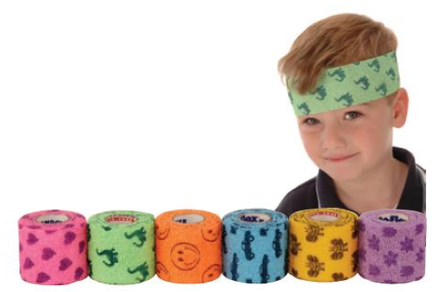
Specifically, my office had the hearts, the dinosaurs, and the race cars (pink, green, and blue). 

So my own, personal, bearded, honey-haired, thirty-something whippersnapper of a phlebotomist has finished the draw, and I'm dutifully holding the gauze, and next thing I know, he's lassoing my elbow with the pink one.  "Why did you--" I sputtered.  Then I smiled and chuckled.  "Oh, I see," I say.  "Girls get the hearts and boys get the racecars?"

...To which he replied, without irony, "Yep."  Not being able to let it go, I said, "Wait, really?  Blue for boys and pink for girls and green if you run out of either?"  "Yeah," he said again, at this point seeming a little puzzled at my inability to grasp the concept of gendered self-adhesive medical wrap.

"Well, if you would have asked, I'd have preferred the race cars, or even better, the dinosaurs," I said.  I grinned, hoping to convey that I didn't actually give a hoot what was on my arm at the moment, but that he might want to ask kids their preferences.  "It's just like when I was a kid," I continued.  "They gave me the pink, but I wanted the green or the blue."

At this point, he gave me a look that--albeit not the least bit mean--made it clear he had more useful places to be, told me to have a great day, and headed out of the room.  I didn't stop him, but I hope that next time he phlebotomizes a wee one, he thinks twice before slapping on a gender-normative wrap.  Is one wrap a big deal in the context of things?  Of course not.  But these little signals add up.  They are the stuff of society, and they are the stuff of gender normativity.  They are the way, brick by brick, we come to build the beliefs we hold about the way men and women "are."

Yeah, I'm butch enough to sport pink hearts around my left elbow.  But just the same, I made sure to conspicuously choose a big ol' Spiderman sticker on the way out.


I attended an amazing event this weekend, where I got the privilege of spending two days with some of the most accomplished, dynamic LGBTQ folks I've ever met.  More on that in a future post, but while I was there, someone asked me what topics I've wanted to address on BW but haven't gotten around to, or that I've found it too hard to write about.  I had two answers: (1) Butches and race; (2) Butches and body image.

The former is hard to write about because, as a white woman, it's impossible for me to speak from personal experience about how being a racial minority interacts with butchness.  Sure, I can talk about whiteness + butchness, and maybe I will--but I'm still looking for a guest blogger of color to write a post about this (hit me up if you're interested).  Number (2) is hard to write about because it's such a touchy topic for so many people.  But I'm going to take my new friend up on his challenge anyway, and delve into the topic of butches and body image.

First, my experience.  I'm not exactly "fat," and I'm usually pretty active (well, when I'm not dealing with mono, whooping cough, or a broken foot).  But I'm carrying around about 30 pounds more than I'd like, and the BMI scale puts me solidly in the "overweight" category.  I've lost 12 lbs this year without giving up ice cream (because, like, let's be realistic, people), and hope to lose a bit more.  So I know firsthand what it's like to be hefty, though admittedly I don't know what it's like to be obese.  (And I really don't know what it's like to be thin.) 

I've had multiple butches confide body image issues to me, though always one on one, and sometimes anonymously.  There's a sense out there that it's just not "butch" to talk about being insecure about your physical appearance.  Most butches don't talk about this with one another; to whom are we supposed to talk about it?  A girlfriend in front of whom we're trying to appear confident?  A male friend?  A straight female friend?  Frankly, none of those options sound appealing.

Furthermore, diet and exercise present special problems for butches, which mirror some of the problems faced by straight men.  Butches trying to lose weight may think they'll lose butch points if they admit to dieting.  The diet industry paints monitoring food intake as something "feminine."  I know I wouldn't feel comfortable telling a butch buddy that I'm on a diet.  And when it comes to exercise, many of us want to look competent, because physical fitness is "butch," right?  But what if we're wheezing after a half mile?  What if we can't bench press as much as our femme friends can?  Overall, it can be a lot easier to hide behind your butchness than to risk making yourself vulnerable.  It's easier to "puff up" as you walk by the gym, but to avoid going in.  And don't even get me started on swimsuits. 

On the other end of the spectrum, some butches suffer from anorexia, bulimia, and other eating disorders.  And these folks can feel invisible.  It can feel decidedly un-butch to seek help for this.  And available support groups may not contain a heck of a lot of people who look like you.

I hope to post more on this issue soon, but for now, I just wanted to get the topic out there.  We think about our bodies, too, and a lot of us are self-conscious--and we don't always talk about it.

What do you think, butches?  Is butchness and body image an issue you've ever thought about?  Experienced?  Heard about from others?  What kinds of issues related to body image would you like to see addressed on BW?


Just a quick post to announce that The Trevor Project won the poll, and 1/3 of the proceeds from Mad 4 Equality will be donated there.  Thanks for voting--I expect to post entry info in a day or two, and am super stoked about the tournament.  Stay tuned!

On a slightly different BW note, I wanted to apologize for being such a lax little blogger lately.  A couple different things have been going on, one of which involved me stepping off of a sidewalk onto uneven pavement and twisting my foot, causing a ligament to pull a chunk of bone off.  So I'm hobbling around on crutches and demanding things from my DGF, who is being a ridiculously wonderful sport about it. 

I'll try to pick up the pace, though, for your reading pleasure.  I miss you guys!  Love, BW
 
 
My last post got a ton of traffic; it seems like I'm not the only one out there with gynecologist stories (nor, for that matter, chin hairs). 

I really did intend it as a public service announcement, *not* a scare story.  I hope you'll consider it even if you have a deep aversion to such things.  Here are some tips to make your gyno-health-ventures more tolerable:

Before making the appointment:
  • Do your homework.  Get a friend's recommendation, look on Yelp, and/or contact your local LGBT center for a list of queer-friendly docs.
  • If you're reallyreallyreally nervous, you may want to make an appointment to meet the OBGYN ahead of time.  That way if you dislike the person or feel that he or she isn't queer-friendly, you're not obligated to come back.  If the doctor refuses or wants to charge you for a five-minute intro, call a different doctor.

While making the appointment:
  • If you have a preference for a man or a woman OBGYN, say so.  It's a very common request, so don't feel like you're being a pain.
  • Say something like, "I need a gay-friendly doctor who's been trained in lesbian health."  Whether you need the expertise isn't the point; you want someone who won't flinch at your stunning butch-osity.
  • Book a morning appointment.  This way you'll be fresh from the shower--giving you one less thing to think about.

A week before the appointment:


  • Arrange to bring a friend if it will make you more comfortable.  They can come in with you, wait in the waiting room, whatever you want.
  • Make a note of when your last period was, how regular it's been, any problems you've been having, questions you have, etc.  This way, you'll have it right in front of you when you're asked.

The day of the appointment:


  • Wear shoes that are easy to slip on and off, as well as clothes that aren't too much of a pain to change into and out of.
  • If it will make you feel better, shave your legs and butch-scape your nether-regions.  (But they've seen it all, so you seriously have nothing to worry about.  I never do anything different from normal.)
  • Your feet will be up in stirrups, basically in the doc's face.  If you have stinky feet or something, deal with them ahead of time.

At the appointment:
  • If you want, ask to see the doc with your clothing on first.  Sometimes it's easier to meet on "equal" footing, (i.e. when you're not wearing a teensy robe).
  • If it's your first time, or you aren't used to--uh--much in-and-out traffic, tell the doctor immediately to use the smallest speculum (pronounced SPECK-you-lum) possible.  This will make it far less likely to hurt.
  • Remember that you are in charge.  It is your body and your appointment, even though it may not always feel this way.  Even as I toughed it out with DSM yesterday, I knew that I could call it off any time I wanted to, which made me feel a little more empowered.

Any other tips I'm missing?  Please add them in the comments!
                                

                   That's a speculum. ---->

Guess where it goes.  Wouldn't you prefer a small one?
 
 
This is a hard entry for me to write, since it's perrrrsonal, but it's important.

A lot of women hate going to the gynecologist.  But when I say that I hate it, I mean, I HATE it.  As in, I would rather get a cavity filled, clean my toilet, or run a mile with my old PE teacher screaming at me. 

A few years ago, I finally found an OBGYN whom I love.  (I'll call her "Superdoc.")  Superdoc is a lesbian, was wholly unassuming when I was asking about lesbian sexual health while trying hard not to seem (or be) gay, and best of all: she has very small hands.  But Superdoc is on a long medical leave, so I had to see someone else.  Alas.

As soon as the new doc came into the room, I knew I'd made a mistake.  (Also, she looked like an old-timey schoolmarm, so I'm going to call her "DSM" for "Dr. School Marm.")  She didn't shake my hand (bad sign), and sat at her computer while I sat naked beneath my dopey little robe.  Then she started asking me questions.  The conversation proceeded thusly:

DSM: When you came here last, you and Superdoc talked about PCOS?
BW: Yeah.  But I think I don't have it, because I got an ultrasound and they said my ovaries weren't polycystic. 
DSM: That's not the only way we diagnose it.  Do you remember what Superdoc said would happen if you didn't have a regular period?
BW [more subdued]: I had a CAT scan for an unrelated reason and I asked about my ovaries and they said they were OK.
DSM: [laughs consescendingly]: well, if they didn't look specifically at that, then they can't tell you.  You have to do calculations
BW: [very softly, looking away] Oh.  I...  I don't know, then.
DSM: Look, I'm not trying to convince you that you have PCOS.  I'm trying to make a diagnosis here!
BW: [even more softly] Oh, yeah, I--I don't... um...  Yeah, I mean, I'm not saying I don't have it, I just thought...  Well, one thing is my hormone levels are normal.  They took blood and--uh--they're in the normal range.  I--uh...
DSM: That's not dispositive. 
BW: Oh.  [Feels small.]
DSM: It says here you had an IUD.
BW: Yeah.  I did.  Maybe five years ago?  Six?  Or four?
DSM: What was your period like then?
BW: I don't--I'm not sure.  It was, um, I...  I don't know.  [Melts into a puddle of shame, embarrassment, and discomfort.]
DSM [incredulous; annoyed]: You don't know?

At this point, I am looking away, basically mumbling softly and incoherently, and--I kid you not--very close to tears, which DSM does not notice.  I decide I'm not going through with the exam.  Then I think about how folks in their 30s can get various kinds of nether-region cancer.  And then I feel worse.  And then DSM tells me that irregular periods put me at risk for endometrial cancer.  And I think about dying.

More awkward conversation ensues.  Some highlights:
  • DSM asks me what kind of birth control pills I've taken in the past.  I say I do not know.
  • DSM asks me when I got my IUD removed.  I say that it was somewhere between two and six years ago.
  • DSM asks me whether I filled the prescription from Superdoc last year.  I admit that I did not.  She gives me a withering stare.  I look away and mumble about "logistics" being "hard."
  • DSM asks me if my "current partner is a woman now."  She asks it in a way that makes it clear she knows from my chart that my former partner is male.  For no good reason, I feel dumb. 
  • DSM continues asking about my past periods.  I continue not knowing the answers except in the broadest sense.  She continues becoming frustrated and shooting exasperated, piteous looks at me.

When she gets up to do the exam, Kelli Dunham's refrain keeps going through my head: Get your bits checked outI will mentally dissociate, I think.  I'll pick a spot on the ceiling.  I will notice absolutely everything about that spot.  Bit-checking will be over before I know it.

But while conducting the breast exam (which, yes, I also loathe), DSM asks if I wax or pluck.  I tell her that yes, about every other month, I get my upper lip waxed (I don't have a lot of lip hair; I just don't want any).  Then, she asks if, although she can't see any facial hair, do I ever have to pluck a hair from my chin.  I say sure, sometimes.  She says it isn't normal for women to have hair anywhere besides their heads, and that this is probably because of PCOS (which, it is now clear, she has affirmatively decided I have).

Because my brain clicked off, I neglect to point out that countless businesses are sustained by the presence of hair on women's faces.  That "lip-wax" and "chin wax" are actual menu items at many beauticians'.  That this fact is excellent evidence that I am not a freak of nature for having unwanted hair. 

So instead, I say nothing.  I am silent.  I imagine a carnival barker yelling, "Get your bits checked!  Get your bits checked right here, folks!"  I find a spot on the ceiling.  I stare at it.  She conducts the exam.  It is uncomfortable, but lasts five minutes, tops.  My bits check out fine.  She leaves and I put my clothes on and get out as fast as I can.

Basically, it was an awful morning that reduced me nearly to tears, and I had to be consoled by my DGF (lucky for me, I was seeing her right afterward).  But I did it.  And now I don't have to think about it, and I've taken care of myself, which is an excellent feeling.

If I can live through that whole freakin' ordeal, you can, too (and chances are, your experience will be better than mine!).  Get your bits checked out.   I promise you'll live through it, and it can save your life.


The convergence of two things I was reading today led me to this post:
  1. An older post over at The Feral Librarian, in which that blogger responded to a question I asked her: if you had one month + unlimited money, what would you do to improve your institution's library?
  2. The book The Willpower Instinct, by Kelly McGonigal, which is about the science of willpower, and what we can do to increase our willpower.  (I'm only a few dozen pages into the book--it's great so far.)
So I started wondering: if I had unlimited willpower, what would I do with my life this month?  How would it look different from the way it looks now?  What things would I do, not do, start, or finish?

According to McGonigal, most people struggle with willpower.  I know I do.  She invites readers to pick a particular "willpower challenge" of one of the following types:
  • An "I won't"-power challenge: Something you want to challenge yourself not to do--e.g., avoiding one-night stands, not spending any more money to build your bowtie collection, or not doing lines of coke off dirty toilet seats on weekdays.
  • An "I will"-power challenge: A habit or practice you want to do--e.g., pay your bills on time, work on your home knitting projects for at least an hour each day, or learn to tie a new tie knot each week.
  • An "I want"-power challenge: A long term big goal you want to achieve, or big project you want to complete--e.g., go to Zanzibar, lose 200 pounds, or pitch a guest post for Butch Wonders.

Then she suggests various ways to help meet these challenges.  In Chapter One, for example, she advises being uber-vigilant about when you are making a choice--even to the point of carrying a notebook and writing it down.  Why?  Because we often aren't aware that we're making decisions at all.  It turns out that if you ask people in the abstract, "How many decisions do you make about food/eating daily?" they guess about 14.  But then if they actually count these decisions, it ends up being over 200!  The idea is to get acquainted with how the decision-making moment feels, whether it's the urge to check your email or the urge to order those hot Converse from Zappos.

That brings me to my question for you: if you had one month and unlimited willpower, what would you do in that month?  What "I will"/"I won't"/"I want" challenges would you take on?  These aren't rhetorical questions--I really want to know!  You show me yours and I'll show you mine...


_As part of my New Years resolution to drop a few pounds--a resolution which has been slow-going, to say the least--my DGF and I decided to join a gym.  I've had gym memberships before, and sometimes I've been good about using them; other times I haven't.  (Bizarrely, the likelihood that I will use a gym seems to be inversely correlated with the gym's niceness.)

I'm an afternoon or evening workout person.  Working out in the morning makes me feel virtuous, with a nice post-exercise buzz, but the habit doesn't stick.  Turns out I'd rather loll about in pajamas (on days I work from home) or drive grudgingly to work, down some coffee, and allow my mind to wake at roughly the pace of a banana slug.  I covet the virtuosity of Morning People.  I spent a brief time as a Morning Person in college, cheerfully forgoing Jell-o shots so I could go to sleep at eleven, wake up at six, lift weights, and run a mile.  I have no idea what got into me, and no idea where it escaped to.

All of this is to explain that although I've worked out at gyms in the past, I've never needed to change clothes there.  I either change at the office or wear gym clothes under my work clothes.  Then right after I work out, I just drive straight home.

But this new gym we've joined has a pool.  And for some reason, I have been obsessed with the idea that I want to swim.  I do not have a swimmer's physique, nor am I particularly good at it.  But surfing is on my bucket list and I need to be in better swimming shape if I want to surf before I hit 40.  Also, I recently read Haruki Murakami's South of the Border, West of the Sun (which I liked very much), and the main character is always swimming to clear his mind.  Murakami himself also swims, and I am presently a little obsessed with Haruki Murakami, so my burgeoning interest in swimming makes a fuzzy kind of sense.

Anyway, since I don't want to drive home sopping wet after a swim, I need to use the locker room at this new gym.  I hate changing in front of other people.  It's totally uncomfortable and I avoid it when I can, sometimes even changing in the shower stall.  But whatever.  I'm an adult.  I can handle being embarrassed about my body or my half-nakedness or my brilliantly white day-glo upper arms.  Here's the part I didn't anticipate but should have: some women are weirded out by seeing a butch in the locker room. They don't read me as male, but correctly read me as a dyke, and some of them kind of stare and look uncomfortable.

Honestly, I don't blame them.  One of the main rationales for having separate men's and women's locker rooms  (along with the safety issue) is that people want to be able to change their clothing without worrying about being looked at as sexual objects.  I get this.  And since I'm obviously a lesbian, some of them probably feel that it's a little like having a guy in the locker room. 

Even those who are quite progressive (and there are many of them at this gym), and don't blink at seeing a lesbian couple hold hands on the street may feel uneasy when there's a dyke in the locker room, because it makes them uncomfortable to think I might be looking at them in a sexual way (which I'm not).

So far, my basic strategy has been to try to make myself as small and unobtrusive as possible.  I avert my eyes and position my entire body away from the other women.  I guess this has worked okay so far, but it still makes me *and* them uncomfortable.  And probably one of these days, I'm going to get told, "This is the women's locker room!"  I guess I *could* wear tight pink T-shirts or lavender capris sweatpants things to announce my girlness, but, uh, that's not going to happen. 

I know I have just as much right to be there as everyone else and yada yada yada.  But for me, the issue is not about being ashamed to be a butch or not wanting to hold my head up high, or anything like that.  Just as *I* have a right to feel comfortable in the locker room, so do they. 

I'd really prefer to allow everyone to be as comfortable as possible.  I don't *want* to ignore their discomfort.  After all, I would feel totally uncomfortable if there was a guy in the locker room.  Not because he looks different from me, or because I think he's going to do anything he shouldn't, but simply because he is sexually attracted to women and I am a woman.

Have any of you other butches ever felt uncomfortable in a locker room?  How do you deal with it?  Just keep your head down and your gaze averted?  Or is there a magical approach I haven't figured out yet?

(Update: Wendi at A Stranger in This Place had a great post on this last year!)


I recently read this story in the New York Times about a photographer who takes pictures of old animals.  I find the pictures beautiful, and they made me think about aging.  I've long thought societies that revere and cherish older people have gotten it right.  I live in the U.S., where people start saying they're "getting old" in their thirties or forties, where people love getting carded, and where it's considered insulting for someone to guess that a person (especially a woman) is older than she really is.

I'd like to think that the lesbian community is different, and that we have tons of respect for the older (by "older," I mean 60s or 70s plus) dykes among us.  But I'm not sure this is true.  More than once, I've heard people my own age (30s) talk disparagingly about older lesbians, saying that they don't "get it" with regards to boi culture, or trans culture, or some other aspect of contemporary queer life.  (And, to be fair, I've occasionally heard older lesbians say disparaging things about queer youth culture, too.)

Why does this age divide exist?  Maybe because LGBTQ history and culture have evolved so rapidly in the last 50 years.  Maybe those who came of age in the Stonewall era share less with their younger counterparts than is true for straight people.  I don't think so, though; I suspect it's a manifestation of a broader tendency to dismiss older people rather than integrating them into society and seeking their wisdom.  And why does this tendency exist?  Are we obsessed with "progress," which we conflate with youth and newness?  Does hanging out with old people scare us because we don't understand it?  Does it force us to confront our own mortality?

It's especially important for the LGBTQ community to take care of its older members, because in many ways, it's harder to be an old dyke than it is to be an old straight woman.  Here are a few reasons why:
  • Lesbians have more health problems than straight women do.  (This stems in part from higher rates of obesity, smoking, and alcohol abuse among lesbians than among straight women.)  Heath problems become more severe with age.
  • While many lesbians have kids, we are less likely to have them than straight women are.  Old people are often taken care of by their kids; a lot of lesbians lack this resource.
  • Lesbians are more likely than straight women to be alienated from their families.  This means fewer financial resources, but also fewer social ones--leading to increased rates of depression.  
  • Lesbians often have few legal resources if their partner dies.  The deceased partner's family may challenge the living partner's legal standing to keep property or other assets that previously belonged to the couple.
I'm curious to know what you all think about this.  In general, do you think the queer community takes care of older dykes?  Should we? 

Do you ever hang out with older lesbians?  What's it like?  Tell us about your experiences: positive, negative, whatever.  And if you're a 60+ lesbian reading this blog, I'd love to hear your perspective about younger queers.


The huge amount of responses I got to my last post made me wonder if queers are more likely to feel alienated from their families than straight people are.  I mean, if your family doesn't respect your queerness, this is pretty self-evident.  But I know a lot of queers whose family is cool with their queerness, but they still feel alienated.  Why would this be?

One reason I can think of is the kid factor.  Plenty of queers have kids, but on average, we're less likely to procreate than our heterosexual counterparts (partly because homo sex ≠ babies, and partly, I'm guessing, for a whole host of other social/cultural/maybe-even-biological reasons).  Holidays tend to center around a traditional family structure, and also tend (for good reason) to center around kids.  Sometimes we don't really fit into that.

My own family is an example of this.  I have a brother (I'll call him DB for Dear Brother) who is married and has a young daughter.  I love my niece dearly, and love DB and his wife as well.  Partly because DB has a kid, a trend has emerged: My parents and DB's wife's parents, who live 10-12 hours' drive apart, spend Christmas together.  Actually, it's more like my parents have been subsumed into DB's wife's family, since the group includes many other members of her family as well.  So DB and his wife each get to be with both sets of parents every Christmas.  This is convenient for them, and also great for my niece, since she gets to be with all four of her grandparents every year.

As you can probably figure out, this leaves me in a slightly weird place.  Do my DGF and I drive 10-12 hours to spend Christmas with DB's wife's family?  Last year, we did; we rented a car and spent some time on our own and some time with them.  This year, however, they are renting a house in a remote, snowy location and spending four nights there.  DGF and I were invited to come (though we were not invited to help decide where Christmas would happen).  DGF and I decided we would not come along this year.  Our decision was met with much sadness and consternation by my parents.

The first two years it happened, I was annoyed that my parents decided to join a new clan.  But now I am at peace with it: they want to be with their grandkid, and this way they can see her every Christmas.  I understand.  The hard part for me is the expectation that I will always join them.  My mom is upset that I am not coming this year.  And while I am sad that I will not be with my parents, DB, sister-in-law, and niece, I do not wish to drive 12 hours to spend four nights with my DB's wife's family.  They are nice people.  But I have decided I will come along some years, and not others.  This is the first year I've said no.  I'm okay with my parents' choice about how to spend their Christmas, but I wish they better understood my decision to sit this one out.  I'm not trying to prove or anything by not going, either.  I just don't feel like going again this year.

If I had kids, things would probably be different.  Either my parents would switch off between my brother and I for Christmas, or I guess I would go along so the cousins could be together.  But I don't have kids, and I don't foresee having them in the near future.  And so as a result, Christmas is as I've described above.  And it just leaves me feeling weird and sad.  Am I being selfish?  Independent?  Petulant?  Self-actualizing?  I don't know.  I wish Christmas wasn't loaded with so many weird emotions. 

I'm hoping that this year, the DGF and I can start some traditions of our own.  Last night, we lit a candle for Hanukkah (we're not Jewish) and I gave her all of her Christmas presents.  It was wonderful and unexpected and romantic.  On Christmas, we're planning to spend some time with our friend M, and some time with our friends C&D (C is my butch buddy; D is her awesome wife).  Maybe we'll think of some other traditions to incorporate.  Will we bake cookies together?  Go to church?  Eat Chinese food with Jewish friends on Christmas eve?  Who knows.  But despite my weird guild/sadness/confusion about family stuff this year, I'm looking forward to creating some traditions that are mine and my DGF's. 

How about you guys?  Any sticky family situations you're avoiding?  Any cool new holiday tradition ideas that you and your DGF share?


If you grew up celebrating Christmas, the holiday that used to bring you unbridled joy may now bring a big ol' dollop of mixed emotions.  When we were kids, Christmas was less complicated.  After all, what can top the idea of a benevolent, costumed, bearded man leaving gifts while you sleep?  (Hmm, come to think of it, that sounds like something a gay man dreamed up.)  But if you're like me, somewhere along the way, Christmas stopped being so easy.  Note: if you're totally stoked about the holidays this year, this entry doesn't apply to you: go have a cup of eggnog or something.

My own mixed feelings about Christmas have to do with divorce, with people I miss, and with various types of guilt.  For others of you, it has to do with a falling out with your parents, or with the death of someone you love, or with the frustration of having to pretend to be someone you're not.  These aren't exactly thoughts you can bring up at the office holiday party.  Instead, they're the kind of things that hit you when you're in line at the drugstore at 9:30 pm with a box of Red Vines in one hand and a bottle of zin in the other (just hypothetically, of course), and "The Little Drummer Boy" starts blaring from the store speakers, and--BOOM--a wave of Holiday Depression.

The first thing to know about Holiday Depression is that you're not alone.  Lots of people deal with it; they just don't talk about it.  The second thing to know about Holiday Depression is that it passes.  Don't let yourself think that your unhappiness during the holidays is somehow symbolic of the shortcomings of your life more generally.  Because this is not true.  Holidays are the time of year when the highest number of people report feeling depressed.  You will feel a hell of a lot better in January.  I promise. 

A few quick fixes for dealing with a sudden wallop of Holiday Depression:
-    Lay on the couch.  Put your headphones on and listen to the least holiday-ish music you can think of.  Angry, not sad.  I recommend Tool, Rage Against the Machine, or whatever the current equivalent of that stuff is.
-    Open up Pandora and create a "Suzanne Westenhoefer" station.  Listen.
-    Start planning a trip for somewhere you're going to go in 2012.
-    Write to me.  Ask me anything.  Or tell me something you don't feel like telling anyone else.
-    Do a project that involves plants or animals.  Personally, I love paperwhites, and they're only about $1 each for the bulbs.  You can grow them in anything and it's mesmerizing. 
-    Buy yourself a new watch, or some other stylish thing that you will look awesome in.  My DGF (and others) call this "shopping therapy." 
-    Clean your whole house.  Rearrange stuff that's been bothering you.  It will distract you, let your mind wander, and make you feel like you accomplished something.
-    Go for a walk or a run--anything that gets you outdoors.  Don't come back until you're exhausted.  Then take a nice hot shower.

These are only temporary fixes, but sometimes a quick fix is all we need to get us over the hump.  So let's hear from you: Do you ever get hit with Holiday Depression?  And what do you do about it?