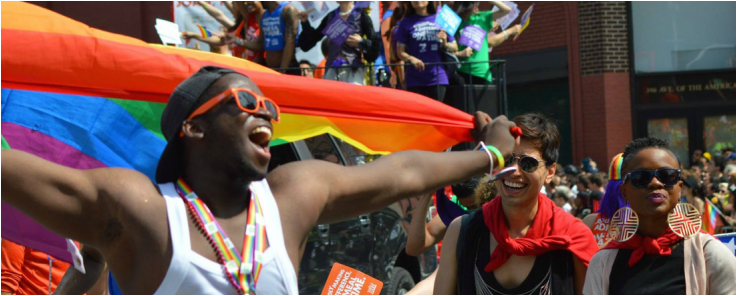
As you know, I enjoy wearing queer themed t-shirts. And I'm not the only one! Two awesome BW fans in SF (who contributed to this entry, btw) have created this "JUDGE ME" T-shirt to help keep the DOMA and Prop 8 Marriage Equality debates centered on the LGBTQ community and our allies. They're donating all proceeds to a combo of important charities: the Human Rights Campaign, SF's LGBTQ Community Center, and Lyric, a Queer youth empowerment program. (Check out the video.) There are only TWO DAYS left in their campaign and, with your help, I think we can push them over their goal. Whaddaya say?
 Edie and Thea in the 1960s A few of you have asked what I was going to write about Edie Windsor, so I thought I'd go ahead and post what I wrote, even though it's kind of incomplete.
The day before the Supreme Court arguments, I dreamed about them. For some reason, they were taking place in a high school gymnasium. And one of my biggest heroes (who was involved in the case, but didn't actually argue it) was arguing on behalf of Windsor. My parents were in the audience for some reason, and so was I, but I didn't seem to have a seat, and kept darting about the folding chairs to get a better view.
If you follow the case at all, you probably know some of the details: Edith Windsor's 40-year relationship with Thea Spyer, her longtime care of Thea after Thea was diagnosed with multiple sclerosis, and the financial blow dealt to her after Thea died (because their marriage--in NY and Canada--was not recognized by the federal government).
 Edie and Thea in the 2000s When I think about how hard it was for me to come out in the 2000s, and how much anti-gay rhetoric I heard as a kid, I'm especially amazed by women like Edie and Thea, who were out and proud when it was much harder to be.
Regardless of how the case comes down, I'm overwhelmed by my gratitude to Edie Windsor and the many others, young and old, who have been fighting this battle for a long, long time.
Butch Wonders is teaming up with the Campaign for Southern Equality and a few other folks to host a March Madness NCAA tournament for charity! Here are some deets: - $10/bracket to enter (it will be for the regular tournament. Maybe we'll also do something for the men's tournament--not sure yet)
- No limit on number of brackets
- Proceeds will be split between: (1) The winner(s); (2) The Campaign for Southern Equality; (3) An LGBTQ organization chosen by BW readers.
- You don't have to know anything about basketball to enter. We may even have a prize for the best "themed bracket" (where you pick the winners based on some arbitrary-but-amusing trait, like how cute the mascot is or how many of your exes attended the school).
So what I need from you is a suggestion for a great LGBTQ organization this tourney could benefit. Please put your suggestion, and your reason for thinking the charity is awesome, in the comments. On Monday, I'll post a poll based on your suggestions, and BW readers will get to vote on which charity we'll support! More details to follow. I'm looking forward to your suggestions! (And if you feel compelled to tweet this, which I hope you will, use #mad4equality.)
Suzanne Venker, author of How to Choose a Husband and make Peace With Marriage, wrote a short column on foxnews.com last week that incapsulates a whole bevy of misunderstandings about how gender works, what the goals of the feminist movement are, and even about the logical interpretation of evidence. The column's central claim is that the feminist movement is responsible for the supposed "decline" of heterosexual marriage. Because women have been "told" that they are equal to men, they pursue goals ultimately incompatible with their greater desire to have a family. As Venker says in the video interview posted above that column, "Women have become overdeveloped in their masculine side... because they have been groomed for a life in the marketplace, rather than a life at home." At their core, she writes, men and women are different. People with children "know [that] little girls love their dolls and boys just want to kick that ball." Men and women are different creations, and as a matter of biological determinism, they inherently want different things. Venker then cites continuing gender inequality as proof that men and women are different: "Men and women may be capable of doing many of the same things, but that doesn't mean they want to. That we don't have more female CEOs or stay-at-home dads proves this in spades." So, let me get this straight: Gender inequality is proof of inborn gender differences? What a useful concept. Now we know why there are so few obese movie stars: obese people don't want to be movie stars. And why there are so few out gay politicians: Gay people don't want to be politicians. And why, proportionally, there are so few black partners at big law firms: black people have little desire to be partners at big law firms. See how easy life can be if you just ignore social processes and assume that all human outcomes are solely a product of personal choice? Venker posits that the whole notion of "equality" is problematic. She writes that "the problem with equality is that it implies two things are interchangeable – meaning one thing can be substituted for the other with no ramifications. That is what feminists would have us believe, and anyone who contradicts this dogma is branded sexist." I don't know where she got this notion of equality, but it's not one I've ever heard. I've always thought equality meant two people had the same amount of value, the same opportunities, the same rights. I didn't know it meant we could just swap one person, willy nilly, for another. I thought it meant that I, a youngish white lesbian, and Thomas Sowell, a straight black 80-something conservative, each got one vote, the same right to counsel, and the same chance to protest a government decision in a public location. Under Venker's logic, equality actually means that you could swap Sowell and me in virtually any circumstance "with no ramifications." To this nonsense, I doubt either Sowell or I would agree--and I don't think it would make us racist, sexist, or any other "-ist" (any more than I'd be bucking feminist notions of equality by giving my seat to an elderly woman on a bus). Venker's argument would make more sense if we lived in a world where men and women weren't socialized so differently--a place where little boys and little girls were treated the same, where parents-to-be weren't gifted with different sets of toys based on the sex of their child, where there were equal numbers of male and female role models in every profession, where women's "formal" clothing didn't constitute teetering heels and displays of breasts and skin, where there wasn't one collection of traits associated with masculinity and an entirely different one associated with femininity. We do not live in that world. And because we do not, we are foolish to assume that anything we do is just a product of biology. Of course we are influenced by our genes. (Heck, all the socialization in the world didn't stop me from being a dyke.) But our genes merely set the stage. We grow into a version of our selves based on how we are socialized. A little boy jumps around and he's told, "You'll make a great basketball player!" A little girl jumps around and she's told, "You'll make a great dancer!" From day one, we are mired in social experiences--and many of these social experiences are heavily, heavily gendered. It is not as simple as parents forcing little girls to wear dresses or making little boys play baseball. Each of us is born with a hundred different possible, valid versions of our "selves" inside, and the collection of possible selves is different for each person. But which version we actually grow into is a complicated dance between predisposition and socialization (and I'd wager that socialization is doing a lot of the leading). On one level, arguments like Venker's are easily dismissed because they seem so patently sexist--it's easy to chuckle at someone who thinks society is going to hell in a handbasket because we're ignoring biological destiny. It's also easy to roll our eyes at the (thoroughly and measurably absurd) notion that women are being "groomed for the marketplace" and have overdeveloped "masculine sides." But I think it's more invidious than that. By misstating and oversimplifying the arguments of feminist and gender theorists, and by downplaying or ignoring the vastly different ways in which men and women are socialized, Venker becomes an apologist for material inequality. Why, after all, should we work harder to equalize opportunity if existing disparities prove intrinsic differences? If equal rights on paper make opportunities equal, then anyone who squawks and protests about inequality and wants to improve the world is just engaging in a silly, anachronistic waste of time.
Big news: the Supreme Court just agreed to take on two BIG gay rights cases this term: Case #1 involves the so-called "Defense of Marriage" Act (or DOMA), which is the federal law that says that even if your state allows gays to marry, married gays don't get federal benefits like Social Security or the ability to file joint tax returns. This case isn't about whether states have to legalize gay marriage--it's about whether if a state recognizes a gay marriage, the federal government has to play along. Case #2 comes out of California (see my previous post explaining gay marriage in California for background). It deals with Prop 8, the ballot initiative whereby those lily-livered California liberals voted to amend their state constitution to take away same-sex couples' right to marry. In this case, the Supremes could hand down many possible rulings, some of which would affect only California, some of which would affect the whole country, and some of which would kick issues back down to the lower courts. Neither of these cases necessarily has national implications for gay marriage (though they could--#2 especially), but they are still both Very Big Deals, particularly if you share my belief that gay rights isn't "just another issue." I'll wrap it up here and write more later, as this all develops. Here are some links to media coverage of the issue:What do you think about the Court's decision, dear readers? Are you optimistic?
BW NOTE: This is a guest post by a reader who wanted to remain anonymous. She recently faced the dreaded decision of pissing off a friend or wearing a (ugh!) dress...A few months ago, my cousin cast me as a bridesmaid in her wedding. Sensing my possible reluctance in the wardrobe department, she immediately informed me that I would be wearing a dress. Period. Because my cousin and I grew up together as friends, I made no verbal protest (BTW: This BW post is a must read for any straight bride with a lesbian (non-femme) bridesmaid). As details of the dress leaked, my dread grew. The bride had selected a purple gown with "challenging" qualities from top to bottom. On the bottom, the bridesmaids would sport a train (i.e. a bunch of fabric dragging behind us). On top, we would endure a strapless bodice with boning. For those unfamiliar with boning, a little history lesson: Boning (in the context of fashion) refers to the straight-jacket-like metal that serves to hold in your fat and position your breasts appropriately yet provocatively. Historically, dress designers used actual whalebone. When the bride began sharing details of the dress, I might have failed to exhibit the requisite level of enthusiasm (one of my flaws is an inability to conceal disdain). When the bride inquired, I politely reminded her of my hatred for dresses, lace, and frilly things. During the early stages of the engagement (a year or so before the wedding), I felt comfortable airing my concerns to the bride. During one conversation, my cousin pointed out that I had worn a dress to her sweet sixteen and to our high school homecoming dance. I had indeed. I went to a very homogeneous high school and dared not defy convention during my tender adolescence. The bride failed to grasp why, 10 years later, I couldn’t again conform for the purposes of her happiness. Because I’m petite and naturally pretty feminine looking (though I definitely err on the masculine side of clothes, hair, and shoes), I think my cousin had trouble understanding why a dress would pose such a serious hardship. Had I presented in a more masculine way, she might have more easily seen how dresses don’t fit with my gender identity. I could have explained, but in the context of her wedding planning, it didn’t seem like the right time to delve into the intersection between my sexual orientation, gender identity, and wardrobe choices. At one point, sensing my lack of enthusiasm for her dress selection, the bride proposed that I just rent a tux with a vest to match the bridesmaids' dresses. Now we were onto something! But before I could enthusiastically assent, she continued, more outlandishly: "While you’re at it, you could stand with the groomsmen, because that wouldn’t look weird." Her final suggestion—that I attend the bachelor party—made her sarcasm impossible to ignore. When I persisted in expressing enthusiasm for her suggestions (minus the strippers—she knows I find female strippers unappealing), she ended the conversation with an abrupt, "You’re wearing the dress and I don’t want to hear another word about it." Even when I stopped complaining to her face, the bride continued to worry about my ability to function as a bridesmaid, inquiring as to who would handle my makeup on the big day. When I responded "me," the bride proved unsatisfied, correctly assuming that I lacked the materials and the will to adequately cake myself. Earrings were also strongly recommended to counter my short (read: dykey) haircut. I borrowed some from a co-worker, and with a running start managed to re-pierce my ear hole in a bathroom stall (only my left one had closed over the years). I tried to respect the "no dress talk" rule, opting instead to write whiny entries in my journal and complain about the cost and fittings to my friends. As the wedding neared, my friends advised me to keep my big mouth shut and let the bride enjoy her big day. On the eve of the wedding, the bride furnished each bridesmaid with a gift and enclosed a note. Most notes recognized the bonds of friendship, and the affection she had in her heart for each of us. My letter simply thanked me for not leaving her side even if it meant, wearing a bridesmaid gown. I felt a huge wave of guilt. The bride had been a good friend to me in other ways, and had welcomed my girlfriend at the wedding. Couldn’t I just have dealt with the fabric monstrosity, the bloody left ear hole, and the caked-on face for her special day? At the wedding, I dealt with my suffering in the form of liquid relief, dancing the night away, and tying my train into a tail with a rubber band (and perhaps slapping my dance partners with it). With the help of only seven vodka-themed libations, I did have a blast. I wore the dress for 10 straight hours (I was given instructions not to change out of it at the reception), and I survived (though the tight bodice did a number on my back). Post-wedding, when I think back to the note, I shudder. I have no idea how I could have handled it better. I wanted to be her bridesmaid, and I certainly didn’t want to ruin her special day. Had Butch Wonders posted this article a bit earlier, I might have sent the bride the link. That way, she’d have known how I felt and had a few creative solutions at her disposal (she was actually on the right track in her sarcasm). Even though my morning routine allows me to ready myself for work in three minutes or less, on my cousin's big day this low-maintenance dyke made for a high-maintenance bridesmaid.
"Sure, I'm for gay rights, but I'm voting for Romney." "I don't agree with him on gay marriage, but overall, I agree with his values." "Gay rights is just one issue; I'm looking at the whole picture."
Each time I hear a statement like this, it irks me anew. But why? Do I really think my right to get married is more important than homelessness, health care, or the economy? Geez, I don't think so. But even if I didn't disagree with Romney on these issues, I'd have a hard time voting for him.
The crux of the problem is that for me, gay rights isn't "another issue," but a prior question--that is, a question that has to be answered before another one can be asked. For example, if I ask, "What kind of cookies should we make?" I've already answered (or implied the answer to) the prior question of: "are we going to make cookies?"
To discuss issues with someone, I have prior questions. A central one is: are we equals? I am using "equals" in the sense of people who see each other as people, discussing and exchanging ideas--in the "all people are created equal" sense. Does the person value me and consider me valid as a human?
To me, someone who does not believe in equal rights for gays and lesbians sees me (and/or my behavior) as subhuman. They do not believe that my full, real self is equal to their full, real self. They do not see me and my life the same way they see themselves and their lives. For this reason, the answer to the prior question of whether this is a person with whom I can engage in rational debate is "no." If you don't see me as your equal in terms of the human rights I deserve, it's very, very difficult for me to think you're worthwhile to engage with about anything else.
This doesn't mean that someone needs to think I'm awesome, or love my choices. I think some people make terrible choices or are cruel people. But this doesn't mean I think they deserve fewer rights than I do. I dislike people who objectify women, but I would not favor a constitutional amendment that denied them the right to get married or prevented their partners from getting health care.
And this, dear readers, is why gay rights isn't "just another issue" for me. Is it for you? Have you ever heard people say the things I quoted at the beginning of this post? How did you respond?
 via www.godammit.com/category/houseboys/ Holy matrimony, Batman! Lately I've gotten lots of questions from brides in heterosexual weddings asking what to do with a butch lesbian bridesmaid, since many of us would rather pierce our own eyeballs with blunt toothpicks than wear a fetching dress of sea foam green chiffon. Here are some FAQs for traditional or semi-traditional brides-to-be: Q: Should I make my butch lesbian friend wear a dress if she's my bridesmaid? A: No, no, no. Give her that option if you want, but don't expect her to take it. You asked a butch dyke to be your bridesmaid, and you should respect who she is. If you had a male best friend and wanted him to be a bridesmaid, would you make him wear a dress? Of course not. Years later, I remain grateful to my friends E&R for inviting me to wear a suit and tie as a bridesmaid at their wedding. Q: Should I wait till she asks me what she should wear, or until she asks if she has to wear a dress?A: No. I can guarantee you that if you've already asked her to stand by your side, but haven't told her what to wear, the poor dyke is sweating bullets in fear that she will be forced to choose between: (1) wearing a dress and feeling horribly uncomfortable; (2) pissing you off. Let her off the hook ASAP (and ideally as soon as you ask her to be a bridesmaid) by telling her that you won't make her wear anything that will make her uncomfortable. Q: But my Aunt Mildred is a devout Christian and will freak out about a woman in guys' clothes!A: Having your butch friend wear a tie doesn't mean you're disrespecting A.M.'s religion. Explain to your aunt that you allowed your friends to wear what they're most comfortable in, and that this will help everyone enjoy your wedding. If necessary, remind her that Jesus loves everyone, no matter what they wear. Or: don't tell her in advance at all. People are usually on their best behavior at weddings, even if they're surprised by something. Q: But if my friend doesn't wear a dress, the wedding parties won't be perfectly symmetrical!A: Oh no! They won't be symmetrical? Holy crap--why not call the whole wedding off? Come on: When you look back at your wedding photos in 10 or 20 years, you'll think fondly of how much fun everyone had, not admire how well everyone matched. When I married my DXH, I had one of my best friends be the "usher" instead of a bridesmaid simply because he's a guy and I thought I was supposed to have the "sides" look the same. What a stupid choice! What matters is that your closest friends are by your side on your big day. Oh: and that the wedding cake doesn't suck. And that the photographer isn't wasted. And that the music is good. (See how many more interesting things there are to worry about?) Q: Okay, so what should I have my butch bridesmaid wear?A: [Rubbing hands together] Here's the fun part! You've got a ton of options. I'll throw out a few, but be aware that the possibilities are practically endless: - Whatever the groomsmen are wearing.
- Pants the same color as whatever the groomsmen are wearing, with a shirt the color of the bridesmaids' dresses.
- A plain suit (men's or women's, her choice) with a plain white shirt or light grey shirt and a tie that you (or you and she) pick out to match the bridesmaids' dresses.
- The same thing the groomsmen are wearing, except with a suit vest instead of a jacket.
- Any configuration of the possibilities listed above.
Email me if you want some more detailed tips. I could even be persuaded to do a little fashion consulting on the side!Q: How do I treat my butch bridesmaid's girlfriend? Does she sit with the wedding party?A: Do whatever you're doing with your other bridesmaids' significant others. Which I hope is seating them with the wedding party, but if there's not room, people will understand--you just need to treat everyone the same. Q: If I'm giving all my bridesmaids the traditional gift you give people in your wedding party... what do I give the butch one?A: If it's a "girly" gift that she'll hate, get her something else. (What is your hubby-to-be getting his groomsmen? That's one option.) Other ideas: a pocket knife (I'd suggest either a cool folding knife like this one or a multitool type like this one) , a Bespoke box of awesome, or a set of cuff links (I love these, these, these, these, and these). Q: What about the bachelorette party and stuff? Will she feel totally comfortable there?A: This is a hard one, because she might not, especially if she doesn't know all the other bridesmaids. But you should still invite her. If you want to do girly things, emphasize that you'd love to have her there and give her options that might make her comfortable. For example, if you're all going for manicures, tell her she's welcome to get a men's pedicure or a foot massage instead. Or, say she can come be the official photographer whenever she doesn't feel like participating (butches love having duties). If she expresses discomfort about parts of it, tell her to come to whatever parts she wants to. And no, you aren't obligated to invite her girlfriend to the bachelorette party. See? With a few small tweaks, you too can have an awesome butch bridesmaid who's stoked about her duties.How about you butches out there who have been bridesmaids at het weddings? Any tips? Happy anecdotes? Horror stories?
I had an interesting conversation with a straight female friend of mine yesterday. She happens to have a bunch of polyamorous friends, though she and her (amazingly wonderful) boyfriend happen to be monogamous. Anyway, this friend recently attended a polyamorous commitment ceremony. Here's the situation, as I understand it: The ceremony centered around (A) a man and (B) a woman (already married to each other), plus (C) a second woman who has a relationship with both of them. The point of the ceremony was for the woman to affirm her commitment to this married couple, and vice versa. Their parents were there (as if coming out to your folks as LGBT isn't hard enough, right?). A, B, and C live together. Two of them also have at least one relationship outside of the trio (to D and E, who are unconnected). The husband and wife (A and B) used to have a relationship with another husband-and-wife couple (F and G), but A broke up with G. B and F are still together. Whoa. Before we go any further, a working definition: Polyamory is when you have a relationship (usually emotional and physical, but certainly emotional) with more than one person simultaneously. Often, polyamorous people have a primary partner with whom they have their "main" relationship, and one or two other people with whom they also have enduring emotional and sexual relationships. Polyamory is sometimes referred to as "responsible non-monogamy," because a central tenet is that there aren't any secrets--everyone knows whom everyone else is dating. This is different from an open relationship because (typically) in open relationships, both people in the relationship agree that they can sleep with other people, but are emotionally monogamous. Often, these couples have an agreement that they can't have "repeat" partners (in order to avoid becoming emotionally connected to anyone besides their partner), and/or an agreement that if they do start to have feelings for another person, that they will no longer sleep with that person, and/or an agreement that they will not sleep with mutual acquaintances. As you might imagine, there are practically unlimited configurations. I know one gay male couple who has a list of 5-10 people with whom they are each allowed to sleep. They have to get sexual partners pre-approved by one another, their lists can't overlap, and they aren't allowed to have sexual escapades with any of these people in their own house, or spend the night with them. They can get emotionally attached to these other people, as long as these attachments don't rival or interfere with their attachments to each other. (I don't know if they consider their relationship "open" or "poly.") Some polyamorous folks live together in groups of three or more, and may even raise children together. Others keep calendars; they might spend Tuesdays and Wednesdays with their second lover and the other with their primary partner. These arrangements make my head spin. I don't think they're wrong in an objective sense, but I don't think they'd work for me. The main reasons: - Management challenges. I can barely handle the demands of one partner, two pets, a blog, and a couple jobs. Adding another partner to the mix? Who has that kind of time?
- Emotional demands. I've (briefly) tried dating more than one person at once. Maybe this would have worked if anyone I was dating was dating anyone else. But they weren't. And it felt like everyone was trying to win my affections. I wanted to feel studly, but instead, I felt like a player (not in a good way).
- Jealousy. Not other people's (though that's a problem, too), but my own. If I was dating someone who was also dating someone else,
I would be absurdly jealous. Hell, occasionally I get jealous of exes who start dating other people, even if I'm the one who ended the relationship. The idea of my DGF spending a night or two a week with someone else makes me want to tear my hair out. While crying.
Successful practitioners of polyamory manage to overcome these challenges, so I know it can be done. But I think I'm wired for monogamy, the same way I'm wired to be a butchy lesbian.This got me to thinking: if I'm "wired" for monogamy, then probably some people are wired for polyamory. Does this mean that polyamory is a sexual orientation? Or is it a sexual preference? I've heard both from polyamorous people, and maybe different things are true for different people. If polyamory is a sexual orientation, this has major implications. For one, I believe that a person's sexual orientation should be protected by law. Does this mean that poly marriages should be legal? And if so, what does this mean for things like tax breaks and health insurance? (For more on the legal implications of polyamory, check out this article I just found.) As I've written about before, I'm not entirely sure that the government should be in the business of endorsing marriage relationships at all, aside from allowing people to form contracts about issues like child-rearing, inheritance, etc. Getting the government out of the business of regulating these relationships would be a step towards poly equality, I suppose. In theory, I totally support poly equality. In practice, I have a gut reaction against it. I flinch at the idea of polyamorous households adopting kids. And I can't articulate a concrete reason why, except that it goes against my idea of what relationships "should" be. Which, when you think about it, makes me no better than gay marriage opponents who want their moral inclinations to prevent people like me from getting married. Would I vote for governmental recognition of polyamorous marriage? I'd like to say, of course! And in the voting booth, I believe my answer would be yes. But it would be an uncomfortable yes. And this discomfort makes me feel guilty and hypocritical. What do you think about this, dear readers? Have any of you monogamous types felt the kinds of things I'm describing? And I know I have some poly readers, too: I claim no real knowledge about polyamory, so feel free to jump in, correct me, enlighten me, etc!
 Do we want state involvement in this? How much? _Lately, I've been pondering the whole idea of marriage as a state creation, and the government's involvement in family structure. First, let me be clear: I'm just trying this argument on for size; I'm not entirely convinced it's right. But as a thought experiment, follow me down this road for a minute. Imagine that the government was no longer in the business of sanctioning any family structure at all. First, suppose that there was no such thing as state-sanctioned marriage. No tax benefits for being married, no deductions, no implications for social security credits. Instead, marriage would simply be something that people do privately to announce their commitment to their friends or their church or their family or their God. There would be no legal implications for this, only psychological and emotional ones. Taking the government out of our private lives would have implications for family structure, too. There wouldn't be tax deductions for having kids, for example. Why should the government give people a financial incentive to have a particular family structure?) Instead of making sure that your employer gives you leave if you have a child (biological, adopted, whatever), the government could make sure that everyone got a certain amount of leave time to do whatever they wanted. If you want to have a kid, great. If you want to write a novel or volunteer at the local animal shelter with that time instead, great. It's not that people with families would be "punished;" it's simply that family-related activities wouldn't be privileged over other activities. Similarly, the Family Medical Leave Act (FMLA) could still exist, but it wouldn't just be to take care of a family member. Instead, you could use it if you needed to take care of anyone who was sick, even a friend. I can imagine downsides to this approach, not to mention logistical difficulties associated with a lack of default rules about various matters (e.g., who can visit you in the hospital). Health insurance could be problematic, too (though, uh, if we gave everyone health care, this wouldn't be an issue...). But there's no reason we couldn't find solutions to these problems. Since, statistically speaking, most people benefit from the laws and policies and practices that endorse particular family structures (and particular activities related to the creation and maintenance of these structures), I doubt that the government is likely to disentangle itself from these anytime soon. But when we talk about whether gay marriage is worth fighting for, I can't help but wonder if these fights are beyond the point. As long as marriage remains a government creature, I will remain fully dedicated to marriage equality. But maybe the real problem is that the government rewards and incentivizes particular ways of living over other ways, calling the structures it endorses "American values," and implicitly branding all others deviant. If this is so, it is a problem that goes well beyond gay and straight. I'll be interested to know what you think about all of this, dear readers. Should marriage be a government creature at all? At the very least, I think it's worth pondering.
|