Recently I was talking to someone I respect a great deal, and she said something I've often thought as well: many people are more uncomfortable with gender nonconformity than with homosexuality. Of course, the two often go hand in hand. But let's assume, for a moment, that we can disaggregate them.In my work circles, which mostly comprise upper-middle-class NPR listeners, few people care if your partner is male or female. Same-sex partnership is still noteworthy, interesting, and a titillating gossip source to some people, but for the most part, it's not a big issue. Homos abound at high levels in my profession, and most are pretty open. But I have trouble coming up with examples of high-powered women in my profession who wear mostly men's clothing. If you're a woman giving a conference talk, it's not that big a deal to mention your same-sex partner. It is a big deal to wear a necktie. No one else does it, and you're likely to be seen as "making a statement." For me, this begs two questions: (1) Why?; (2) What implications does this have for my own self-presentation? Today, I'll write about the former.Here's my guess: looking gender-conforming still adheres to people's ideas and assumptions about gender--the idea that men "are" and "look" a certain way, and that women "are" and "look" a different way. If we define homosexuality narrowly (as I think most people do, particularly non-queers), it only challenges one aspect of gender typicality: whom you sleep with. It's as if are only two kinds of ice cream, and ice cream always comes in double scoops: one vanilla, one chocolate. This is what most people always order, then later they learn that some people order two scoops of vanilla or two scoops of chocolate. "Fine," they think. "Some people like two scoops of the same thing. But there are still just two kinds of ice cream." In contrast, if someone orders vanilla with chocolate swirls and says, "It's still vanilla--it just has chocolate swirls in it," (or if, God forbid, they order strawberry) this challenges people's fundamental ideas about the kinds of ice cream that exist. In this way, gender nonconformists mess with people's categories. A woman in a tie, when only men are wearing ties, is like chocolate chip ice cream. "What IS that?" people think. "No flavor I've ever seen." This is probably why, as Kristen Schilt writes in One of the Guys, when people go from identifying as butch women to identifying as trans men, they become more accepted in the workplace. As butch women, people viewed them as gender atypical. When they become trans men, people can say, "Oh, I kind of understand--you were really chocolate all along!" As more states adopt legal protections based on sexual orientation, I think gender conformity will be one of the next frontiers. This is closely tied--though not identical--to the fight for trans rights, providing another reason to help fight for the rights of all other queers, not just your personal subset. For now, I'll leave the conversation there. What do you think, dear readers? In your everyday work lives, what's people's reaction to sexual orientation versus gender nonconformity?
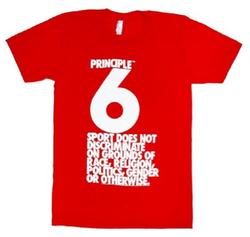
As you know, I enjoy wearing queer themed t-shirts. And I'm not the only one! Two awesome BW fans in SF (who contributed to this entry, btw) have created this "JUDGE ME" T-shirt to help keep the DOMA and Prop 8 Marriage Equality debates centered on the LGBTQ community and our allies. They're donating all proceeds to a combo of important charities: the Human Rights Campaign, SF's LGBTQ Community Center, and Lyric, a Queer youth empowerment program. (Check out the video.) There are only TWO DAYS left in their campaign and, with your help, I think we can push them over their goal. Whaddaya say?
Butch Wonders is teaming up with the Campaign for Southern Equality and a few other folks to host a March Madness NCAA tournament for charity! Here are some deets: - $10/bracket to enter (it will be for the regular tournament. Maybe we'll also do something for the men's tournament--not sure yet)
- No limit on number of brackets
- Proceeds will be split between: (1) The winner(s); (2) The Campaign for Southern Equality; (3) An LGBTQ organization chosen by BW readers.
- You don't have to know anything about basketball to enter. We may even have a prize for the best "themed bracket" (where you pick the winners based on some arbitrary-but-amusing trait, like how cute the mascot is or how many of your exes attended the school).
So what I need from you is a suggestion for a great LGBTQ organization this tourney could benefit. Please put your suggestion, and your reason for thinking the charity is awesome, in the comments. On Monday, I'll post a poll based on your suggestions, and BW readers will get to vote on which charity we'll support! More details to follow. I'm looking forward to your suggestions! (And if you feel compelled to tweet this, which I hope you will, use #mad4equality.)
Suzanne Venker, author of How to Choose a Husband and make Peace With Marriage, wrote a short column on foxnews.com last week that incapsulates a whole bevy of misunderstandings about how gender works, what the goals of the feminist movement are, and even about the logical interpretation of evidence. The column's central claim is that the feminist movement is responsible for the supposed "decline" of heterosexual marriage. Because women have been "told" that they are equal to men, they pursue goals ultimately incompatible with their greater desire to have a family. As Venker says in the video interview posted above that column, "Women have become overdeveloped in their masculine side... because they have been groomed for a life in the marketplace, rather than a life at home." At their core, she writes, men and women are different. People with children "know [that] little girls love their dolls and boys just want to kick that ball." Men and women are different creations, and as a matter of biological determinism, they inherently want different things. Venker then cites continuing gender inequality as proof that men and women are different: "Men and women may be capable of doing many of the same things, but that doesn't mean they want to. That we don't have more female CEOs or stay-at-home dads proves this in spades." So, let me get this straight: Gender inequality is proof of inborn gender differences? What a useful concept. Now we know why there are so few obese movie stars: obese people don't want to be movie stars. And why there are so few out gay politicians: Gay people don't want to be politicians. And why, proportionally, there are so few black partners at big law firms: black people have little desire to be partners at big law firms. See how easy life can be if you just ignore social processes and assume that all human outcomes are solely a product of personal choice? Venker posits that the whole notion of "equality" is problematic. She writes that "the problem with equality is that it implies two things are interchangeable – meaning one thing can be substituted for the other with no ramifications. That is what feminists would have us believe, and anyone who contradicts this dogma is branded sexist." I don't know where she got this notion of equality, but it's not one I've ever heard. I've always thought equality meant two people had the same amount of value, the same opportunities, the same rights. I didn't know it meant we could just swap one person, willy nilly, for another. I thought it meant that I, a youngish white lesbian, and Thomas Sowell, a straight black 80-something conservative, each got one vote, the same right to counsel, and the same chance to protest a government decision in a public location. Under Venker's logic, equality actually means that you could swap Sowell and me in virtually any circumstance "with no ramifications." To this nonsense, I doubt either Sowell or I would agree--and I don't think it would make us racist, sexist, or any other "-ist" (any more than I'd be bucking feminist notions of equality by giving my seat to an elderly woman on a bus). Venker's argument would make more sense if we lived in a world where men and women weren't socialized so differently--a place where little boys and little girls were treated the same, where parents-to-be weren't gifted with different sets of toys based on the sex of their child, where there were equal numbers of male and female role models in every profession, where women's "formal" clothing didn't constitute teetering heels and displays of breasts and skin, where there wasn't one collection of traits associated with masculinity and an entirely different one associated with femininity. We do not live in that world. And because we do not, we are foolish to assume that anything we do is just a product of biology. Of course we are influenced by our genes. (Heck, all the socialization in the world didn't stop me from being a dyke.) But our genes merely set the stage. We grow into a version of our selves based on how we are socialized. A little boy jumps around and he's told, "You'll make a great basketball player!" A little girl jumps around and she's told, "You'll make a great dancer!" From day one, we are mired in social experiences--and many of these social experiences are heavily, heavily gendered. It is not as simple as parents forcing little girls to wear dresses or making little boys play baseball. Each of us is born with a hundred different possible, valid versions of our "selves" inside, and the collection of possible selves is different for each person. But which version we actually grow into is a complicated dance between predisposition and socialization (and I'd wager that socialization is doing a lot of the leading). On one level, arguments like Venker's are easily dismissed because they seem so patently sexist--it's easy to chuckle at someone who thinks society is going to hell in a handbasket because we're ignoring biological destiny. It's also easy to roll our eyes at the (thoroughly and measurably absurd) notion that women are being "groomed for the marketplace" and have overdeveloped "masculine sides." But I think it's more invidious than that. By misstating and oversimplifying the arguments of feminist and gender theorists, and by downplaying or ignoring the vastly different ways in which men and women are socialized, Venker becomes an apologist for material inequality. Why, after all, should we work harder to equalize opportunity if existing disparities prove intrinsic differences? If equal rights on paper make opportunities equal, then anyone who squawks and protests about inequality and wants to improve the world is just engaging in a silly, anachronistic waste of time.
I'm excited to share this guest post from a BW reader who's working as a Peace Corps volunteer. I hope you enjoy her insights as much as I did! For reasons that this piece makes clear, she's chosen to remain anonymous. Discovering the Lesbian Underground in Rural South AmericaPeace Corps is a two-year commitment to do development work in impoverished countries. I am an Agricultural Peace Corps Volunteer (PCV) in South America. My site is a very rural, impoverished, and conservative village in a conservative country. I generally present myself as androgynous. Short hair, comfortable clothing, and a slim build make this easy. I didn’t tell my Peace Corps recruiter about my sexual orientation, but I scoured the internet trying to find information on queer life in the small, culturally isolated country to which I was assigned (and on the experiences of queer PCVs worldwide). To my dismay, I found little information. The Peace Corps welcomes queer PCVs, but warns that in many countries they will have to stay closeted—sometimes to work smoothly with host country counterparts, but frequently for the safety of the PVC. In my village, miles away from paved roads, surrounded by banana and pineapple crops, I am very deeply in the closet. I still dress androgynously, but I have not, and likely will not, tell anyone in my community the direction in which my romantic interests generally lie – the señoras trying to match me up with their sons don’t know how much of an uphill battle they face. Due to my unfeminine hair and clothing, I also receive far fewer cat calls and less sexual harassment than other female volunteers. After working with men in the community to rebuild a wall of my house, someone joked that a "man " would be moving in: me. This comment from a community member made me anxious, and led me to worry about every interaction—to an unhealthy extent. Indeed, my self-censorship has been one of the most stressful parts of being here. I am fearful that they will “guess,” but I actually haven’t altered much. I don't change my appearance or flirt with men, though I certainly don’t flirt with women in my site either. My second year, I’ve loosened up because I know the people in the village, and they know me. For example, when señoras would ask me if I had a boyfriend I used to say, “not right now,” but now I say, “I don’t need a boyfriend.” It’s a small, but significant, difference. One of my queer volunteer friends says that this is a country of “open secrets:” Secrets everyone knows, but tacitly agrees not to talk about. It makes me wonder, am I living an open secret too? Is it possible everyone in my site knows and are electing to keep quiet? One of the biggest personal changes I have experienced here is the role my sexual identity plays in my sense of self. Like many people in their mid-twenties from accepting backgrounds, I never viewed my orientation as a big deal. However, here in rural South America, I needed to hide this part of myself for the first time in my life… so it has become more important. I am open with other volunteers and the Peace Corps support staff in-country, but I miss being in an active queer community. Once every month or two, I travel to the country’s capital to get mail and to socialize with other PCVs. If possible, we visit one of the few gay bars in the whole country. Unsurprisingly, it’s usually full of gay men. However, after a conversation with a posse of local gay men looking out for me, we got directions, scrawled on the back of a napkin, to a rumored lesbian bar. It was months before we found the place. When we finally did, we discovered that we had to get past the guards, ring the bell, and wait for someone to come unlock the door. They’re only open one night a week, but have information regarding human rights campaigns, queer film festivals, and Pride activities. Despite their limited hours, it was nice to know that such a locale existed. However, I still needed a queer community closer to where I live, and as luck would have it, I stumbled across one! There is a town an hour and a half away, and during my first few months, I traveled there frequently to buy supplies to build my house. A PCV there introduced me to a friend of hers (I’ll call her B), a female firefighter. This PCV told me that B was a lesbian and told B the same thing about me. A few months later, B invited me to a secret, underground drag show! Out here, in the middle of nowhere, there was a community! The event was invitation only, with the location announced a few hours ahead of time. Secrecy was a big priority. Drag queens from all over the country performed, and under a blanket of stars, the rest of us queers watched. It was great! But the most valuable part of the experience was finding out that there is a network, even out here in the rural countryside. However, it’s distressing that such a high level of secrecy is necessary. Now I find myself dating B’s ex (I guess lesbians are the same world over). This chapter is unfolding day by day…Our interactions are full of cultural misunderstandings and poorly translated endearments. (Also, how on earth does one discuss strap-ons in a country without toy shops?) She is closeted even to those in her family who would be accepting. I worry that I overestimate the level of acceptance around her, and thereby put her in danger. Her internalized homophobia and self-hatred is another challenge altogether. I am pleased to have been admitted into the secret lesbian underground of this country. I’ve never met any established lesbian couples, but supposedly several pairs live together, frequently raising children from their past relationships. One of the pairs was comparatively wealthy and lived somewhat more openly, and the other pairs just quietly lived together as “housemates.” I never heard of couples in the countryside, only in town. I also met people who had been part of the lesbian community but ended up marrying men. For some of them, marrying was one of the few avenues of independence they had. Outside of the capital, most people don’t leave their parents’ house till they get married. I can be an example of a happy, queer, woman within the underground lesbian community. Their eyes went wide when I mentioned that my mother once asked my (ex)girlfriend which of the states with legalized same-sex marriage we would be moving to. I’m not sure what blew their minds more, the fact that marriage was an option for us, or that my mother treated our relationship legitimately. I introduced terms like “family” and “gaydar,” and exposed the underground to television shows like The L Word and Modern Family. Seeing queer people on TV just like any other telanovela was a very significant, empowering experience, especially for my girlfriend. It’s been powerful for me as well: by seeing it from the outside, I truly appreciate the strength of the queer community in the US. Clearly I can only base this off of the lesbians I know, but but at least in this country, there seems to be less gender nonconformity than in the US or other South American countries. But maybe that’s because all the lesbians I know are from the countryside (the town is in the middle of nowhere. The only real “city” is the capital. Lesbians here either never find each other (sad but true), or find one other lesbian or gay man who introduces them to her or his friends (like what happened to me). Some of the most important work I’ve done my last few months in the site, has been introducing a few teenagers (males) who came out to me to the community in the town. Additionally, I introduced the community in town to the resources and clubs in the capital. My Peace Corps experience has changed me in many unexpected ways, including strengthening my identity as a queer person. But more importantly, it has highlighted something else to me, the fact that who I am is not just for me alone. I'm a member of a beautiful community, not just underground in a small country and not just causally out in my hometown: it’s a community that's everywhere, worldwide, where I'd most and least expect it. When I pack my bags, say my goodbyes, and leave this country, I'm taking that lesson with me . Many thanks to the guest poster for sharing her story. She also wanted me to pass along this link for LGBT Peace Corps Alumni. Do you have an experience worth sharing? I welcome guest post submissions; email me at butchwonders@yahoo.com for more information.
Big news: the Supreme Court just agreed to take on two BIG gay rights cases this term: Case #1 involves the so-called "Defense of Marriage" Act (or DOMA), which is the federal law that says that even if your state allows gays to marry, married gays don't get federal benefits like Social Security or the ability to file joint tax returns. This case isn't about whether states have to legalize gay marriage--it's about whether if a state recognizes a gay marriage, the federal government has to play along. Case #2 comes out of California (see my previous post explaining gay marriage in California for background). It deals with Prop 8, the ballot initiative whereby those lily-livered California liberals voted to amend their state constitution to take away same-sex couples' right to marry. In this case, the Supremes could hand down many possible rulings, some of which would affect only California, some of which would affect the whole country, and some of which would kick issues back down to the lower courts. Neither of these cases necessarily has national implications for gay marriage (though they could--#2 especially), but they are still both Very Big Deals, particularly if you share my belief that gay rights isn't "just another issue." I'll wrap it up here and write more later, as this all develops. Here are some links to media coverage of the issue:What do you think about the Court's decision, dear readers? Are you optimistic?
Possibly the most depressing "welcome" sign in the history of the world.
As if that wasn't bad enough, one of the council members explained that he didn't want Grand Island to become "gay-friendly." Riiiight. Like all the queers were suddenly going to flock to Nebraska if this thing passed.
So I have an idea. I would LOVE to mess with them by showing them how doggone gay Grand Island can be. If you're in Nebraska (or anywhere near it), I would LOVE for you to drive to Grand Island and do or put something super gay and rainbow-y in front of their stupid-looking "welcome" sign.
In fact, I would love to do this for ANY city that's passed anti-gay ordinances, or that has refused to pass laws giving --gasp!--equal rights to LGBTQ folks. I'm sure there are a whole bunch of other cities we can target. What are they? And should we plot to get back at them by fomenting a big ol' pro-gay movement with them at the center of it? E.g., Grand Island is for (Gay) Lovers? What do you think?
I feel like it would be virtually anti-American not to say anything about the presidential debate, but for me it hovered between depressing and irritating. The substance centered around giant economic plans whose conception--let alone implementation--is opaque to practically all of us. Would most people know the difference if Obama had said Romney favored cutting $8 trillion in taxes instead of $5 trillion? Or if Romney had said Obama planned to cut $416 billion from Medicare instead of $716 billion? Numbers that huge are difficult for most of us to assess unless we've got special expertise and/or gobs of free time. Instead, we assume that the candidate we favor is mostly telling the truth, while the other guy is spinning it somehow. Candidates vaguely reference "studies," but never go beyond that. Are there really "six studies" debunking Obama's critique of Romney's tax plan? At most, you might Google it (whereupon the sketchiness of Romney's citation becomes apparent). But even when you learn that the studies were conducted with biased motives, how do you know they're not accurate? Are you going to go read them and assess their validity? Am I? The debate format--with its time constraint, vague questions, unwieldy numbers, and dearth of precise follow-ups--makes it very difficult to see who's telling the truth. If you're like me, you end up relying on trusted sources, or on your own assumptions about the candidates, or on the candidates' values as best you can discern them. And this is where Obama could have scored big, I think--turning the topics into questions of values rather than questions of numbers. Gay rights, women's rights, Romney's "47 percent" gaffe--these issues underscore crucial value differences between Obama and Romney. And voters understand values; we have them, too. And since values underpin specific economic proposals, if we only have 90 minutes I'd rather hear about values. Instead of talking about my other reactions to the debate, which will depress you and me both, here are my reactions to the debate I wish I'd seen:- That Jim Lehrer is one tough dude! Although he was a bit of a hardass with the time limits, I appreciated it, because it made things SO FAIR.
- Saying that a plan will help the middle class is useless unless you're willing to define it (everyone thinks they're "middle class"), which is why I appreciated that the candidates agreed to a definition prior to the debate, so that everyone could be on the same page.
- Obama really scored a zinger with that "47 percent" quip at the end. And the way he looked right into the camera during his closing? So intense--it gave me chills!
- The section of the debate on the pervasiveness of racial inequality really highlighted the difference between Obama's philosophy and Romney's. Of course they both know that America isn't "postracial!" I feel silly for fearing that they wouldn't talk about it.
- That new rule that both candidates are required to provide written citations on their websites the next day for everything they said in the debate the night before? Brilliant. And useful to me as a voter.
- Thank goodness women's issues played such a big role.
Did you watch the debates last night, dear readers? What did YOU think? I'm looking forward to your comments.
"Sure, I'm for gay rights, but I'm voting for Romney." "I don't agree with him on gay marriage, but overall, I agree with his values." "Gay rights is just one issue; I'm looking at the whole picture."
Each time I hear a statement like this, it irks me anew. But why? Do I really think my right to get married is more important than homelessness, health care, or the economy? Geez, I don't think so. But even if I didn't disagree with Romney on these issues, I'd have a hard time voting for him.
The crux of the problem is that for me, gay rights isn't "another issue," but a prior question--that is, a question that has to be answered before another one can be asked. For example, if I ask, "What kind of cookies should we make?" I've already answered (or implied the answer to) the prior question of: "are we going to make cookies?"
To discuss issues with someone, I have prior questions. A central one is: are we equals? I am using "equals" in the sense of people who see each other as people, discussing and exchanging ideas--in the "all people are created equal" sense. Does the person value me and consider me valid as a human?
To me, someone who does not believe in equal rights for gays and lesbians sees me (and/or my behavior) as subhuman. They do not believe that my full, real self is equal to their full, real self. They do not see me and my life the same way they see themselves and their lives. For this reason, the answer to the prior question of whether this is a person with whom I can engage in rational debate is "no." If you don't see me as your equal in terms of the human rights I deserve, it's very, very difficult for me to think you're worthwhile to engage with about anything else.
This doesn't mean that someone needs to think I'm awesome, or love my choices. I think some people make terrible choices or are cruel people. But this doesn't mean I think they deserve fewer rights than I do. I dislike people who objectify women, but I would not favor a constitutional amendment that denied them the right to get married or prevented their partners from getting health care.
And this, dear readers, is why gay rights isn't "just another issue" for me. Is it for you? Have you ever heard people say the things I quoted at the beginning of this post? How did you respond?
Hi friends! Sorry for the kinda-long absence. My ADD-addled brain has been preoccupied with a number of things the past few weeks, including but not limited to: 1. Finishing a profile for one of my jobs; 2. Propagating succulents; 3. Doing a big around-the-house project with my DGF; 4. Taking a bunch of photographs for a website for one of my other jobs; 5. Undergoing massive amounts of career-related identity crisis. Anyway, I'm back now (yay! I missed you!) and was wondering what you all thought about the following topic: When, if at all, is separation based on sex ideal/necessary? First, a few caveats. Let's acknowledge that this question is inherently problematic: cissexist, falsely essentialist, and denies the experience of intersex people. It assumes that sex is a dichotomy, which it is not. (Also, note that I'm talking about sex, not gender.) So, I'm curious: What do you think about separation based on sex in the following scenarios? And why? When do you think that sex (or gender) separation is necessary and/or ideal? Would you be happier in a world with no sex separation?
|