I've been warming up to the idea of writing a post about what it was like to come out while married to a guy. While I am not quite ready for that post yet, I thought it might be fun to share some red flags (or, well, rainbow flags) I now see as clues that I was a big ol' lesbo. My DXH says that the only characteristic that gave him pause was my habit of keeping my wallet in my  left rear pocket, and when I was about to pay for something, reaching back with my left hand and whipping the wallet out of my pocket, “like a guy.”

I have a friend who came out while married to a woman.  Now he lives with his partner in the Bay Area, and collects little Wedgwood dish sets from the "Peter Rabbit" collection.  I told him that the collection had to be his gayest characteristic.  It turns out that he began building his collection while he was married.  If you can believe it, she didn't suspect a thing!  While my DXH and I might not have been quite that clueless, in retrospect we can both see  many characteristics that were… perhaps a tad dykey.
  1. My enduring penchant for fleece vests.
  2. In college, I joined the rugby team.  Shortly thereafter, I quit in part because I felt slightly uncomfortable being around so many lesbians. Even back then, I was big on gay rights, but that didn't mean I wanted to be tackled by a bunch of butch women.  Denial, anyone?  (Hmm...  I wonder how much I would pay now for exactly that opportunity.)
  3. Most of my crushes, from high school through college, were on men who later turned out to be gay.
  4. As a child, my favorite Halloween was the year I got to be a knight. I wore a mustache and carried a shield and sword. Awesome!
  5. Until I started dating women, I never really understood flirting. It always seemed a huge waste of time.
  6. For a couple of childhood years, there was nothing more I wanted in the world than a skateboard.
  7. Avoiding premarital sex never struck me as all that difficult.
  8. Two words: granny panties.
  9. L.L. Bean.
  10. REI.
  11. At one point in college, I joined a coming-out group—not because I thought I was gay—but because I  was dating a much older guy and felt like I needed some “relationship support.”  (What?!)
  12. I always wanted to shop in the boys' department, especially if it presented even a remote possibility of obtaining cargo pants.
  13. In high school, I was a member of various teams.  This sometimes involved traveling and staying in hotels. I hated having to share a bed with another girl. I would wait to see if she slept under the covers, or on top of them, and then I would do the opposite.  I was totally grossed out at the possibility that her leg might graze mine.
  14. I always found the idea of heterosexual sex fairly gross, the idea of gay male sex kind of hot, and the idea of lesbian sex unthinkably disgusting.
  15. My aversion to makeup, dresses, skirts, lace, and similar frivolity.
  16. I  hated purses, and stated this with clear, uncharacteristic rudeness whenever someone bestowed one on me as a gift.
  17. My complete obsession with major league baseball, which began at age five, and lasted until age 15 or 16.
  18. An inability to discern the romantic intentions of the opposite sex. In high school, I used to hang out with this guy, M. We would go to movies on the weekend, and even went to a couple of dances together. One Valentine's Day, he took me out, then at the end of the evening, gave me some scented bath stuff as a present, along with a Valentine's Day card that was signed “love, M.” It was only at this point that I began to wonder if he was interested in me romantically.  Before leaving, he leaned forward, and I gave him a big bear hug. At school the next day, he was cold to me, and I couldn't figure out why. Finally, one of his friends said to me rudely, “Would it have killed you to let him kiss you?” I was flabbergasted.
  19. In college, wanting to express my support for gay rights, I put a pink triangle sticker on my dorm door. Later, I learned that some of my dorm mates had taken this is a coming-out signal. Again: flabbergasted.
  20. As a kid, I was always insulted when someone called me a “tomboy.” I hated this term, because it suggested a stage—something fleeting—and I was sure that this was simply the way I was.
  21. Periodically, someone would tell me that I “walked like a dude.” This generally didn't bother me, but I was a little perplexed.
  22. Though I idolized my mother, I never wanted to learn anything that I saw as stereotypically female—cooking, sewing, etc.
  23. When I was a little kid playing house with other little kids, I always wanted to be the dad. 
  24. In third grade, we were given the opportunity to dress up as any character in a book we had read that year.  I chose an obscure character—one of no particular note, except that he always wore a tie. I was super excited to wear one of my dad's ties to school.
  25. I never wanted to play with dolls. People gave me Barbies, but instead of dressing them up, I would spend my time meticulously constructing houses for them out of cardboard.

Were there any bright rainbow "flags" in your life before you came out?


As you might remember, the sardonic and stylish Lady Haha herself recently agreed to an interview with yours truly.  What fun!  Here are the questions I asked (thanks in large part to your awesome suggestions, dear readers) and Kate's answers:

BW: You're in your 60's and still smokin' hot.  What's your secret?  A great workout regimen?  Your 20-year relationship?  A macrobiotic diet? 

KC: You're very kind.  My secret is my father's genes.  At 90 he looked like an older Paul Newman.  I've been doing yoga for two years now and wish I'd started earlier.  My galpal is 11 years younger than me, so she keeps me on my toes.  Twelve years ago I did Weight Watchers and still am a daily point counter.

BW: One of my readers points out that you always look stylish (ah, so true...).  What are some common butch fashion faux pas you see?  Are there any fashion trends you'd like to bring back?

KC: Whatever you wear, you have to wear it confidently.  I wish we had more--any?--butch tailors who speak the same language.  So you could take something you found--a plaid hunting vest, gabardine trousers--and go to them and get it tailored perfectly for your body.

BW: How do you think the growing number of FTMs will affect the lesbian community--and butches particularly?

KC: First, I respect FTM choices.  We butches--soft through hard--have a big responsibility to carry on!

We're not running short on femmes, are we?

BW: As a butch with crushes on women like Rachel Maddow and Julie Goldman, I'm acutely aware of the stigma against butch-butch dating.  Do you see this, too?  Where do you think it comes from?

KC: Very strict people.

You can talk stigma all you want--but when it comes to rip-roaring, throbbing attraction, stigma goes out the window.  Thank goodness.  Or I would never have come out years ago.  Thank goodness for some of the loveliest lady ankles and what went up from there for knocking me off my stigma rocker. 

BW: Would you rather (1) host "Saturday Night Live;" (2) make out with Annette Bening; or (3) run for Congress?

KC: I'd love to make out with Annette Bening on "Saturday Night Live" and then go work on Tammy Baldwin's Wisconsin senatorial campaign.

Thanks again, Kate!  Much love from Butch Wonders--we can't wait to see what you do next!


I've had many conversations with friends--butches, trans men, femmes, straight people, gay men--about the tension that sometimes exists between butches and trans men (FTMs).  When I attended the first Butch Voices conference in Oakland a few years ago, the discomfort was sometimes palpable.  There was talk of whether a person can be trans and butch, and whether "butch" is an inherently female term. Although both FTMs and butches understood they had a great deal in common, it was tough to come to make sense of what their differences actually meant.  These issues can also add to confusion for butches who are questioning whether they are trans, or vice versa.

The purpose of this post is to try to shed some light on this tension.  What does it look like?  Where does it come from?  What can we do about it?  It's a tough topic to write about, but it's an increasingly divisive issue in the queer and lesbian communities, and I think it deserves to be addressed.  I hope this post will help foster more dialogue about the butch-FTM divide.  (Of course, this tension doesn't always exist; I know some butches and FTMs who are good buddies and talk openly with one another.)  Anyhow, here's my working list of some of the sources of tension/weirdness/friction/dialogue/disagreement I've observed between trans men and female-identified butches.

1. THE IDEA THAT FTMS ARE GAINING MALE PRIVILEGE
In our world, men are privileged over women.  (Please don't make me start yammering on about the gender-wage gap and hegemonic masculinity.)  When a person goes from navigating the world as a woman to navigating it as a man, he is treated differently--and overall, better (as Kristen Schilt has documented)--than he was as a woman.  So, yes, trans guys can often take advantage of male privilege if they want to.  This doesn't mean they transition because they want this privilege, though.  It seems to me an unfortunate byproduct of trans men becoming who they really feel comfortable being.

2. FTMS' TRANSITION FROM A MARGINAL IDENTITY TO A (SORT OF) MAINSTREAM IDENTITY
Many--but not all--FTMs identified as butch before identifying as trans men.  Before testosterone and surgery, they may have passed as men sometimes--but afterward, most FTMs are eventually able to pass as men all the time (stubble, thick arm hair, Adam's apple, the works).  As butches, they were non-gender-conforming women.  They were unusual, marginal, and often visible as queer.  As I have talked about before, this is not always a comfortable feeling.  But as FTMs, they can (usually) pass as bio men in their everyday lives.  As some see it, trans men get to walk around a grocery store and feel like "normal" men in a way that many butches do not get to feel like "normal" women.

3. BUTCHES' AND FTMS' RELUCTANCE TO DATE EACH OTHER
I've occasionally heard trans men complain that butches won't date them, or butches complain that trans men won't date them.  But much more commonly, I've heard trans men and butches say they wouldn't want to date each other.  It's always been obvious to me why (lesbian) butches wouldn't want to date trans men.  Generally, trans men want to be seen as men.  And generally, they (eventually) look like men.  And if you're not attracted to men, this presents an obstacle.  But I was flummoxed about why most of my FTM friends would ask out feminine women, or other trans men (or occasionally, gay bio men), but never butches.  This confused me until an FTM friend (my roommate at the time) explained: "If I date a femme, we look like a traditional straight couple and it affirms my masculinity.  If I date a fag or a trans guy, we look like two gay guys; we're both men and that affirms my masculinity, too.  But if I'm with a butch, where does that leave me?  It's just weird.  Plus, she's a woman and I'm a guy and sometimes she's more masculine than me.  It makes me question my masculinity, which as a trans guy is super important to me." 

4. PERCEPTION THAT THE TERM "BUTCH" IS WEAKENED BY THE INCREASED PRESENCE OF FTMS
Many of us were "bisexual" on our way to full-blown gayness, right?  Well, many FTMs identify as butch on the way to trans maleness.  So "butch" risks being seen as a phase or a transitional state rather than a place people stay.  Butches who are permanent, dyed-in-the-wool butches may be seen as FTMs in the making.  Mostly, I think: who cares?  If you're a butch, be a butch.  Yeah, other people might think you'll become trans.  Then you won't.  Then they'll understand that it's not a phase.  At the same time, it's annoying not to have your identity recognized or taken seriously.  It's also annoying to be called "he" when you want to be called "she" (just like the reverse). 

5. CONCERN THAT BUTCHES ARE A "DYING" BREED
Transitioning is usually a one-way ratchet; butches sometimes become trans guys; trans guys rarely become female-identified butches.  So necessarily, butches decrease in number and trans guys increase in number.  If you identify as a "type" and you feel like your "type" is diminishing, it's easy to imagine how you might feel threatened.  Some lesbians lament the increased transition rates, and decry the "loss" of butches in the lesbian community.  I get this sentiment--I really do.  But it overlooks the important fact that transition has only recently become widely available.  This means that for a very long time, there was probably a backlog of women who would have wanted to take T and have surgery, but because they couldn't, they identified as butch--the closest identity available.  They may have always experienced gender dysphoria, but had no way to do anything about it.  Indeed, it might not have even occurred to them, since trans visibility is a relatively new phenomenon.  In my opinion it's likely that these factors artificially inflated the number of female butches.  If I'm right, then we're not "losing" butches; we never "had" as many as we thought to begin with.  We just got to borrow thousands of trans guys until society caught up.

6. THE NOTION THAT THERE'S TOO MUCH PRESSURE TO TRANSITION
I've heard many butches and FTMs say that pressure is put on gender-nonconforming teens to identify as trans.  If you're a masculine female, this story goes, your friends will tell you that you must be trans; after all, shouldn't your biology line up with your internal feelings of masculinity?  I have no idea whether this "pressure" story is true.  I'm not a teenager, and the very few FTM teenagers I do know are going through hell to make their parents understand that they're trans boys, not "just" lesbians.  At the same time, it's true that butches are sometimes asked if they're going to become men.  Still, this falls short of "pressure," doesn't it?

7. THE IDEA THAT FTMS ABANDON THE GAY COMMUNITY BECAUSE THEY WANT TO BE SEEN AS "NORMAL"
True, some trans men just want to pass as het guys and completely dissociate with the queer community.  Yeah, I wish these folks were more interested in spotlighting the "T" in "LGBT," but you know what?  They're not obligated to.  Imagine feeling like you were born in the wrong body, and that everyone had seen you inaccurately your entire life.  Maybe all you'd want to do is quietly pass.  Maybe you never saw yourself as part of the gay community in the first place.  My grandmother used to say not to judge anyone until you've walked a mile in their moccasins, and that applies here.  Not to mention--there are plenty of gay men and lesbians who've never lifted one homosexual finger for gay rights.  I have an uncle who's been in the closet (with his "roommate" of 15 years--I kid you not) so long that he reeks of mothballs.  And there are plenty of out-and-proud trans folks who fight for equality and take great pains to come out to whomever they can, whenever they can.  It doesn't seem possible to generalize with any degree of fairness about people's personal or political commitments. 

8. BELIEF THAT TRANS MEN ARE TAKING THE EASY WAY OUT
This relates closely to #1 and #2.  And sure, trans guys are often eventually free to be the beneficiaries of male and heterosexual privilege.  But...  the "easy" way out?  Really?  Giving yourself testosterone shots?  Convincing your family and friends to call you by a different name?  Getting expensive breast removal surgery that can take several weeks to recover from?  Risking being shunned by your lesbian friends?  To me, that sounds like the world's biggest hassle, not the easy way out.  I can't fathom that anyone transitions simply for the convenience. 

9. THE DESIRE TO MAINTAIN WOMEN'S-ONLY SPACES
Historically, women-only spaces have been important to the lesbian community (and to the women's movement generally).  If people who used to be female but now identify as trans men--that is, as men--want to become or remain a part of those spaces, it changes the spaces for the female-identified women there.  A lesbian bar or a women's AA group may not feel like a women's group if people who present as men, look like men, and identify as men are present there.  I sympathize with this view.  Just as I see the value of all-trans spaces or all-gay-male spaces, I see the value of all-women's spaces.  And I'm not sure that all-women's spaces should be forced to include trans men if they don't want to.  At the same time, I bet it would feel crummy to be excluded from a space where you previously found community simply because you started identifying as trans. 

10. STEREOTYPE OF BUTCHES AS "OLD-SCHOOL" AND OF TRANS GUYS AS THE NEW, YOUNGER "VERSION" OF BUTCH
I've heard this one mostly from FTMs.  It's sort of the reverse of #5, which I've heard mostly from butches.  The idea that "trans is the new butch" strikes me as silly, and conflates causation and correlation (tsk, tsk).  Yes, trans men are on average younger than butches.  I'm guessing this isn't because butches are somehow "evolving" into trans men, but because transitioning is increasingly seen as a viable option.  To me, any view that sees trans men and butches as inversely correlated (if one goes up, the other goes down), misunderstands both identities.

11. PERCEPTION THAT TRANS MEN REINFORCE THE GENDER DICHOTOMY
The argument goes something like this: Butches are non-gender-conforming women.  But trans men are often (sort of) gender-conforming men.  By transitioning, FTMs are refusing to acknowledge the diversity of female-ness.  They're saying, "I can't be a woman and be masculine, so I must be a man," which embraces and reinforces gender norms.  I might be totally wrong, but I think the problem with this line of thinking is that is misunderstands trans guys' experience.  Without exception, the trans guys I know don't say, "I used to be a woman, but I decided I would rather be a man." It's more like, "I was born with a woman's body and I always hated it because I always knew I was really a man."  It's not simply, "I don't always like my breasts," but more like, "These things aren't really part of me at all."

What do you think, BW readers?  Have you thought much about these issues?  Have you felt the kinds of tension I'm describing?  Do you have anything to add to the list, or can you contribute some insight to the ideas I've talked about in this post?


While no label can encapsulate you, labels can be useful descriptors of some of your traits and identities.  Letters from a couple of straight cis male fans (keep reading, guys--we love to have you here!) made me wonder about how you, dear readers, think about your identities.  Check all the terms below that you feel apply to you.  (And feel free to leave comments, too!)


cardboard signs
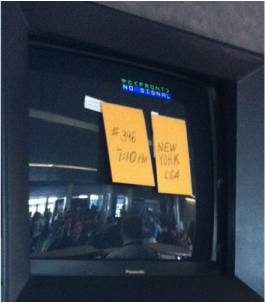
I spent the past week in New York.  The trip had several high points, including the best chocolate chip cookie I have ever eaten (at Levain Bakery--thanks for the rec, DXH!), a brief visit to the Stonewall Inn, and a thorough inspection of Chicago's O'Hare Airport during an eight-hour (surprise!) layover.  You might not know that some of the most advanced airports in the U.S. are making the switch from traditional monitor displays to crudely penned cardboard signs in order to conserve electrodes.  Thanks, O'Hare, for doing your part! 

I also got a chance to explore several different parts of New York City, and have a few observations, some gay-relevant and others not:
  1. I saw few obviously gay people, even fewer obvious lesbians, and almost no butches (compared to other large US cities, that is--tough midwestern housewives notwithstanding).  This held true in the West Village, on the Upper West Side, in Times Square, Sutton Place, Battery Park, Chinatown, and on about 20 different buses and subway trains. 
  2. Despite #1, no one stares at you in New York.  This is because they don't care about you even a teensy little bit.  This is both the good news and the bad news.
  3. New York men wear Windsor knots for a regular day at work.  (In many other cities, a Windsor is more like a statement that you're getting all fancy-like.)
  4. People in New York go absolutely batshit for smoked and preserved fish. 
  5. We went to Henrietta Hudson's (a lesbian bar) and there were about fifteen people there.  It was loud and smelled vaguely of vomit.  The bartender was kind of butchy, as was one other woman.  No one else.  A little disappointing.  Any readers from New York want to shed some light on the NYC Butch Deficit?
  6. Some Manhattanites are slightly out of touch with nature.  In Central Park, my DGF and I saw a family whose members were tremendously excited about seeing a squirrel.  Dad was videotaping, Sis was offering it her hot dog bun, Bro was trying to pet it, and Mom looked positively stricken.  I would have pointed out some nearby ants to them, too, but I didn't want anyone to pee from all the wildlife-induced excitement.
  7. If you are gay, and you take the Staten Island Ferry, you will be the only gay person on the Staten Island Ferry.
  8. This exists:
  
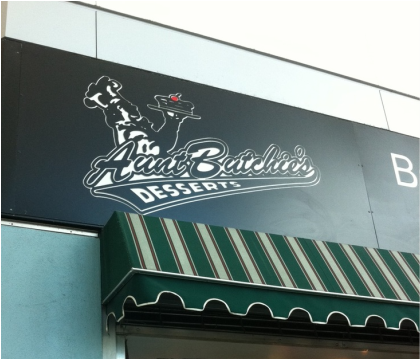
Aunt Butchie's Desserts
 

  9.   As does this: 
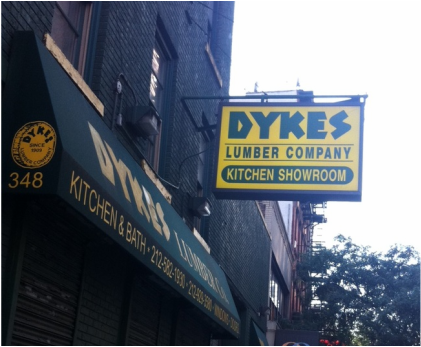
Dykes Lumber Co.
 

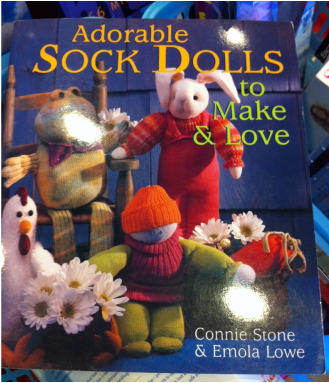
10.  Despite the plethora of entertainment options available in their bustling metropolis, New Yorkers are particularly fond of shapeshifting and crafts (as the selection of used books for sale at Symphony Space revealed):
Picture
Picture

And lastly, my two brushes with fame:

I am 99% sure  we encountered John Bartlett while he was out walking one of his dogs in the West Village.  I didn't know anything about him, but after we talked to him for a while about dogs and walked away, the fashion designer friend we were with told us, "Oh wow--that was John Bartlett."  So I googled him, and not only is he a famous (gay) fashion designer, but is very committed to animals, particularly dogs.  (And he's even cuter in person.)

In the taxi line at LaGuardia right after we arrived, my DGF noticed that the address on the luggage tag of the (het) couple in front of us was a few blocks from where we were staying.  Resourcefully, my DGF asked if they wanted to split a cab.  Indeed, they did.  During the ride, we learned that the woman was coming back from the west coast, where she had just been at the Frameline Film Festival promoting a film in which she had acted.  What film, you ask?  "Jamie and Jessie Are Not Together."  She was surprised I'd heard of it, and had no idea that it's been getting great buzz in the lesbian blogosphere.  Has anyone out there seen it yet?  I'd love to post a review.


Two pieces of great news!

1. Thanks for your wonderful, encouraging feedback on my letter to my mom!  She loves the blog, and sent me the world's absolute sweetest email about it.  (I'd say more, but she's waaay more private than I am.)  So: Welcome, Mom Wonders!  (I should convince her to do a guest post sometime, shouldn't I?  I'll start working on that...)   Dear readers, if you're a butch and you and your mom have a solid, honest relationship consider coming out to her as butch.  Yes, it's hard if, despite everything, she STILL suggests that you grow your hair out.  But once she "gets" your style, just think how helpful she'll be in finding snappy cuff links that match your tie! 
2. Kate Clinton--yes, THE Kate Clinton--has agreed to a mini-interview with Butch Wonders.  I have a bunch of questions in mind, but want to ask YOU, dear readers, what YOU would like me to ask the lovely Kate Clinton.  I'd like to ask about topics she hasn't already answered, ad nauseum, elsewhere, so use your imaginations!  Write your questions for Kate in the "comments" section of this post, and I'll use them to write the interview.


Hi Mom

08/07/2011

4 Comments

 
Dear Mom,

It's only been about 12 hours since I sent you the url of this blog.  During that time, I've checked my email about 20 times to see if you've written back.  Boy, was it hard to send that.  I'm not sure why.  Maybe I'm afraid you won't like my writing, or that you won't like the topics, or that the whole "butch" thing will weird you out.  I mentioned this to a friend, who suggested I write a letter to you on the blog.  I thought it was an awesome idea, so here I am. 

I hope you weren't upset about that last post (or any of the others).  Reading over it, it occurred to me that sometimes we like to talk about the challenging parts of our upbringing.  Being (semi-)confident adults, it's interesting to look back and ponder the ways we didn't fit in as a kid.  I think it helps us make sense of who we are, and how we got here.  But sometimes the negative or neutral stuff is so elucidating that we don't focus as much on the positive stuff.  I've been thinking about that positive stuff a lot today, and wanted to thank you for a bunch of things, including the following:
  1. Thank you for never telling me that baseball cards--or anything else--were just for boys.
  2. Thank you for encouraging my writing, and for teaching me that you don't get to choose whether or not you're a writer.
  3. Thank you for telling me, "We are always in a state of becoming."  I think back to that all the time.  It helps give me the courage to change.
  4. Thank you for telling me that you loved me no matter what when I came out to you tearfully in the middle of a very crowded Chinese restaurant four years ago.
  5. Thank you for being such a great role model, and showing me that women can be incredibly strong.
  6. Thank you for talking to me on the phone when I'm having a crappy day and I call you in a lousy mood.  Somehow, I always feel better after we talk.  
  7. Thank you for making my high school prom dress, which was so much more awesome than all the other prom dresses, and made me feel comfortable because it wasn't ridiculously low cut.
  8. Thank you for indulging and encouraging my intellectual interests, whether I was a first-grader obsessed with stegosauruses or a grad student obsessed with Haruki Murakami.
  9. Thank you for being so welcoming and loving to my DGF, and being so supportive of our relationship.
  10. Thank you for instilling the confidence to figure out who I am.  I would not have had the courage to come out, or to start this blog, or anything else, if it wasn't for you.

There's more, of course, but lists should always have a nice round number of items.  What if I'd written a list with 6 items?  Or worse, 13?  Preposterous.

Anyhow, Mom, this Butch Wonders thing is going pretty well.  It's been up for only a few months, and I'm getting at least 300 readers every day, and growing.  Yesterday was 642.  Kate Clinton (a famous lesbian comedian) recently endorsed me on her Facebook page, and I also got an invitation to do a radio interview in October.  Not bad, eh?  I'm really enjoying it.  I get to hear from readers (gay, straight, male, female) from all over the place.  The best part is when I learn that something I wrote affected them: helped them come out to their parents, resolve a conflict with their girlfriend, or even figure out what to wear to a wedding.  It's really amazing to feel like I'm making a difference (especially since my day job can, as you know, be pretty abstract). 

I hope to hear back from you soon, and I hope you don't mind hundreds of strangers reading my note to you.

Love,
"BW"


Most of the girls where I grew up started wearing make-up in middle school.  By the start of high school, I still wasn't on the bandwagon.  I didn't understand why girls were expected to wear make-up, since boys didn't have to--and goodness knows there were dozens of boys at my high school whose goth-pale or acne-addled complexions would have been improved by a touch of foundation.  But since no one expected them to paint over their faces' imperfections, I was inclined to exhibit my own just as freely. 

Understanding that I was a pretty logical kid, my mom chalked up my aversion to makeup (as well as to carrying a purse) as old-fashioned, practical minimalism.  As my overloaded tie rack now reveals, this was off the mark, but given the evidence available at the time, it was not an unreasonable hypothesis.  Although my mom didn't want me to be Barbielicious or anything, she sometimes commented on my lack of interest in makeup--or, as she put it, in "putting on a little color."  E.g. (pleadingly): "Don't you want to put on a little color?!?"

Playing to my "minimalism," my mom would try to give me makeup survival tips.  "Instead of carrying around separate blush, you can just put a dab of lipstick on each cheek and rub it in," she might advise conspiratorially.  Or: "In a pinch, you can always use mascara to darken your eyebrows."

I was highly doubtful that I would ever be in a "pinch" involving insufficiently dark eyebrows.  But gamely, I gave both strategies a shot.  I wore makeup on and off for several years.  Putting it on always felt like putting on a costume, but I could look at myself in the mirror and see that I was pulling off a conventionally feminine look.  I figured that this was how all women felt--that it was one of those burdens that she-creatures have to bear, like menstruation or writing thank-you notes. 

When I was married to my DXH, every time I applied what seemed to me a LOT of makeup, I'd ask him if he thought it was okay.
DXH: Is what okay?
BW: My makeup.  Too much?
DXH [looking at me; tilting head]: You're wearing makeup?
BW: Obviously, YES.  And possibly way too much of it.
DXH [squinting]: I literally cannot tell that you're wearing any makeup.
BW: I don't believe you.  I look like a clown.
DXH: Sweetie, what seems to you like a LOT of makeup is not exactly what the rest of the world considers a LOT of makeup.
BW: Oh.  Well, now I just feel stupid.
DXH: Sorry.  In that case, you look like a two-dollar whore.

As a kid, I tried to humor my mom's suggestions to look more feminine, which often involved compromise on both our parts.  Because I threw a huge fit at the prospect of putting on a skirt, my mom tried to persuade me that culottes (thanks to Bee Listy for the correct spelling) were JUST like shorts.  "Then why can't I just wear SHORTS?" I'd ask, incredulous.  (My mom and I are still very close, by the way--which is proof that, despite occasional frustrations on both sides, a butch dyke NPR-loving daughter and a conservative, Fox-News-loving parent can still find enough common ground to want to spend time together.)

It wasn't that I objected to the style of the culottes (though I should have).  Nor were they physically uncomfortable; they felt like well-ventilated shorts.  But there was something I hated about other people seeing me in a skirt.  It felt wrong, uncomfortable, humiliating.  Some butches say that in childhood, they "felt like a boy," and didn't want people to see them in the "wrong" clothes.  But I didn't feel like a boy; I felt like a girl who wanted to wear pants and a tie and have everyone think I looked dandy that way.  From a very young age, I wanted sex and gender to get a divorce.

(A brief aside: This is what I mean when I say that there's something "visceral" about masculinity.  My DGF doesn't like me to use the word "masculinity."  She says it's too tied to maleness, and that part of the fun of being a butch woman is turning maleness on its head by co-opting its trappings.  But for me, "masculinity" refers to a style of dress and way of being that is not tied to biological sex--although for the rest of the world, there happens to be a very strong correlation.  For me, maybe masculinity is more of an aesthetic?)

Anyhow, the other day, for the first time in years, I slapped on a touch of makeup, just to see what it felt like.  And you know what?  A bit of lipstick and some eyeliner looked kind of kickass with my masculine glasses, haircut, and clothing.  It was enough of a pain that I don't plan to do it again anytime soon.  But it was pretty funny that after so many years of resisting makeup, it finally didn't feel "wrong." 

It makes perfect sense, though, doesn't it?  Since I'm at a point where I feel free to dress as masculine as I want to, a tube of lipstick isn't a threat to my core being.  It's just--well--a little color.


Many of you awesome readers have started sending me questions.  (Keep the emails coming.  I love hearing from you guys!)  I write each of you back individually (well, eventually--sometimes I get a backlog--but I'll get there; I promise!), but it occurred to me that I should occasionally post Q&As that might apply to other readers.  So here's BW Q&A installment #1!  K writes:

I know you didn't identify as a butch until a bit later in life, but do you have any advice on being a butch as a teenager? I just graduated high school, and I've always had difficulty relating with other people because I've never really known any other butches.

I've always been a bit of a butch (hanging with  boys, falling in love with girls, and playing a more 'masculine' role in my short lifetime), and my parents have allowed it. They were accepting when I came out to them. Also, during my entire childhood, my peers never gave me guff about it. However, I can't help but feel out of the loop when none of them understand the difficulties of a butch female.  I was hoping you'd have some tips on how to find other butches around you (other than the obvious, look for a girl that looks like a boi.)

Dear K.,

Being butch as a teen can be tough, and I'm glad to hear that even if they don't always understand you, your friends and parents support you--that's awesome (and all too rare!). 

It's strange being the only one you know who's like you, isn't it?  Sometimes you probably feel like you're from a different planet (or that everyone else is).  Fundamental assumptions about gender are built into virtually every facet of life in most modern cultures--from bathrooms to clothing departments to Little League.  When I was growing up, these divisions never made any sense to me--and the REALLY weird part was that they seemed to make perfect sense to everyone else. 

Funnily enough, I sort of always understood that I was "butch"--indeed, long before I realized I was gay.  There was something visceral about masculinity for me.  I never had crushes on girls as a kid or a teen (I was too busy trading baseball cards, reading sci-fi, and playing basketball), but all the other signs of butchness were there.  I wasn't just another "tomboy"--it felt permanent.  I knew there was something elemental that separated me from my female friends, though I didn't know what it was.  You are already way ahead of where many of us were in our teens!

Later in life, when I came out and started to meet other butches, I finally understood what I "was."  Indeed, this is one of the many reasons why I identify as butch.

You're right that butch buddies can be super important (see my post about the topic here).  And they're not always easy to find when you're young.  Here are a few ideas I have for how you might cope.  Some involve ways to meet butches; others are just general advice for life as a youngish butch.

  1. Get to know as many other lesbians as you can.  Our networks are amazing, and non-butches tend to know butches, too.  If you tell them  you wish you had butch buddies, I bet they'd be willing--even eager--to set up a "friend date" for you.  I've found that friends slightly older than me (C, C, D, B, I'm talking to you!) can offer insight that I lack.
  2. Online sites can be great places to meet people near you.  You definitely have to be careful (meet in a public place, never give out personal info, etc.).  But sites like okcupid.com are great places to find other butches.  Take a risk and reach out to a few who look boi-ish.  Be explicit that you're not looking for a date with them (assuming you're not).  Say that you're recently out and are looking for a couple butch buddies to hang with.  Most of us understand how tough it is to be the only butch in town. 
  3. Join groups or teams that other butches are likely to join.  These include softball teams, hockey teams, hiking or backpacking groups (e.g., Gay and Lesbian Sierrans), and geocaching groups.
  4. You can sometimes meet other butches at public places, but *you* will usually need to approach them.  This is scary, especially because some of us aren't friendly at first.  But for every five times you get brushed off, you're going to have at least one great conversation.  Places to start: feminist bookstores (or any bookstores... or libraries...  we butches seem to adore print media), sporting events, independent coffee shops, rock concerts, concerts featuring lesbian musicians, art museums, and dog parks.  As a conversation opener, try asking a question.  Many of us love offering our expertise.  Be sure to ask something that requires explanation (e.g., "What are some other good dog parks around here?").  You can also offer an opinion of your own and see if she takes the bait (e.g., "I love the lattes here, but they close way too early").  If you have a DGF, mention her so the butch you're bro-mancing doesn't think you're hitting on her (well, unless you are).  Other ways to let a butch know you're not hitting on her: maintain a fair amount of physical distance and sprinkle the word "dude" liberally into the conversation.  Want to know a secret?  Many butches want other butch buddies, but we're too shy and self-protective to show anyone--least of all other butches--our soft teddy bear selves until we really trust them.
  5. An online community can  serve as a decent placeholder until you can move somewhere the bois roam free.  In the spirit of shameless self-promotion, the Butch Wonders Facebook fan page is an excellent spot for that!  Many of the blogs I've listed in the "Blog Roll" column to the right can put you in touch with some cool folks, too.
  6. Read books written by/for butches.  Some good ones: Butch is a Noun by S. Bear Bergman, Crybaby Butch by Judith Frank, and Stone Butch Blues by Leslie Feinberg.  There's even a butch cookbookIvan Coyote also has some wonderful stuff, from stories to columns to spoken word.
  7. Watching butch comedians can be really affirming--not only does someone "get" you, but helps you see the humor in your butchness.  To start you off, here's Tig Notaro on gender mistakes, Julie Goldman on shopping for formalwear, and Sabrina Matthews on lipstick.
  8. If you're comfortable with it, discuss some of your butch-girl challenges with straight (male or female) friends.  I've found that although my straight friends don't always "get" what I'm talking about, they can offer useful insight and be great sounding boards.  I've sometimes been surprised that things I thought made me "different" were things my friends didn't even notice.  We've also had terrific conversations about things like the meaning of clothes and the roots of attraction.
  9. When you're in a position to move--for college, a job, whatever--go somewhere you'll be comfortable.  You probably don't need to find a lesbian mecca, but if community is important to you, know that there are some places you'll find it and others you won't.  Not all gay-friendly cities are identical, either.  Some places, there will be lots of butchy types (Berkeley/Oakland, Seattle).  Other places, there will be lots of lesbians but few butches (*cough* L.A. *cough* Chicago *cough*).  Check out the scene and talk to people there before you move.  
  10. Be true to yourself!  You're already headed in that direction.  Be proud of who you are.  Own the label "butch."  Or redefine it.  Or eschew it altogether.  Be open-minded and confident.  Develop your aesthetic and your attitude.  Chances are, there are other future butches looking on from the sidelines who are just mustering up the courage to join you. 

I hope other readers will weigh in with their ideas, too.  But one more thing: Even after you find your community and your butch buddies and are comfortable in your own skin, don't forget what isolation felt like.  Five or ten years from now, a young butch will come up to you at a farmer's market or a baseball game and ask you some inane question to start a conversation.  I hope you'll greet her with a smile and a fist bump.