|
Trans issues have popped up on Butch Wonders quite a bit in the past, so when a super-smart English professor I knew came out as trans, I shamelessly pounced on the chance to ask him all kinds of questions about his process and identity.
BW: How long have you "known" that you're trans? What does it mean to know? Allen: I've known that I was not quite cisgendered for several years, and I've felt trans off and on for several years, but more solidly during the last six months. BW: Can you give an example of something that makes you feel non-cisgendered? After all, I've always hated and felt totally uncomfortable in "girly" things. It just feels not-me. Is that what you mean by feeling non-cisgendered, or is it different? Allen: Those feelings of discomfort with "girly things" are part of it for me, but it also includes dysphoric feelings about my body, such as feeling really psychologically uncomfortable with my female chest and even more minor things like my female-looking neck, female hairline, etc. I have also never liked to be called a girl, woman, or even "tomboy," since "tomboy" suggests that one is not a real boy! So all of these things are part of my feelings of not being cisgendered. BW: I hate the word "tomboy," too. To me, it always suggested that my "boyishness" was a phase I'd grow out of! I resented that, even as a kid, because I knew that there was something in me that other people saw as boyish, and I knew that it wasn't going to change. Okay, so say more about the feelings and knowledge of being trans. Allen: I use those words--felt/feel trans or male--instead of "know," because to me, the transition process centers on feeling more than knowledge. For me, it's not an issue of "knowing" I'm trans, but one of being ready and willing to feel my feelings. BW: How do you know you're not just taking advantage of "male privilege," since in most places it's easier to be a gender-conforming male than a non-gender-conforming female? Allen: Because when I'm allowing myself to feel male and when others view me as and call me male, I just feel happier and feel I'm more able to express myself and let go of hesitation and self-consciousness and depression, even when I'm only in the company of loving, supportive people like my wife and my mom. Male privilege doesn't come into play with such people, yet I am much happier being male even in such small company. BW: So, with these people like your wife and your mom, what does it mean to be treated "like a man?" Can you give an example? Allen: That’s a great question. They don't treat me especially differently, actually; I think the main things that make me feel male and make me feel good in such circumstances are that they don’t call me girl terms and that as male I'm able to feel happier inside my own head, which causes interactions to automatically feel better. An example of the first is that my mom has always called my wife and me "the girls," but now she is trying her hardest to not do this. And my wife calls me "hubby" instead of "wife," which is validating. BW: Do you still ID as butch? Do you ID as a straight man? Allen: No, I don't identify as butch anymore. To me personally, "butch" implies being something other than a guy, and I feel like a guy. I'd probably just lean towards calling myself a guy, or a trans guy. I like those terms. I'd be more likely to identify as a straight man than as butch, but "straight man" feels a bit confining. I am about 99.8 percent straight, but the associations that go along with that term—e.g., uptight, not queer or trans, "bro"—don't feel so great to me. BW: What's the other .2%? Attraction to guys (since you're a guy)? Allen: Well, yes; in my lifetime I've had genuine crushes on two men! But nothing ever happened with that. BW: It seems like few trans men date butches, though I can think of plenty of trans men who date men (either cisgendered or trans), as well as plenty of trans men who date feminine-presenting women. Why so few butch-trans male couples? Or am I wrong about this? Allen: Yeah, I can't think of any transmen dating butch women, that I know of. But maybe there are some! I don’t think I have any answers here. BW: I suspect there are some out there somewhere. (Any BW readers want to chime in?) So as you were dealing with all this gender identity stuff, how did your wife respond? Allen: We've been together for more than nine years, so I've talked with her about my gender feelings for the entire time I've been exploring my identity. So it is certainly not a surprise to her that I'm trans. She is very supportive and happy for me, which I'm grateful for, and she is excited for my future happiness and our future in a potentially better relationship! After all, if both people in a relationship are able to be fulfilled and comfortable, doesn't the relationship end up better for it? BW: I would certainly think so! Allen: Also, she's had relationships in the past with cisgendered men, women, and transmen, so she can certainly be attracted to maleness. While she feels disappointed about not being able to refer to her "wife" and thus be recognized by others as queer, and while she's sometimes nervous about how my personality may change on T (I don't think it'll change radically), she is supportive and hopeful. BW: How are you going to decide whether to get surgeries? Is that a hard decision? Allen: It's an easy decision to get top surgery, which I'm getting on August 5! Or rather, the decision is easy at this point, after I've debated, analyzed, and overthought about transitioning for at least eight years! I decided to get top surgery because I am mentally uncomfortable about my chest every single day of every month and year. BW: Uncomfortable how? Allen: The look and feel of my chest bothers me intensely. I feel a deep, intense, and excited longing to have a male chest. To me, it sounds better than any Christmas present I could imagine! As for lower surgery, I'm not even thinking about that right now. I have always thought I will not get lower surgery, due to the cost, pain, risk, and my current lack of desire for it (partly due to the less than perfect results of FTM lower surgeries). But we'll see how my feelings develop over the years. BW: Are you worried about any changes in your social life? Allen: I'm worried about cisgender guys saying sexist things while hanging out with me (which I've not yet experienced but have heard a lot about from other transguys). I think that would be depressing, and it could be challenging for me to challenge them and "call them on it," but I would do my best, since anyone who spouts sexist ideas or attitudes should be called on it. BW: Any medical worries? Allen: Medically, I'm most worried about increased risk of heart disease and cancer of female reproductive organs. However, these are not gigantic risks, because I read a scientific study on somewhat long-term HRT in trans people which suggested that FTM heart disease risk is not really higher than that of cisgender men, and I have a healthy lifestyle. And like many transmen, I plan to have surgery to take out my ovaries and uterus in several years, if I still feel like I want and need to be on T long-term. This prevents cancers of those organs and also reduces internal hormone "battles." BW: You've referred in the past to having "access to the male parts" of yourself. Which are male non-physical parts, and which are female? And doesn’t almost any answer assume that women "are" a certain way and men "are" a certain, different way? Allen: This is a very complicated question to answer. I'm not sure it can really be explained. The short version is that my deepest spirit feels male. BW: I think I understand that. Because even though I have a ton in common with lots of trans men, reject many socially "feminine" things, etc., men remain "other" to me. I guess a lot of women remain "other" too. But I have no desire, for example, to exist in all-male social spaces as a man. I don't know if I ID strongly with one gender or the other, really. But being called "she" is much more comfortable to me than "he." My own deepest spirit feels female, I suppose, though in a different way from stereotypical femaleness. I am very aware, on a basic level, of feeling "other." Allen: I'm not sure that I feel much of a female part of my inner being. To quantify it, I feel like 80% of myself feels male, and the other 20% might be genderless. Obviously there are many stereotypical activities, mannerisms, etc. that could be labeled as female or feminine, like certain ways that I sometimes sit on a couch, for example. Or being emotional. These things don't feel very female to me, when I do them; they just feel human. So I won't even get into any such stereotypes any further right here. BW: Are you afraid of getting a hairy chest? I totally would be. Allen: Haha. No. I think that a hairy chest would feel foreign to me at first, but then, it would occur very gradually. Especially after I get top surgery, I think a hairy chest would be OK. Sometimes it seems weird to me that I am currently relatively hairless (since I've only just recently started T), so perhaps more body hair would actually feel less weird. BW: You've said that you prefer to be treated as male. In social situations, does being "treated male" mean being treated with more respect? If men and women were treated identically in social situations, do you still think you'd want to be male? Allen: Yes, I would still feel male and want to be male regardless of social equality issues, since I feel much better, happier, and more like myself as male even in private social situations, even in groups of women. Especially in groups of women. BW: Like when, for example? Allen: A few years ago, I was part of a lesbian book group that met monthly. I always felt a little "off" or like a misfit in this group, and I always felt angsty when I would prepare to go to the group: I'd have this urge to dress not just in a T-shirt, which is what I wear on 100% of my days off, but something more decidedly masculine like a button-up shirt. I really chafed against blending in with the other women. They were very friendly and cool people, but still. I felt frustrated when I would sit with them in the book group. BW: That is so interesting! I'm guessing that plenty of them were butch or masculine-identified women. But you still felt a desire to define yourself oppositionally to the others in the group. Allen: I felt that in portraying myself as a woman (since the group was only for women), I was not revealing my real self and was thus invisible. This is a horrible, depressing feeling that I think no one should have to experience. So now, presenting as male in social or work situations, I feel happy and visible, and instead of the dulling and quieting feeling of invisibility, which just made me feel like not talking a whole lot, I feel a positive energy that inspires me to talk more, put myself out there more, and let others get to know me more. BW: Are you afraid of not being treated or seen as "one of the butches?" (This comes from your earlier statement that you don’t ID as butch—I’m not suggesting that trans men can’t be butch.) Allen: No, I’m not afraid of not being seen or treated as "one of the butches." I don't identify as butch and am extremely far from wanting to identify as a woman, so I would feel more validated and comfortable if I were not viewed as a butch woman. I actually don't think things will change much for me in this regard, as I have never felt like "one of the butches." I've never had any close butch friends and have never been part of a butch group of friends. This is kind of sad, since I wanted this for many years. But I found that butch women who wanted to be friends with me were almost nonexistent, and many butches were in cliques that I couldn't manage to work my way into. BW: You're awesome! I want to be your butch friend! I have a few close butch friends, but never a group of butch friends. In part, I've felt like butches en masse can sometimes be a little "bro"-ish. (I'm not saying this is how butches are, just describing my own experience.) Particularly since I don't date femmes, I tend to feel like a bit of an outsider. Allen: I can relate to that; I have also felt that groups of butches were like that! I've already made a number of FTM friends and am surprised at how much we relate and how easy I find it to talk with them and how much I DO want to be one of them. I guess that's a sign that I'm doing the right thing in transitioning! Most of the transguys I've met are less "bro" and more "regular guys" and seem to have less of a "macho" front. I don't know if this is just reflective of the types of guys who choose to go to the FTM support group where I've met friends, or what! BW: That's super interesting. I've never been around big groups of FTMs, but have been in mixed butch/FTM groups, which to me didn't feel significantly different from all-butch groups. But in any case, it sounds like you have an awesome support group! How are your female-ID'd butch friends reacting? My background for asking is this: I had a close friend transition, and although I was super proud of him, it was weird being seen in public with him as a man and a woman, rather than as two gender nonconforming women. We had been existing in the world in a similar way (as people who "didn't belong"), then all of a sudden, he was seen as a "regular" person—just a normal dude. But I was still a gender nonconforming "other;" he fit in and I didn't! Does this make any sense? Allen: Yes, that does make sense. Well, as I said, I have never had any close butch friends, none that I hang out with regularly. But the ones I know, like on Facebook, have been very supportive of me, as far as I can tell. I value that a lot. Yes, I do get to fit in—at a stranger's first glance, anyway—more than a visibly genderqueer person or butch woman would. Actually, for many years now, strangers in public have tended to perceive me as male about 90% of the time, judging by the frequency at which I was "sir-ed" and so forth. So I think strangers often view(ed) me as a "regular guy," even when I was pre-T, so this will not be much of a change, actually. BW: Gotcha. Allen: One example that comes to mind is when I was walking to the BART train after attending the Trans March in San Francisco last week. There were two couples ahead of me, further down the block, who had a "dykey" appearance. A couple of homeless guys called out some mildly insulting remark about "lesbians" to them, which I thought was awful and scary. The men hardly looked at me. Really the only thought I had here was that I felt sorry for those folks ahead of me and glad that I could blend in. BW: That reminds me of a time my butch-appearing partner and I were walking back from dinner with a friend and got yelled at by some guy who called us "batty men" (an offensive slang term for gay men). I wanted to tell him, "You’re mean--and wrong!" It was odd to be gay-bashed incorrectly. But I did think about how encounters like this would be easier if I/we looked like a more conventional couple. Allen: Yeah, it just happens to be that I feel most myself when I appear to be kind of a conventional dude. By chance. So I can sometimes avoid people viewing me as unusual. But this is a side effect of my transition and my clothing choices, not a reason for them. BW: Do you expect that being a man will affect your career as a professor positively or negatively? Allen: I don't expect it to affect my career much either way. The hiring process at state-funded colleges, the only places I want to work, is very regularized and doesn’t allow (in theory) for any discrimination or personal preferences of the hiring committees. However, many English departments are predominantly female these days, so, ironically, I could potentially add some diversity by being male! BW: Okay, one more question: Is it the case that you were always "really" male, or that you have decided that you would be more comfortable "becoming" male? Allen: I feel mostly male on the inside—in my mind, heart, and spirit—so I am already male, rather than becoming male, in those ways. I am becoming male on the outside, and I'm thus giving more life and sustenance to my mind, heart, and spirit, which are in the process of becoming less hidden and quiet and more alive and visible and strong. BW: Good for you! I think it's awesome that you have the courage to be seen the way you want to be seen, and to live life as your true, authentic self. Thank you for taking the time to chat, particularly about something so important and personal.
3 Comments
If you're like me, you think that the Republican Party's stance on civil rights issues makes lesbianism as compatible with Republicanism as horseradish is with chocolate. But the Log Cabin Republicans disagree. They're a national organization of openly gay GOP members who want to strengthen the Republican Party, limit government, promote free markets, and advocate for LGBT equality. Intrigued, I contacted Log Cabin and asked for an interview with a member. I soon heard back from Casey Pick, Programs Director at the organization's national office, who is an out butch lesbian. She graciously agreed to an IM interview for BW, which I've printed here (edited only for length and clarity). Unless otherwise specified, her answers are hers alone and not that of the Log Cabin Republicans. 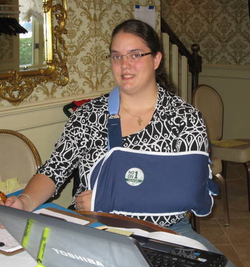 Pick in action, undeterred by injury BW: Thank you so much for agreeing to talk to me. I really appreciate your time. CP: Absolutely. I enjoyed reading your blog earlier, so I've been looking forward to this. BW: Thanks for reading! I'd love to start by asking a little about you. You're in your late 20s, and a graduate of UCLA Law School, is that right? CP: That's correct. I'm a proud Bruin, and a licensed attorney in the state of California. Now I'm the programs director for the National Log Cabin Republicans. BW: Have you been a Republican since you were young? CP: No, I became a Republican in college, shortly after the 2004 elections. That's quite a story. BW: I'd love to hear it. I was guessing that you've always identified as Republican, then came out later in life as a lesbian. CP: I'd always been pretty moderate, but sort of a "Democrat by default," especially after I realized my orientation in high school. But when I went to college at Claremont McKenna, I started to really define my political views, discovering that I was much more of a national security hawk--I was strongly affected by the 9/11 attacks--and that I really did believe in a free market and conservative political philosophy. BW: That's interesting. CP: But still, I was more concerned about gay rights than party politics, so I didn't make the change until two big things happened. CMC invited Patrick Guerriero, then Executive Director of Log Cabin Republicans to speak, and I really admired the work he was doing to change the party from within. The second thing was when I watched Democrats, after losing in 2004, start blaming Kerry's loss on LGBT people, and talking about how the Democratic Party needed to get in with religious voters. 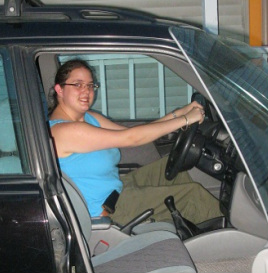 Casey Pick in her lez-baru BW: What was the political climate like at Claremont McKenna? CP: CMC is a special place. It is one of the only schools I know of where the student body splits pretty evenly into liberal/conservative/independent, and we've been called the most political campus in the country. Add to that a really strong emphasis on leadership and studying government, and you have a politics wonk's dream! BW: Did you grow up in California? CP: I was born in CA and lived there until my mother decided to go to law school when I was 10 or so. We moved to Iowa, but I kept going back to CA during the summer, so it never really stopped feeling like home. BW: I bet you miss it! CP: I do! I've got plane tickets in hand for a trip to Palm Springs this summer, actually. BW: So when you began to ID with a conservative political philosophy, did you feel tension between your sexual orientation and new political leanings? CP: Given that it was 2004, and I had just watched 11 states pass constitutional amendments banning marriage equality, I knew there was work to be done in the GOP. It was very important to me, knowing that I was a conservative at heart--and also a newly born-again Christian... it was an intense time - it was important that I use my ability to speak, Republican-to-Republican, evangelical-to-evangelical, in order to change hearts and minds for equality. I was going to be a Republican, but I wasn't going to abandon my pro-equality principles at the door. And frankly, I believe the GOP's core principle of freedom and individual liberty is entirely in line with LGBT equality. BW: Did your Christian beliefs cause any tension re: your sexual orientation? CP: I became a Christian after really getting to know and love some of my evangelical neighbors at CMC, so they knew I was gay and welcomed me from the start. I will say that my orientation, and a long fear of Christians/God, made it harder to accept my faith, but now I reconcile the two happily, and enjoy helping others do the same. It's a theme in my life - I like to be a bridge. BW: I agree that freedom and individual liberty is in line with LGBT equality. But I'm skeptical of the idea that freedom and individual liberty are in line with the Republican agenda. Economic freedom and deregulation, yes. Social freedom, no. CP: Well, there are many Republicans who believe, as Vice President Dick Cheney said, "freedom means freedom for everyone" - and on issues like LGBT liberty, more Republicans are coming on board every day. BW: More may be coming on board. But in absolute numbers, it still seems low compared to Democrats. CP: The LGBT community has spent a long time investing in and educating the left side of the aisle. I find it unfortunate that we've conceded territory on the right for so long that now Democrats sometimes take our votes for granted. Log Cabin Republicans is working hard to do much of that same work on the right, and it's bearing results - I'd point to important votes on "Don't Ask, Don't Tell" repeal, or to marriage in NY, WA and NH as examples of where hard work pays off. BW: But if the Republican Party really believed in getting out of our personal lives, wouldn't they be totally accepting of LGBTQ folks? CP: We have to remember that the movement for LGBT equality, slow as it may seem, has actually moved very fast. As a matter of political philosophy, conservatives tend to be more cautious of social change in general, and the reality is that a large portion of this nation is still coming to grips with what it means for gay people to be out, proud, and forming families. BW: But if conservatives supposedly care about personal freedom, why do they tend to be cautious about social change? CP: A lot of times, what is marketed as change - as in, say, a "hope and change" agenda - is really about giving government more control. At the same time, it's about the law of unintended consequences - if we change this, what happens next that we can't see? This is the academic, geeky butch coming out in me - it's Burke, Hayek, that kind of political philosopher that says beware radical changes, and to a lot of folks, LGBT rights still seem radical. But as people learn that we're just like them, interested in going to work, raising our families, sometimes serving our nation in uniform - the more they learn that, the less radical we seem and the more progress we make among conservatives. BW: The fact that we have to "convince" Republicans that we're "just like them" suggests to me they DO care about getting into our personal lives. CP: It isn't so much about your personal life as about what society looks like as a whole. Conservatives often believe that a self-governing society, one which can maintain a high level of freedom, requires strong families and other private institutions to provide stability. BW: The values you're articulating sound more Libertarian than Republican. CP: The GOP, like the Democrats, isn't a monolith. We're a coalition which includes your libertarians, your national security hawks, your social conservatives, and so on, and we don't always agree. BW: The idea that strong private institutions should be a source of social stability is another place you and I diverge. I'm wary of the idea that private institutions--that are hard to hold accountable--should be a big source of social stability. Look at outsourcing. I'd argue that insufficient regulation is why we have such a withered manufacturing base. CP: And I'd come back pointing out that we have some of the highest corporate tax rates and most burdensome regulations in the world. I think we'd enjoy a debate over a couple of beers. BW: Agreed. CP: Btw, I enjoyed reading your field guide on types of butch lesbians--I'm going to be thinking about that for awhile! 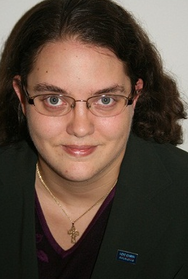 photo credit: Amy Walter Beisel BW: Thanks. Do you ID as butch? Which one are you?
CP: I'm slightly on the butch side of the spectrum. All about holding open doors, being protective, and let's just say not a lot of work got done during the women's NCAA basketball tournament! BW: Okay, back to The Gays: What’s your reaction to Obama’s stance re: gay marriage? CP: Obviously it's tremendously significant, and having the president on the right side of this issue is in the nation's best interests. That said, Americans can be certain that the President would not have made this decision at this time if it were not in his best political interests. ...the trap is laid for any Republican who responds with intolerance. I think a lot of Republicans know this, which is why you're seeing a pretty mild, measured response, particularly from people like Speaker Boehner and Governor Romney, who is only bringing it up when asked so far. BW: Do you see gay rights as a states' issue? CP: I will say I was very disappointed in the timing of the announcement. I was on the ground in North Carolina working against Amendment One, and I know that there were a lot of people there who were hurting at that defeat, who are asking now why the president couldn't have come out for this one day sooner, which it might have made a difference for them. So while I'm happy he's finally caught up to Dick Cheney on this, in a way the timing of it just made it bittersweet. BW: Do you agree with Cheney that it's a states' rights issue? CP: Log Cabin Republicans are working hard to pass a federal employment nondiscrimination act and other important legislation for LGBT Americans at the federal level - but we do sometimes make the argument that the federal government should show more respect for the states. To conservatives, it is a strong argument to remind them that the federal Defense of Marriage Act was actually an unprecedented intrusion on states' rights, and that today it is actually working in an anti-federalist way by allowing - forcing, even - the federal government to ignore marriages in states like New York and New Hampshire where the state has decided to grant marriage rights. If we treated marriage like a states rights issue, we'd be recognizing those marriages today for purposes of federal benefits like social security and taxes. That said, we do agree with former Bush administration solicitor general Ted Olson that marriage is a fundamental freedom due to all Americans, gay or straight. BW: Ted Olson is an excellent advocate. Do you think it would hurt Romney politically if he came out in favor of gay marriage? Or, put differently, do you think that the Republicans have basically given up on getting the gay vote? CP: There is a growing number of Republicans leaders who are aware that campaigning on marriage, or even appearing antigay in any way, is a losing strategy for the GOP. I'd point you to an article in the Washington Post which shows more and more Republicans strongly encouraging the party to take a more modern stance on these issues. That said, social issues activists like the National Organization for Marriage and the Family Research Council aren't going away just yet. BW: It must be annoying to you that so many visible Republicans are so anti gay rights. CP: It isn't just about the gay vote at this point - those gay voters have friends, family, co-workers, and polls are consistent in showing that moderates, younger voters and women are inclined to support equality. It's a growing voting block to be taken into consideration. It's frustrating sometimes, not just because as a gay woman I find some of what is said offensive, but also because I think that kind of rhetoric is harmful to the Republican Party. BW: You think Romney would lose votes if he came out in favor of equal rights for LGBTQ Americans? CP: I think there are some measures Governor Romney could comfortably take to reach out on issues of equality, including support for employment nondiscrimination. On marriage, I think he has stated his position and intends to stay with it, though Log Cabin Republicans have informed him of our disagreement and strong desire to see DOMA repealed. BW: Do you foresee Obama repealing DOMA if he's elected again? CP: The question is whether I see him investing significant political capital to move DOMA repeal through Congress. Given his anemic efforts on DADT repeal and broken promises on the federal contractor executive order against employment discrimination, I'm not optimistic. BW: [Sigh.] Me either re: his political capital. [Though I'll definitely be voting for him come November.] CP: See? Not only is a lesbian Log Cabin Republican not a unicorn, I'm also not crazy! BW: You've been super generous with your time. A couple more questions? CP: Sure. BW: I listened to another interview with you, and the interviewer was literally yelling at you for being a gay Republican. Do you get that a lot? CP: Especially this week! Our statement in response to President Obama ruffled a few feathers. But yeah, there are plenty of people who don't understand how a person can stay in a party where there is significant disagreement on something as personal as marriage and families. I remind them that I am a multifaceted human being who cares about a lot of issues; that somebody has to be willing to speak with the right side of the aisle if we're ever going to truly win equality; and that it's my party, too - I'm not about to be driven out of it or told I can't be a Republican. We won't have real freedom as LGBT people in this country if there's still the idea out there that your sexual orientation dictates your politics. BW: To me, civil rights are so personal that it would be hard to be a member of a party whose official platforms suggested that I was inferior. CP: Civil rights matter to me, too - that's why I do this work. I think the most important battleground for equality today is with people who disagree with us, and if I have the knowledge, perspective and, frankly, stubbornness to have those conversations, then it's my job to do so. Log Cabin Republicans are unapologetically Republican and unapologetically pro-equality, and that's why I'm proud to be a member. BW: Although I disagree with you in many ways, I'm glad that there are people like you in the Republican Party. CP: We need folks on the left pushing Democrats, too, so if you're not a Republican, you've still got work to do. I'm happy to work with other advocates to get things done. Log Cabin works with Freedom to Marry, Immigration Equality, Servicemembers United, GLSEN, to make equality a reality. BW: Here's a question I know a lot of readers are wondering: does being a Republican affect your dating life? CP: Being a workaholic political activist affects my dating life! BW: I can just imagine it. Candlelit dinner, romantic music... then all of a sudden, you say it: "Honey, I'm a Republican." Do you encounter a lot of women who are just like, "I totally don't get you." CP: To be honest, yes- there are some folks who find it a turn-off, who think I must be self-loathing or fundamentally greedy, willing to trade equality for tax cuts. For others, it's not the Party, but being deeply involved in these issues. Thankfully, it rarely gets that far - when the answer to the question "so what do you do?" is "I lobby Republicans for gay rights," that screens out those types pretty effectively. BW: I bet. Do you prefer to date other Republicans? CP: Lol! If that was my criterion, I'd be in trouble. I prefer to date people who are passionate about whatever they believe in. Clearly I'm comfortable with liberals and have plenty of lefty friends - I don't discriminate. BW: Who's your dream woman? Ann Coulter? Rachel Maddow? CP: *shudders* No thank you. BW: Shudders to whom? Both of 'em? CP: Pretty much, though Rachel has her moments. BW: LOL--if she was a conservative, you know you'd be all over that. CP: No doubt! Sadly, she's not so fond of Log Cabin types. BW: Maybe she'll invite you on her show one of these days. CP: I think I'd enjoy that conversation - sparks would fly, just not romantically! BW: Well, I should wrap up, but just want to say thanks again. It's been fun talking with you, Casey. CP: Anytime - it's been a nice break. BW: Good luck. CP: Thanks. A couple of days ago, I wrote about my memories of my father's dresser, and I included a snapshot of my own. I asked readers to send in pictures or descriptions of their dressers. Here are some of the pictures and quotes people sent in. (The pictures are interspersed with the quotes. Some quotes go a picture; others don't. Can you guess which ones do?) • • • 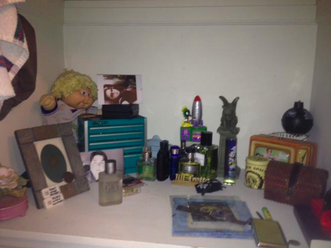 "Coins, keys, pens, pocketknife. Valet with wallet, cufflinks, bracelets, tie tacks. Vintage ash tray with odd bits like collar stays, dog whistle, lost button, corsage pin, matches. Vintage tip tray with specs, sunglasses, cell, biz cards. Always a memo pad. All neatly arranged on top of TWO dressers pushed together and garnished with a bureau scarf. Geez. What a fetishist." "Picture of my lady, stuffed amoeba my friend sewed for me, three books on female masculinity, a chapstick, my wallet, and a roll of duct tape." "I had a fascination with my father's dresser as well. I snooped though ...found a lot of interesting things! Every week I would hope for something new...it's still intriguing every time I see it now." 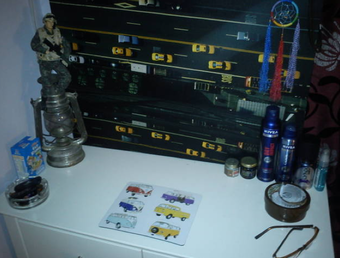 "Generally there is a cat napping on mine and nothing else...since he'd just knock it off." "In essence, her side is the zebra lamp side, and mine is the one with all the nail polish and hair things...we've got receipts, a pen cup, water bottle, and a Bath and Body works bag there... That mask, though, is my favorite, and a keepsake from the Highland Games in Enumclaw." 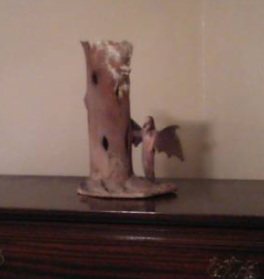 "Mine is in my closet, and I avoid going back in there as much as possible." "Diapers, shirt, that's it." "It's a mess of nothing but junk. Change, receipts, a fan, 2 valet boxes." "Perfume, deodarant, talcs, nail polish, brush, comb, wet wipes, clock, mobile." "Aftershave, deodorants, my gf's perfume [and] makeup, jewelry, bobble rack, face wipes, creams a teddy, watches." "As for my parents, they never had anything interesting on their dresser... but their closet always fascinated me because my mom kept all her jewelry, important documents and things like that in a safe, inside the closet. Also, their closet was the only way to get up into the attic, and so as a child, I was convinced that if I ever got a ladder and went up there, I'd be able to climb into another world. The modern-day version of Narnia, I guess." 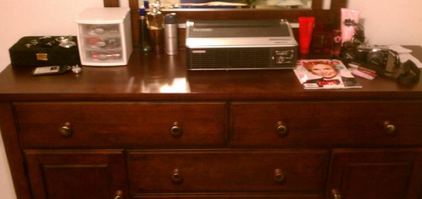 "I was obsessed w my grandfather's [dresser]. [H]is white old spice bottle would be the first thing I went after... and his razor was next... he removed the razor ...when we came over to keep me mainly from shaving something off my face. My dresser is a little more on the romantic side I guess... my candles, colognes, deodorant, and my change jar, most of the time all nice and neat." "Sneakers." "My SnapOn jewlery box. My Cabbage patch doll dressed in a baseball uniform. My AA chips and big gbook. Watches, wallet and colonge. A picture of myself before I lost weight so I don't forget. A picture of my girl." 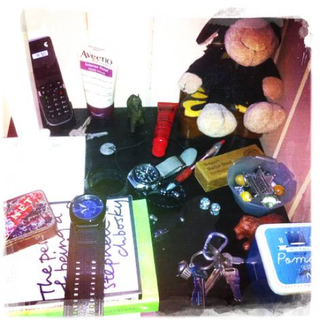 "I was always fascinated with my Dad's dresser as a child because he had all this cool stuff on top and hidden in the drawers that he would sometimes show me if I lurked around while he was getting ready, like pocket knives, boxes, shells, die cast toy cars he had when he was a boy, harmonicas and generally fascinating old stuff... I have a habit of collecting random things through the day that end up in my pockets, then at night this is where most of it ends up when I empty them. " "A black fanny pack... a jewelry box my brother brought back from Japan when I was 11 and a bunch of books and lotto tickets... and a stuffed animal someone gave me when i was going though chemo." 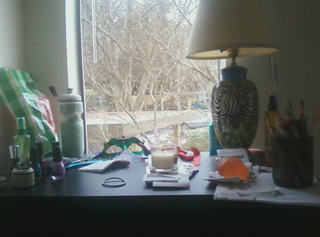 Lots of folded, multi-colored t-shirts, passport, foreign money, important documents, Canadian cell phone for when I go "home." "Coins, deodorant , mini-hope chest, papers of important stuff that needs to be done but have been laying there for about 6 months, hand lotion, dust..." 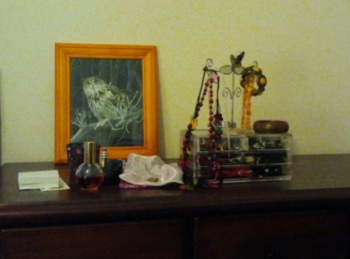 "I was always fascinated by my grandad's dresser. He had a box of things he picked up whilst serving in WW2, Brill cream and a comb. Minimal. I have my grandad's old oil lamp, my toy soldier minus a foot, ashtray of loose change and memory cards, deodorants, hand gel, tiger balm, body butter, glasses, a wee pot of body jewellery, and my rice crispies i forgot to eat this morning."
This is the third of a three-part series of posts about butch-butch relationships. These posts are based on my own experiences, as well as those of about 15 butches I interviewed who are, or have dated, other butches. You can read parts one and two of this series here and here. Toughness and Vulnerability Several members of butch-butch couples said one aspect of their relationship they particularly loved was the mixture of toughness and vulnerability in their partner. K was particularly eloquent on this point: "We don't usually think of butch women as being... vulnerable, do we? After all, if butch means masculine, and if boys are encouraged to be tough, then doesn't it follow that a butch lesbian should have a thick skin, and brush off all the hurts... collecting broken hearts and belt notches, and racking up a lifetime of hard knocks? ...[T]he best thing about being with her [is that s]he makes herself vulnerable to me." Butch-butch couples loved that their relationships allowed them not only to exhibit their own toughness, but to take refuge in their partner's toughness. Z told me, "The best thing is that we are both very strong, in ways that compliment the other's weaknesses." And Jennie wrote, "I can be strong and tough for [Lisa], be her butch. But I can also use her toughness and let her be my butch when I need it." Indeed, as one astute femme Facebook buddy pointed out, the qualities that butches seem to appreciate in other butches aren't too different from those that femmes seem to appreciate in butches. Occasionally, some butches in butch-butch couples feel like their "masculinity" or "butchness" is threatened by being with another butch. For example, one anonymous respondent feels a little uneasy when her partner wears a tie: "Then will they think I'm the femme?" she asks. K.D. explains that she and her partner, Becca, sometimes "have butch-offs: 'Sweetie, let me carry that,' 'I'll get the door,' etc. Sometimes I just want to be the sweetheart that helps the other person, comforts the other person, demonstrates chivalry etc. and when Becca wants to be that part of the relationship it can be interesting to navigate." Donnie added that butches are a stubborn breed, and that neither partner likes to be the one to give in! A few butches offered suggestions for making each other feel butch. Jennie said that since she and Lisa "fight over some 'butch' duties," they needed "to buy 2 shovels, 2 chainsaws, etc." Lisa added, "We need to buy a second snow shovel, cuz I am NOT watching her have all the fun!" KT said that it's important to reinforce each others' butchness, since for both her and her partner, being a masculine or androgynous woman was an important part of their identity. Z admitted to a little concern that her partner might one day leave her for a femme, since K has dated femmes before. And alas, I can personally confess to having a similar pang of worry now and then. It's not only important for butch-butch couples to respect each others' butchness, but to be very explicit about valuing this in each other. What Butch-Butch Couples Share Navigating the world as a masculine-of-center woman can be tough, and several respondents mentioned that it's nice to have someone who understands those experiences first-hand. AJ said that being in a relationship with another butch gives her 'permission' to be herself: "I'm allowed to be me. There is no expectation for me to change myself or be more 'feminine' because I am female. We are best friends and lovers. She just gets me." Becca wrote, "I truly appreciate that the other person knows where I'm coming from and understands what it's like to move around in the world as a butch." Jess said, "The best thing is just having someone you can relate to." 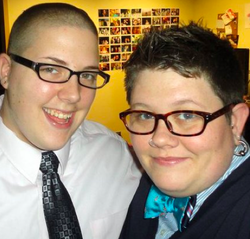 K.D. + Becca = awesome. Butch-butch sharing extends to more practical arenas as well. Becca noted that she loves being able to share ties, and Jess wrote, "You can share - hair gel, clothes and shoes, toys. You have someone you can talk to about anything - getting called sir, woman staring at you in the ladies bathroom, packing or not packing, cargo shorts vs. cargo pants." Several butches also mentioned that butch lovers are quicker in the bathroom: "Chopper doesn't take long to get dressed," Z said. "[S]he is rough around the edges like me. We don't really worry too much about whether our socks match or if we have some dog hair on us." AJ said, "[I]t is quick to go out because I don't have to wait for her to do her hair, makeup, nails and stuff."
Nearly every respondent said the best part of being in a relationship with another butch is that they are simply very attracted to other butches. Some of them are attracted exclusively to other butches, and others have no generalizable preference or pattern. Either way, being in a relationship with someone to whom you are physically attracted is, well, hot. Butch-loving-butches are no more in charge of their own chemical attractions than femme-loving butches, butch-loving femmes, or anyone else. This is one of the many reasons it made me sad that a few people wrote, in response to my previous posts, that butch-butch relationships are "gross" or "a waste." When two consenting adults are in love with each other, a "waste" is about the last thing I'd call it. Butch in the Bedroom: Just Us and Our Socks A few bashful butches didn't respond to this question at all. But I'll let those who did tell you in their own words what it's like for two butches in bed: Stacy: "Butch/Femme is something very different than Top/Bottom, but people assume it's the same. I have had very different roles in each of my relationships in that area. If you have enough trust with someone, you have enough freedom to explore all sides of yourself and your partner. I believe everyone has their butch side, their femme side, their top side and their bottom side. The fascinating thing is to see how yours pairs up in each relationship." O: "Things are very hot in the bedroom. We are both takers and givers so it usually works out very nice. The only thing is sometimes we fight over who tops." eL: "It is amazing. I don't want to kiss and tell... but it was magical." Donnie: "I think it's amazing! It's a true give and take of feelings, emotions, and love on an equal level." Anon: "Really hot! This might be because I'm really only attracted to other butches, and it's fun to have sex with people to whom you're attracted. But yeah, it's great. Sometimes there's a little argument over who tops, though, since we both love topping." Becca: "I think it depends on the butches. :D I appreciate that everyone expresses their sexuality differently, and I'm grateful that my current partner and I are very compatible and satisfied in that area." Lisa: "Completely open and free. I don't have to always butch-up, and I don't have to always be the 'girl.' We can wrestle, we can fight for who has top tonight, or we can take turns, or we can snuggle and cuddle." LG: "Same as any other relationship." K.D: "AMAZING!!! Luckily we are not the stereotypical stone butches (I do not feel like many are.) We get to enjoy each others bodies the way that they are with little to no question about it." Tammi: "I don't know what it's like for 'just any' two butches in bed… It strikes me as a creative wellspring of opportunities, and each time leaves me wowed and full of ideas for the next time." Anon: "There's no hairspray on the pillowcases, or heavy perfume, or itchy lace underthings. Just us, and our socks." There you have it, dear readers--everything you wanted to know about butch-butch couples, and more! A huge thank you to the wonderful butches who let me interview them: AJ and Jo, K (aka Chopper) and Z (aka Zed), eL, LG and KT, Donnie, Becca and K.D., Jess and Beth, O, Stacy, Chelsie, Lisa and Jennie, and a handful of others who preferred to remain anonymous. When I posted my last entry, I worried that it might be behind the times. Especially considering the number of queers who identify as neither butch nor femme (and those who eschew labels altogether), I was uncertain whether the post would ring true for people. But wow. Not only were my fears unfounded, but the number of negative messages I received on Facebook made it clear that this is still a big issue. Whether they specifically identify as "butch" or not, two masculine-of-center women who date each other face serious challenges, even within their own communities. In this post, I continue exploring butch-butch relationships, based on interviews of 15 self-identified butches--10 who are currently in a relationship with another butch, and five who are single and date butches. I've decided to expand the butch-butch exposé into three parts rather than two. This part tackles "balance" in a butch-butch relationship, as well as how butch-butch couples have been received by others. A Different Kind of Balance One of the most-written-about joys of butch-femme relationships is the inherent "balance"--psychic, physical, and otherwise. Many of the butch-butch couples I interviewed also talked about balance, using words like "synergy," "camaraderie," and "equality." Several respondents said that in butch-femme relationships, gender roles had been too present for them. All respondents were quick to state their respect for butch-femme relationships (and understood that prescribed roles are not necessarily part of that equation). Still, they saw butch-butch relationships as a kind of "tabula rasa," with no default (in their own minds, nor in others' perceptions) about who opens the door for whom. "In our relationship, it's as if gender roles just completely don't exist, which I love," KT said. Lisa echoed this, saying that she enjoyed the "fluidity" of her and her partners' roles. Chelsie wrote, "The fem women I was with treated me more like their 'boyfriend' and resembled the dynamic of a straight couple." Personally, while dating men and while dating femmes, I always felt like there were prescribed "typical" ways for us to act. If my femme date brought me flowers (or if I bought my DXH flowers), it was as if were were "bucking" certain roles. I don't like having roles to buck, even if they're only imposed by my own culturally-programmed brain. Nearly all of the butches I interviewed had previously dated femmes, and said dating butches felt "natural" or "was a relief." K wrote, "The dynamic of my relationship with my butch is so different from any of my relationships with femmes (or men, before that). I feel like I have finally been allowed to take off… any kind of costume. There's no doubt that I'm butch, or that she is: even though we're not terribly attached to labels, we both agree that either of us prancing about in a dress or makeup would be Just Wrong." She also said, "But the relaxed and accepting dynamic of our relationship allows me to be myself first and foremost, with costumes optional, whereas in masculine/feminine-roled relationships that I've been in, only certain things were allowed, and to venture beyond them might make somebody squeamish." When it came to the essentials of love and communication, however, most respondents believe that butch-butch relationships are no different from any others. Becca wrote, "[T]he dynamic of our relationship is basically very simple--we're head over heels ridiculous for each other, and I'm grateful for every single moment." Jess shared a similar sentiment: "[T]he dynamic of our relationship is similar to any other relationship, whether it's femme/femme, butch/femme, or any straight couple. We love each other and have committed ourselves to a lifetime together. We argue with each other, we miss each other when we're apart, and we consult each other in any big or small decision we're making. We laugh, we cry and we care." All of this made me wonder if butch-loving-butches experience a different kind of queer "sexual orientation" than femme-loving-butches. What do you think, dear readers? Friends Don't Care, But Strangers Stare The dominant theme from my interviews was that close friends tend to be accepting of butch-butch relationships, but that strangers and acquaintances, whether straight or queer, tend to be weirded out. There also seems to be an uncomfortable "invisibility" that butch-butch couples experience as couples. I'll let these butches explain in their own words: eL: "Most of my friends 'just don't get' butch... I do feel like it's taboo. …[W]hen my ex and I would go out dancing, when we weren't being seen as gay boys/bois, we were often assumed to be single (even though we were dancing together and were, in my opinion, pretty obviously TOGETHER). We would regularly get hit on and then have to politely decline and, much to most folks' surprise, state that we were, in fact, a couple. Also most femmes and some 'straight' women automatically assumed were were interested in them when we just weren't--we only had eyes for each other… Not being seen as a couple was difficult." K.D: "My best friend thinks its adorable, [and]others don't have much to say. I think some people get confused because they are used to the butch/femme dichotomy. I think a lot of people find it unusual but I don't think many would say its taboo, just perhaps confusing." Donnie: "My close friends were ok with it, others thought it was kind of odd to be butch on butch… and teased us about who opens whose door and who does who in bed." Stacy: "My friends didn't say much, but I heard later that they thought it was a bit weird. I find a lot of things feel weird in the lesbo world--the B/B thing was just another one." Becca: "[M]y friends are a broad mix of queers who don't really seem to judge other people's situations, and my straight friends and family don't know that it's different from anything. They just see two queers and it makes sense to them. I don't feel like it's unusual/weird/taboo for me, but I do feel extra gay sometimes. I feel like we'e super visible as queers, but not always super visible as a couple." Anon: "Some friends think it's weird, especially the butches in butch-femme couples. It's like being gay within the gay community. One butch friend of mine said she thought it was 'gross.' I feel like heterosexuals understand butch-femme better than butch-butch. Maybe the butch-femme thing is more recognizable to heterosexuals as what they're used to." 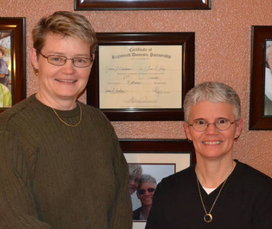 Lisa and Jennie Lisa: "It feels a little taboo sometimes. But it seems to throw off straight people more than other lesbians. Straight people still seem to be stuck in butch/femme roles, and get confused if we don't fit into those stereotypes." Jennie: "None of my friends ever questioned the butch/butch thing. My friends were just excited to see me happy. I don't find it unusual. In fact, I enjoy it more than I realized I could!" AJ: "All my friends were great and they love Jo so there was no problem there. Sometimes when you are out in public and we are together you get weird looks… You do hear… complaints of femmes that it is not fair that you get all the butch girls when they want one!" So What's At the Heart of the Butch/Butch "Taboo?" This all made me wonder... if Portia had short hair and had worn a tux, would people have been quite so stoked about Ellen and Portia's wedding? Would "Ellen Show" viewers still have talked about how "cute" the wedding was? And if not, would this be due to the fact that butch + butch is taboo, or that same + same is taboo, or to the fact that butch women aren't seen as conventionally attractive? Stay tuned. Next entry will be a wrap-up on butch-butch relationships, and I'll finally tackle butch-butch in the bedroom... A huge thank you to the wonderful butches who let me interview them: AJ and Jo, K (aka Chopper) and Z (aka Zed), eL, LG and KT, Donnie, Becca and K.D., Jess and Beth, O, Stacy, Chelsie, Lisa and Jennie, and a handful of others who preferred to remain anonymous. |

|
 RSS Feed