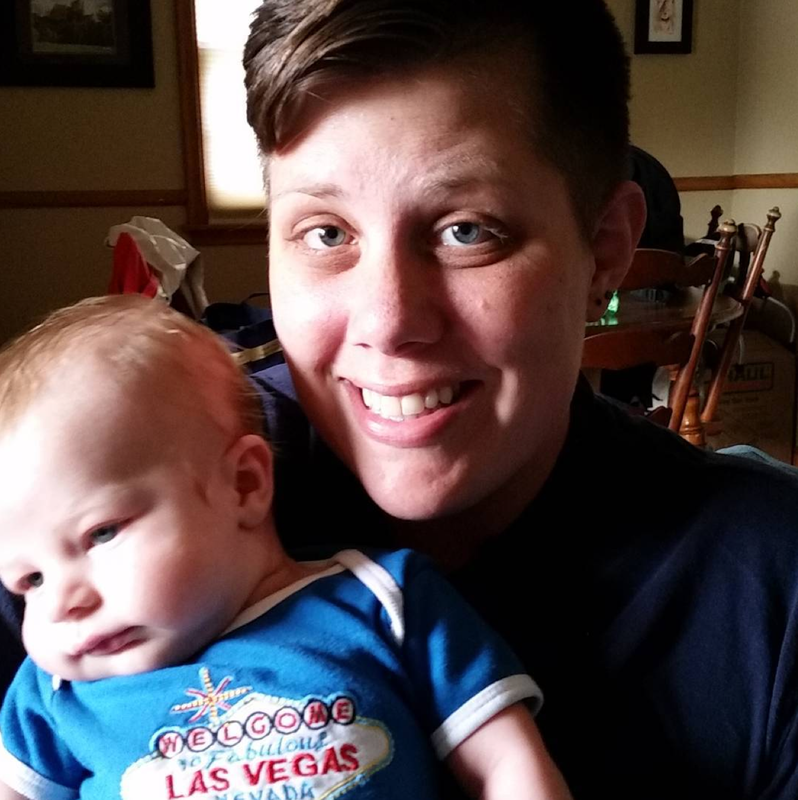
 Guest blogger eL and their son! Guest blogger eL and their son! My name is eL. I am a butch, queer genderqueer (oof, that's a mouthful) and my preferred pronouns are they/them/their. I blog occasionally and tweet often, and I've guest blogged on Butch Wonders before, like I'm doing today. I recently had a fun twitter back-and-forth with BW after reading her recent blog post on butch-butch relationships. In the past, I contributed to this post and this post on the topic of butch-butch love.
I have had relationships with three people who were solidly butch-identified when we dated, plus one who felt she "looked butch on the outside, but felt femme on the inside." I have also dated femmes. Four, to be exact. I would say only one counted as a "relationship." I have also dated a few people who didn't really identify either way, and I am dating one of those fabulous people now. So, how does it feel different to date people of varying identities? How does perception of yours elf and other people change based on who you're dating? Well, for me at this moment, there are a host of complicating factors.
To answer the initial question BW asked me ("Notice any big diffs in dating not-butch, either re: how you feel or re: how others treat you?"): Yes, I do. So here are some of the differences--the differences for me--I certainly don't speak for anyone who is not me. When I date femmes, I feel generally more protective. I fall into a bit more of the security guard role. I suppose it helps that I am tall, broad-shouldered, and "look intimidating." Though I certainly don't *feel* intimidating much of the time. In most relationships, I have been read as "more butch" than folks I've been with based solely on my height and frame. This is fine with me, but also hilarious, as I am certainly not the butchest butch that has ever butched. I don't even drive a stick shift! When I date butches, there seems to be more of a tradeoff. If the butch I'm dating is much smaller than me and doesn't have a Napoleon complex, I do feel like I take on a bit more of the protector or "more butch" role. If the butch holds their own (as far as acting from a place of confidence), then not so much. This really varies person-to-person. When I date non-butches or non-femmes, it varies even more. Regardless, I still feel quite butch and secure in that/my identity. My current girlfriend is struggling a bit with my neutral pronouns. She uses them just fine, but is frustrated with what term to use to refer to me in the context of our relationship. As far as I can find, there are no gender neutral relationship terms that are equivalent in meaning and generalized understanding and seriousness to "girlfriend" or "boyfriend." Prior to dating her, I didn't really think much about what folks called me. (Most said "girlfriend," one called me her "Mister," and another called me her "Beau.") My girlfriend and I generally get read as more "lesbian" so far than I've been read as in a bit. In the past, I think people didn't read me as lesbian as often when I dated other butches. I dated one butch, in particular, and we were often read as gay men. Otherwise, I'm not sure how I was read, only that people would assume that I wasn't with the person I was with because we were both "butch." When I dated femmes, once in a while, we were read as a straight couple. I feel lucky in that my girlfriend is pretty darn attracted to butches, and has been. Seems to be an important part of her identity, and I dig that. If my girlfriend wasn't openly into butches, I might feel differently. Do I have to "tone down" the butch? Something like that. But, I don't. I am just unapologetically me right now, which, I'll admit can be pretty awkward at times. Butches + nursing bras = certainly not my favorite thing and has evoked much frustration and drama including exclaiming things such as, "I don't even wear bras like this! Ugh!" (I usually wear sports bras and/or the occasional binder.) Overall, I feel more comfortable dating butches and folks somewhere in the grey area. This is due to past not-so-positive experiences dating femmes. I have had femmes judge me as "too butch," I have had femmes hit on by men in front of me and not rebuff them - I have, unfortunately, had some disappointing experiences dating femmes. I have found butches. as a whole, to be more accepting of my own butch identity. I have also found that I have stronger chemistry with lesbians / queer folks that lean more butch / masculine on the spectrum of gender. I think the best way to not have stress regarding how you're being read is to be confident in your identity. Own who you are. Own your challenges, own your changes. Be confidently you and keep putting that message out. Stay strong, be yourself. Folks will get it.
7 Comments
I've written in the past about butch-butch relationships, but it's been a few years, and I've slowly been seeing more and more interest in the topic. Last month alone, popular search terms included:
can two butch lesbians date butch woman with another butch woman can a butch and a butch date? butch to butch couples Am lesbian butch attracted to other butch butch on butch lesbian butch on butch Its possible that butch and butch they can date can a butch date another butch do butch lesbians have sex with each other Butch/butch relationships And that's just a small slice. Given that there's so much interest out there about butch-butch relationships, I thought I'd better take them up again. As regular readers know, I am attracted almost exclusively to other butchy types myself. My partner is more typically "butch" than I am, although she doesn't like labels. When I first came out, I knew instinctively that I was attracted to more conventionally masculine-looking than feminine-looking women, but I also thought there must be something a little wrong with me, because all the other butchy-looking women I knew were interested in feminine women. Even if they didn't date "femmes," they certainly weren't interested in other women who were mistakenly called "sir" at the grocery store. But I was. Since my attractions seemed so unusual, I figured I must be in some kind of denial. Once I was "comfortable" being gay, I'd be interested in femmes... right? So I tried dating feminine women. But for me, there was no zing there. No allure. It was fine, but not exciting. Dating other butchy or androgynous or soft butch types, on the other hand, was awesome. I loved it. I could relate to these women, we could understand each other, and most importantly, it had that magic tension and mystery and excitement that romance is supposed to have. Sometimes I say that being a butch-loving butch is like being gay within the lesbian community. I've had other butches tell me that they think it's "gross" to date other butches. (I just smile and tell them that dating butches makes me extra, super, mega-gay.) And it can be really hard to find butch or androgynous types who date other butch or androgynous types. But trust me... if it's what you're into, it's the best. Here's my advice for butches looking for other butch types to date:
In sum: yes, butch lesbians date each other, have sex with each other, break each others' hearts, and have awesome relationships. Just like butch-femme couples, femme-femme couples, straight couples, gay male couples, and everyone else. You may not hear about it all the time, but there's plenty of butch-butch love out there. I got an interesting email from a BW reader several weeks ago. I promised him a response, and with his permission decided to share his question and my answer with the rest of you.
Dear BW, I am a straight man ..not bi or bi-curious. I love women. I have always been attracted to tomboys but now that I'm grown I have discovered that is my preference. I turn my head faster when I see a sexy stud opposed to high heels and a dress. I also feel the conversation or potential relationship is better. I am also amazed sometimes of the perfect bodies when those baggy clothes come off. The sex is simply better. When it comes to relationships, I don't know what to do. The stud I was interested in/having relations with... We enjoy each other's company and sex. But she has a girlfriend, obviously. So I'm confused, probably like she is. Do you think she was just using me? And if so, why? We really mesh but she definitely doesn't want anyone to know... And I promised her that. So, yes, I would love to be in a relationship with a stud... Not that I'm trying to change her. I would not mind if she had a girlfriend... As long as I was her guy. Do I sound crazy or what? Sincerely, Confused Carl Dear Confused Carl, You don't sound crazy. Sure, most straight guys' heads are turned by skirts and heels, but yours isn't! I bet lots of men attracted to "non-feminine" women aren't willing to say so, because they fear others' questions and judgment, or because they think it makes them less masculine (which it doesn't!). My last post talked about the difference between masculinity in women and masculinity in men. It's not weird to me that you would be attracted to one but not to the other. Masculine women are women--and they happen to be your favorite kind. So, cool. Butchy and masculine-of-center bisexual (and even straight!) women DO exist. Some of the bi ones only date women, in part because men aren't usually attracted to them. But this doesn't mean that they wouldn't date a cis man if the right one (like you!) came along. So it might take a little extra effort on your part--for example, dating online, going to bi mixers, or letting your friends know your preference so that they can "keep an eye out" for you. But don't give up hope! A straight guy into masculine women doesn't come along every day, and the right woman will be sooo excited to meet you! And then, of course, there's your specific situation, which is trickier. You may be right that "your" stud is confused... but she may simply be bi. I can't tell from your email whether she wants you to keep your relationship a secret because you're a man or because she is dating someone else. The fact that she is with someone else, though, and doesn't want people to know about your relationship, means that unless something changes, you two aren't going anywhere. If you're okay with being the guy "on the side," fine. But remember that unless all parties know what's going on and are okay with it, it's cheating. This fact doesn't change just because you're a guy. Correct me if I'm wrong, but I get the sense from your email that you're not exactly thrilled with the current situation. You might consider talking with her about this. I have no idea whether she's using you (as you fear) or whether she's genuinely confused. But it doesn't sound like the status quo is working for you--and if it's not, you need to find out what's going on with her. My advice would be to tell her what you've told me. Tell her you don't want her to feel pressure about her sexual orientation, and that you like being with her as a human being and need to know what you mean to her. You write, "I would not mind if she had a girlfriend... As long as I was her guy." This statement confused me. Are you talking about a polyamorous relationship? About regular sex on the side? It kind of sounds like you'd be cool with the latter, except that's what you have right now and you don't sound totally happy about it. What do you want? I don't want you to settle for this "on the side" business, though, if what you really want is a full-on, even monogamous, relationship with a studly woman. If this is so, know that you can get it. It might take a while to find, but it is possible, and you don't have to "settle" for what you have now if it doesn't make you happy. Sincerely, BW Trans issues have popped up on Butch Wonders quite a bit in the past, so when a super-smart English professor I knew came out as trans, I shamelessly pounced on the chance to ask him all kinds of questions about his process and identity.
BW: How long have you "known" that you're trans? What does it mean to know? Allen: I've known that I was not quite cisgendered for several years, and I've felt trans off and on for several years, but more solidly during the last six months. BW: Can you give an example of something that makes you feel non-cisgendered? After all, I've always hated and felt totally uncomfortable in "girly" things. It just feels not-me. Is that what you mean by feeling non-cisgendered, or is it different? Allen: Those feelings of discomfort with "girly things" are part of it for me, but it also includes dysphoric feelings about my body, such as feeling really psychologically uncomfortable with my female chest and even more minor things like my female-looking neck, female hairline, etc. I have also never liked to be called a girl, woman, or even "tomboy," since "tomboy" suggests that one is not a real boy! So all of these things are part of my feelings of not being cisgendered. BW: I hate the word "tomboy," too. To me, it always suggested that my "boyishness" was a phase I'd grow out of! I resented that, even as a kid, because I knew that there was something in me that other people saw as boyish, and I knew that it wasn't going to change. Okay, so say more about the feelings and knowledge of being trans. Allen: I use those words--felt/feel trans or male--instead of "know," because to me, the transition process centers on feeling more than knowledge. For me, it's not an issue of "knowing" I'm trans, but one of being ready and willing to feel my feelings. BW: How do you know you're not just taking advantage of "male privilege," since in most places it's easier to be a gender-conforming male than a non-gender-conforming female? Allen: Because when I'm allowing myself to feel male and when others view me as and call me male, I just feel happier and feel I'm more able to express myself and let go of hesitation and self-consciousness and depression, even when I'm only in the company of loving, supportive people like my wife and my mom. Male privilege doesn't come into play with such people, yet I am much happier being male even in such small company. BW: So, with these people like your wife and your mom, what does it mean to be treated "like a man?" Can you give an example? Allen: That’s a great question. They don't treat me especially differently, actually; I think the main things that make me feel male and make me feel good in such circumstances are that they don’t call me girl terms and that as male I'm able to feel happier inside my own head, which causes interactions to automatically feel better. An example of the first is that my mom has always called my wife and me "the girls," but now she is trying her hardest to not do this. And my wife calls me "hubby" instead of "wife," which is validating. BW: Do you still ID as butch? Do you ID as a straight man? Allen: No, I don't identify as butch anymore. To me personally, "butch" implies being something other than a guy, and I feel like a guy. I'd probably just lean towards calling myself a guy, or a trans guy. I like those terms. I'd be more likely to identify as a straight man than as butch, but "straight man" feels a bit confining. I am about 99.8 percent straight, but the associations that go along with that term—e.g., uptight, not queer or trans, "bro"—don't feel so great to me. BW: What's the other .2%? Attraction to guys (since you're a guy)? Allen: Well, yes; in my lifetime I've had genuine crushes on two men! But nothing ever happened with that. BW: It seems like few trans men date butches, though I can think of plenty of trans men who date men (either cisgendered or trans), as well as plenty of trans men who date feminine-presenting women. Why so few butch-trans male couples? Or am I wrong about this? Allen: Yeah, I can't think of any transmen dating butch women, that I know of. But maybe there are some! I don’t think I have any answers here. BW: I suspect there are some out there somewhere. (Any BW readers want to chime in?) So as you were dealing with all this gender identity stuff, how did your wife respond? Allen: We've been together for more than nine years, so I've talked with her about my gender feelings for the entire time I've been exploring my identity. So it is certainly not a surprise to her that I'm trans. She is very supportive and happy for me, which I'm grateful for, and she is excited for my future happiness and our future in a potentially better relationship! After all, if both people in a relationship are able to be fulfilled and comfortable, doesn't the relationship end up better for it? BW: I would certainly think so! Allen: Also, she's had relationships in the past with cisgendered men, women, and transmen, so she can certainly be attracted to maleness. While she feels disappointed about not being able to refer to her "wife" and thus be recognized by others as queer, and while she's sometimes nervous about how my personality may change on T (I don't think it'll change radically), she is supportive and hopeful. BW: How are you going to decide whether to get surgeries? Is that a hard decision? Allen: It's an easy decision to get top surgery, which I'm getting on August 5! Or rather, the decision is easy at this point, after I've debated, analyzed, and overthought about transitioning for at least eight years! I decided to get top surgery because I am mentally uncomfortable about my chest every single day of every month and year. BW: Uncomfortable how? Allen: The look and feel of my chest bothers me intensely. I feel a deep, intense, and excited longing to have a male chest. To me, it sounds better than any Christmas present I could imagine! As for lower surgery, I'm not even thinking about that right now. I have always thought I will not get lower surgery, due to the cost, pain, risk, and my current lack of desire for it (partly due to the less than perfect results of FTM lower surgeries). But we'll see how my feelings develop over the years. BW: Are you worried about any changes in your social life? Allen: I'm worried about cisgender guys saying sexist things while hanging out with me (which I've not yet experienced but have heard a lot about from other transguys). I think that would be depressing, and it could be challenging for me to challenge them and "call them on it," but I would do my best, since anyone who spouts sexist ideas or attitudes should be called on it. BW: Any medical worries? Allen: Medically, I'm most worried about increased risk of heart disease and cancer of female reproductive organs. However, these are not gigantic risks, because I read a scientific study on somewhat long-term HRT in trans people which suggested that FTM heart disease risk is not really higher than that of cisgender men, and I have a healthy lifestyle. And like many transmen, I plan to have surgery to take out my ovaries and uterus in several years, if I still feel like I want and need to be on T long-term. This prevents cancers of those organs and also reduces internal hormone "battles." BW: You've referred in the past to having "access to the male parts" of yourself. Which are male non-physical parts, and which are female? And doesn’t almost any answer assume that women "are" a certain way and men "are" a certain, different way? Allen: This is a very complicated question to answer. I'm not sure it can really be explained. The short version is that my deepest spirit feels male. BW: I think I understand that. Because even though I have a ton in common with lots of trans men, reject many socially "feminine" things, etc., men remain "other" to me. I guess a lot of women remain "other" too. But I have no desire, for example, to exist in all-male social spaces as a man. I don't know if I ID strongly with one gender or the other, really. But being called "she" is much more comfortable to me than "he." My own deepest spirit feels female, I suppose, though in a different way from stereotypical femaleness. I am very aware, on a basic level, of feeling "other." Allen: I'm not sure that I feel much of a female part of my inner being. To quantify it, I feel like 80% of myself feels male, and the other 20% might be genderless. Obviously there are many stereotypical activities, mannerisms, etc. that could be labeled as female or feminine, like certain ways that I sometimes sit on a couch, for example. Or being emotional. These things don't feel very female to me, when I do them; they just feel human. So I won't even get into any such stereotypes any further right here. BW: Are you afraid of getting a hairy chest? I totally would be. Allen: Haha. No. I think that a hairy chest would feel foreign to me at first, but then, it would occur very gradually. Especially after I get top surgery, I think a hairy chest would be OK. Sometimes it seems weird to me that I am currently relatively hairless (since I've only just recently started T), so perhaps more body hair would actually feel less weird. BW: You've said that you prefer to be treated as male. In social situations, does being "treated male" mean being treated with more respect? If men and women were treated identically in social situations, do you still think you'd want to be male? Allen: Yes, I would still feel male and want to be male regardless of social equality issues, since I feel much better, happier, and more like myself as male even in private social situations, even in groups of women. Especially in groups of women. BW: Like when, for example? Allen: A few years ago, I was part of a lesbian book group that met monthly. I always felt a little "off" or like a misfit in this group, and I always felt angsty when I would prepare to go to the group: I'd have this urge to dress not just in a T-shirt, which is what I wear on 100% of my days off, but something more decidedly masculine like a button-up shirt. I really chafed against blending in with the other women. They were very friendly and cool people, but still. I felt frustrated when I would sit with them in the book group. BW: That is so interesting! I'm guessing that plenty of them were butch or masculine-identified women. But you still felt a desire to define yourself oppositionally to the others in the group. Allen: I felt that in portraying myself as a woman (since the group was only for women), I was not revealing my real self and was thus invisible. This is a horrible, depressing feeling that I think no one should have to experience. So now, presenting as male in social or work situations, I feel happy and visible, and instead of the dulling and quieting feeling of invisibility, which just made me feel like not talking a whole lot, I feel a positive energy that inspires me to talk more, put myself out there more, and let others get to know me more. BW: Are you afraid of not being treated or seen as "one of the butches?" (This comes from your earlier statement that you don’t ID as butch—I’m not suggesting that trans men can’t be butch.) Allen: No, I’m not afraid of not being seen or treated as "one of the butches." I don't identify as butch and am extremely far from wanting to identify as a woman, so I would feel more validated and comfortable if I were not viewed as a butch woman. I actually don't think things will change much for me in this regard, as I have never felt like "one of the butches." I've never had any close butch friends and have never been part of a butch group of friends. This is kind of sad, since I wanted this for many years. But I found that butch women who wanted to be friends with me were almost nonexistent, and many butches were in cliques that I couldn't manage to work my way into. BW: You're awesome! I want to be your butch friend! I have a few close butch friends, but never a group of butch friends. In part, I've felt like butches en masse can sometimes be a little "bro"-ish. (I'm not saying this is how butches are, just describing my own experience.) Particularly since I don't date femmes, I tend to feel like a bit of an outsider. Allen: I can relate to that; I have also felt that groups of butches were like that! I've already made a number of FTM friends and am surprised at how much we relate and how easy I find it to talk with them and how much I DO want to be one of them. I guess that's a sign that I'm doing the right thing in transitioning! Most of the transguys I've met are less "bro" and more "regular guys" and seem to have less of a "macho" front. I don't know if this is just reflective of the types of guys who choose to go to the FTM support group where I've met friends, or what! BW: That's super interesting. I've never been around big groups of FTMs, but have been in mixed butch/FTM groups, which to me didn't feel significantly different from all-butch groups. But in any case, it sounds like you have an awesome support group! How are your female-ID'd butch friends reacting? My background for asking is this: I had a close friend transition, and although I was super proud of him, it was weird being seen in public with him as a man and a woman, rather than as two gender nonconforming women. We had been existing in the world in a similar way (as people who "didn't belong"), then all of a sudden, he was seen as a "regular" person—just a normal dude. But I was still a gender nonconforming "other;" he fit in and I didn't! Does this make any sense? Allen: Yes, that does make sense. Well, as I said, I have never had any close butch friends, none that I hang out with regularly. But the ones I know, like on Facebook, have been very supportive of me, as far as I can tell. I value that a lot. Yes, I do get to fit in—at a stranger's first glance, anyway—more than a visibly genderqueer person or butch woman would. Actually, for many years now, strangers in public have tended to perceive me as male about 90% of the time, judging by the frequency at which I was "sir-ed" and so forth. So I think strangers often view(ed) me as a "regular guy," even when I was pre-T, so this will not be much of a change, actually. BW: Gotcha. Allen: One example that comes to mind is when I was walking to the BART train after attending the Trans March in San Francisco last week. There were two couples ahead of me, further down the block, who had a "dykey" appearance. A couple of homeless guys called out some mildly insulting remark about "lesbians" to them, which I thought was awful and scary. The men hardly looked at me. Really the only thought I had here was that I felt sorry for those folks ahead of me and glad that I could blend in. BW: That reminds me of a time my butch-appearing partner and I were walking back from dinner with a friend and got yelled at by some guy who called us "batty men" (an offensive slang term for gay men). I wanted to tell him, "You’re mean--and wrong!" It was odd to be gay-bashed incorrectly. But I did think about how encounters like this would be easier if I/we looked like a more conventional couple. Allen: Yeah, it just happens to be that I feel most myself when I appear to be kind of a conventional dude. By chance. So I can sometimes avoid people viewing me as unusual. But this is a side effect of my transition and my clothing choices, not a reason for them. BW: Do you expect that being a man will affect your career as a professor positively or negatively? Allen: I don't expect it to affect my career much either way. The hiring process at state-funded colleges, the only places I want to work, is very regularized and doesn’t allow (in theory) for any discrimination or personal preferences of the hiring committees. However, many English departments are predominantly female these days, so, ironically, I could potentially add some diversity by being male! BW: Okay, one more question: Is it the case that you were always "really" male, or that you have decided that you would be more comfortable "becoming" male? Allen: I feel mostly male on the inside—in my mind, heart, and spirit—so I am already male, rather than becoming male, in those ways. I am becoming male on the outside, and I'm thus giving more life and sustenance to my mind, heart, and spirit, which are in the process of becoming less hidden and quiet and more alive and visible and strong. BW: Good for you! I think it's awesome that you have the courage to be seen the way you want to be seen, and to live life as your true, authentic self. Thank you for taking the time to chat, particularly about something so important and personal. After reading my Guide to Having Your Lesbian Daughter Home for the Holidays, my mom (whom I did not realize reads my blog pretty regularly --how rad is that?) mentioned that having one's dyke progeny home is not always a walk in the park, either. Even if they want to be fully accepting and supportive, our families don't always know how. So my mom and I have collaborated on this list of how we lesbian daughters can do our part to make family time as joyous (or tolerable, depending on your family) as possible.
|

|
 RSS Feed