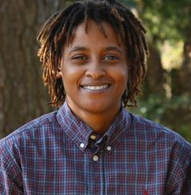
 Jameka Evans was a security guard at Georgia Regional Hospital in Savannah, Georgia. From the beginning of her employment in 2012, Evans was treated badly. She was harassed verbally and physically; she was criticized for wearing a "male" uniform and having a short haircut, and for not carrying herself in a "traditional woman[ly] manner." In short, she was being harassed for both her gender presentation and her sexual orientation.
Evans left her job about a year later, sick of the constant harrassment, and filed a complaint under a federal law known as "Title VII." Title VII prevents discrimination on the basis of sex, including sex stereotyping. The case went to a federal district court, where she lost because the court said that Title VII was intended to protect "sex," not "homosexuality." Evans then appealed to the next court up (the 11th Circuit, since she lives in Georgia), saying that Title VII prevented discrimination against her on the basis of sexual orientation and gender presentation. That court, too, ruled against her (and as a Slate article pointed out, the ruling was weird in a variety of ways). The court separated the gender nonconformity part from the sexual orientation part. They vacated (basically overturned, but without creating precedent) that part of the district court's order, saying that she could go back and try with that part of the case again. Evans and her lawyers then asked for something called an "en banc" hearing, which means that instead of the usual three-judge panel, all the judges on the 11th Circuit would have heard the case. This was denied, meaning that the ruling against Evans stands--at least, until the U.S. Supreme Court says otherwise. So Evans, represented by Lambda Legal, decided to petition the Supreme Court to hear the sexual orientation part of the case. The petition (which you can download from this site if you're interested) is terrific, clearly explaining why discrimination on the basis of sexual orientation is a form of gender discrimination. It states, "It cannot be that Title VII allows an employer to fire Sharon for exercising her constitutional right to marry her girlfriend while retaining her co-worker Samuel after he marries his." Will the Supreme Court take the case? Who knows. But I suspect it will, since nearly all the circuits have weighed in, there's a circuit split (thanks to the 11th Circuit), and it's an important issue. To go back to the gender nonconformity piece for a minute: it's kind of interesting: Title VII definitely applies to "sex stereotyping" (as the Supreme Court decided in a 1989 case called Price Waterhouse v. Hopkins), which is what courts rely on to explain that gender nonconformity is covered. Which would seem to mean that trans people are definitely covered, right? So if the Supreme Court ruled against Evans, a few things would happen that seem like sort of untenable outcomes:
Anyhow, it's an exciting case with huge implications. Keep an eye on this one, dear readers.
1 Comment
OMG. I just got word that I didn't get a job I really, really wanted because the boss-to-be thought that I would be "too much of a leader" and insufficiently deferential. Problems with this assessment include:
I've been thinking about this quite a bit since I heard it earlier today. After some reflection, I told my "inside source" that I think the problem might have had partly to do with gender. That is, women are expected to act in a certain way. By showing up in a women's suit, etc., I made it look like I was trying to "do femininity," but that I was doing it wrong. If this is true--and my inside source (herself an incredibly smart, assertive, feminine woman) thinks it might be--then the solution might be to make it clear that I am not attempting to "do" femininity at all. Maybe if I wear a men's suit and even a tie, it will be clear that I am trying to "do" masculinity. In truth, I am not trying to "do" anything but be the best possible version of myself. But I wonder if, subconsciously, my would-be boss (though extremely progressive) understood me as a woman, judging me by implicitly comparing me to other women. If I wore guys' clothes, I would be putting myself more firmly in the "masculine" category. Not that I would be judged as a man, but rather that I might be judged more by a masculine standard, meaning that my apparent lack of deference(!) would be judged compared to men, not to women, and thus looked upon more favorably, since assertiveness is a quality more valued in men. Either way, depressing. Trans issues have popped up on Butch Wonders quite a bit in the past, so when a super-smart English professor I knew came out as trans, I shamelessly pounced on the chance to ask him all kinds of questions about his process and identity.
BW: How long have you "known" that you're trans? What does it mean to know? Allen: I've known that I was not quite cisgendered for several years, and I've felt trans off and on for several years, but more solidly during the last six months. BW: Can you give an example of something that makes you feel non-cisgendered? After all, I've always hated and felt totally uncomfortable in "girly" things. It just feels not-me. Is that what you mean by feeling non-cisgendered, or is it different? Allen: Those feelings of discomfort with "girly things" are part of it for me, but it also includes dysphoric feelings about my body, such as feeling really psychologically uncomfortable with my female chest and even more minor things like my female-looking neck, female hairline, etc. I have also never liked to be called a girl, woman, or even "tomboy," since "tomboy" suggests that one is not a real boy! So all of these things are part of my feelings of not being cisgendered. BW: I hate the word "tomboy," too. To me, it always suggested that my "boyishness" was a phase I'd grow out of! I resented that, even as a kid, because I knew that there was something in me that other people saw as boyish, and I knew that it wasn't going to change. Okay, so say more about the feelings and knowledge of being trans. Allen: I use those words--felt/feel trans or male--instead of "know," because to me, the transition process centers on feeling more than knowledge. For me, it's not an issue of "knowing" I'm trans, but one of being ready and willing to feel my feelings. BW: How do you know you're not just taking advantage of "male privilege," since in most places it's easier to be a gender-conforming male than a non-gender-conforming female? Allen: Because when I'm allowing myself to feel male and when others view me as and call me male, I just feel happier and feel I'm more able to express myself and let go of hesitation and self-consciousness and depression, even when I'm only in the company of loving, supportive people like my wife and my mom. Male privilege doesn't come into play with such people, yet I am much happier being male even in such small company. BW: So, with these people like your wife and your mom, what does it mean to be treated "like a man?" Can you give an example? Allen: That’s a great question. They don't treat me especially differently, actually; I think the main things that make me feel male and make me feel good in such circumstances are that they don’t call me girl terms and that as male I'm able to feel happier inside my own head, which causes interactions to automatically feel better. An example of the first is that my mom has always called my wife and me "the girls," but now she is trying her hardest to not do this. And my wife calls me "hubby" instead of "wife," which is validating. BW: Do you still ID as butch? Do you ID as a straight man? Allen: No, I don't identify as butch anymore. To me personally, "butch" implies being something other than a guy, and I feel like a guy. I'd probably just lean towards calling myself a guy, or a trans guy. I like those terms. I'd be more likely to identify as a straight man than as butch, but "straight man" feels a bit confining. I am about 99.8 percent straight, but the associations that go along with that term—e.g., uptight, not queer or trans, "bro"—don't feel so great to me. BW: What's the other .2%? Attraction to guys (since you're a guy)? Allen: Well, yes; in my lifetime I've had genuine crushes on two men! But nothing ever happened with that. BW: It seems like few trans men date butches, though I can think of plenty of trans men who date men (either cisgendered or trans), as well as plenty of trans men who date feminine-presenting women. Why so few butch-trans male couples? Or am I wrong about this? Allen: Yeah, I can't think of any transmen dating butch women, that I know of. But maybe there are some! I don’t think I have any answers here. BW: I suspect there are some out there somewhere. (Any BW readers want to chime in?) So as you were dealing with all this gender identity stuff, how did your wife respond? Allen: We've been together for more than nine years, so I've talked with her about my gender feelings for the entire time I've been exploring my identity. So it is certainly not a surprise to her that I'm trans. She is very supportive and happy for me, which I'm grateful for, and she is excited for my future happiness and our future in a potentially better relationship! After all, if both people in a relationship are able to be fulfilled and comfortable, doesn't the relationship end up better for it? BW: I would certainly think so! Allen: Also, she's had relationships in the past with cisgendered men, women, and transmen, so she can certainly be attracted to maleness. While she feels disappointed about not being able to refer to her "wife" and thus be recognized by others as queer, and while she's sometimes nervous about how my personality may change on T (I don't think it'll change radically), she is supportive and hopeful. BW: How are you going to decide whether to get surgeries? Is that a hard decision? Allen: It's an easy decision to get top surgery, which I'm getting on August 5! Or rather, the decision is easy at this point, after I've debated, analyzed, and overthought about transitioning for at least eight years! I decided to get top surgery because I am mentally uncomfortable about my chest every single day of every month and year. BW: Uncomfortable how? Allen: The look and feel of my chest bothers me intensely. I feel a deep, intense, and excited longing to have a male chest. To me, it sounds better than any Christmas present I could imagine! As for lower surgery, I'm not even thinking about that right now. I have always thought I will not get lower surgery, due to the cost, pain, risk, and my current lack of desire for it (partly due to the less than perfect results of FTM lower surgeries). But we'll see how my feelings develop over the years. BW: Are you worried about any changes in your social life? Allen: I'm worried about cisgender guys saying sexist things while hanging out with me (which I've not yet experienced but have heard a lot about from other transguys). I think that would be depressing, and it could be challenging for me to challenge them and "call them on it," but I would do my best, since anyone who spouts sexist ideas or attitudes should be called on it. BW: Any medical worries? Allen: Medically, I'm most worried about increased risk of heart disease and cancer of female reproductive organs. However, these are not gigantic risks, because I read a scientific study on somewhat long-term HRT in trans people which suggested that FTM heart disease risk is not really higher than that of cisgender men, and I have a healthy lifestyle. And like many transmen, I plan to have surgery to take out my ovaries and uterus in several years, if I still feel like I want and need to be on T long-term. This prevents cancers of those organs and also reduces internal hormone "battles." BW: You've referred in the past to having "access to the male parts" of yourself. Which are male non-physical parts, and which are female? And doesn’t almost any answer assume that women "are" a certain way and men "are" a certain, different way? Allen: This is a very complicated question to answer. I'm not sure it can really be explained. The short version is that my deepest spirit feels male. BW: I think I understand that. Because even though I have a ton in common with lots of trans men, reject many socially "feminine" things, etc., men remain "other" to me. I guess a lot of women remain "other" too. But I have no desire, for example, to exist in all-male social spaces as a man. I don't know if I ID strongly with one gender or the other, really. But being called "she" is much more comfortable to me than "he." My own deepest spirit feels female, I suppose, though in a different way from stereotypical femaleness. I am very aware, on a basic level, of feeling "other." Allen: I'm not sure that I feel much of a female part of my inner being. To quantify it, I feel like 80% of myself feels male, and the other 20% might be genderless. Obviously there are many stereotypical activities, mannerisms, etc. that could be labeled as female or feminine, like certain ways that I sometimes sit on a couch, for example. Or being emotional. These things don't feel very female to me, when I do them; they just feel human. So I won't even get into any such stereotypes any further right here. BW: Are you afraid of getting a hairy chest? I totally would be. Allen: Haha. No. I think that a hairy chest would feel foreign to me at first, but then, it would occur very gradually. Especially after I get top surgery, I think a hairy chest would be OK. Sometimes it seems weird to me that I am currently relatively hairless (since I've only just recently started T), so perhaps more body hair would actually feel less weird. BW: You've said that you prefer to be treated as male. In social situations, does being "treated male" mean being treated with more respect? If men and women were treated identically in social situations, do you still think you'd want to be male? Allen: Yes, I would still feel male and want to be male regardless of social equality issues, since I feel much better, happier, and more like myself as male even in private social situations, even in groups of women. Especially in groups of women. BW: Like when, for example? Allen: A few years ago, I was part of a lesbian book group that met monthly. I always felt a little "off" or like a misfit in this group, and I always felt angsty when I would prepare to go to the group: I'd have this urge to dress not just in a T-shirt, which is what I wear on 100% of my days off, but something more decidedly masculine like a button-up shirt. I really chafed against blending in with the other women. They were very friendly and cool people, but still. I felt frustrated when I would sit with them in the book group. BW: That is so interesting! I'm guessing that plenty of them were butch or masculine-identified women. But you still felt a desire to define yourself oppositionally to the others in the group. Allen: I felt that in portraying myself as a woman (since the group was only for women), I was not revealing my real self and was thus invisible. This is a horrible, depressing feeling that I think no one should have to experience. So now, presenting as male in social or work situations, I feel happy and visible, and instead of the dulling and quieting feeling of invisibility, which just made me feel like not talking a whole lot, I feel a positive energy that inspires me to talk more, put myself out there more, and let others get to know me more. BW: Are you afraid of not being treated or seen as "one of the butches?" (This comes from your earlier statement that you don’t ID as butch—I’m not suggesting that trans men can’t be butch.) Allen: No, I’m not afraid of not being seen or treated as "one of the butches." I don't identify as butch and am extremely far from wanting to identify as a woman, so I would feel more validated and comfortable if I were not viewed as a butch woman. I actually don't think things will change much for me in this regard, as I have never felt like "one of the butches." I've never had any close butch friends and have never been part of a butch group of friends. This is kind of sad, since I wanted this for many years. But I found that butch women who wanted to be friends with me were almost nonexistent, and many butches were in cliques that I couldn't manage to work my way into. BW: You're awesome! I want to be your butch friend! I have a few close butch friends, but never a group of butch friends. In part, I've felt like butches en masse can sometimes be a little "bro"-ish. (I'm not saying this is how butches are, just describing my own experience.) Particularly since I don't date femmes, I tend to feel like a bit of an outsider. Allen: I can relate to that; I have also felt that groups of butches were like that! I've already made a number of FTM friends and am surprised at how much we relate and how easy I find it to talk with them and how much I DO want to be one of them. I guess that's a sign that I'm doing the right thing in transitioning! Most of the transguys I've met are less "bro" and more "regular guys" and seem to have less of a "macho" front. I don't know if this is just reflective of the types of guys who choose to go to the FTM support group where I've met friends, or what! BW: That's super interesting. I've never been around big groups of FTMs, but have been in mixed butch/FTM groups, which to me didn't feel significantly different from all-butch groups. But in any case, it sounds like you have an awesome support group! How are your female-ID'd butch friends reacting? My background for asking is this: I had a close friend transition, and although I was super proud of him, it was weird being seen in public with him as a man and a woman, rather than as two gender nonconforming women. We had been existing in the world in a similar way (as people who "didn't belong"), then all of a sudden, he was seen as a "regular" person—just a normal dude. But I was still a gender nonconforming "other;" he fit in and I didn't! Does this make any sense? Allen: Yes, that does make sense. Well, as I said, I have never had any close butch friends, none that I hang out with regularly. But the ones I know, like on Facebook, have been very supportive of me, as far as I can tell. I value that a lot. Yes, I do get to fit in—at a stranger's first glance, anyway—more than a visibly genderqueer person or butch woman would. Actually, for many years now, strangers in public have tended to perceive me as male about 90% of the time, judging by the frequency at which I was "sir-ed" and so forth. So I think strangers often view(ed) me as a "regular guy," even when I was pre-T, so this will not be much of a change, actually. BW: Gotcha. Allen: One example that comes to mind is when I was walking to the BART train after attending the Trans March in San Francisco last week. There were two couples ahead of me, further down the block, who had a "dykey" appearance. A couple of homeless guys called out some mildly insulting remark about "lesbians" to them, which I thought was awful and scary. The men hardly looked at me. Really the only thought I had here was that I felt sorry for those folks ahead of me and glad that I could blend in. BW: That reminds me of a time my butch-appearing partner and I were walking back from dinner with a friend and got yelled at by some guy who called us "batty men" (an offensive slang term for gay men). I wanted to tell him, "You’re mean--and wrong!" It was odd to be gay-bashed incorrectly. But I did think about how encounters like this would be easier if I/we looked like a more conventional couple. Allen: Yeah, it just happens to be that I feel most myself when I appear to be kind of a conventional dude. By chance. So I can sometimes avoid people viewing me as unusual. But this is a side effect of my transition and my clothing choices, not a reason for them. BW: Do you expect that being a man will affect your career as a professor positively or negatively? Allen: I don't expect it to affect my career much either way. The hiring process at state-funded colleges, the only places I want to work, is very regularized and doesn’t allow (in theory) for any discrimination or personal preferences of the hiring committees. However, many English departments are predominantly female these days, so, ironically, I could potentially add some diversity by being male! BW: Okay, one more question: Is it the case that you were always "really" male, or that you have decided that you would be more comfortable "becoming" male? Allen: I feel mostly male on the inside—in my mind, heart, and spirit—so I am already male, rather than becoming male, in those ways. I am becoming male on the outside, and I'm thus giving more life and sustenance to my mind, heart, and spirit, which are in the process of becoming less hidden and quiet and more alive and visible and strong. BW: Good for you! I think it's awesome that you have the courage to be seen the way you want to be seen, and to live life as your true, authentic self. Thank you for taking the time to chat, particularly about something so important and personal.  Last week, I returned to the age-old question of what butches should wear to interviews. In a short poll, I posed the following hypothetical: Imagine helping a butch lesbian decide what to wear for an entry-level professional interview (e.g., lawyer, consultant, finance, manager, gov't, professor, etc.). She usually wears men's clothes, but identifies and presents as female, though people sometimes accidentally call her "sir." She tells you, "I know the employers are kind of conservative, though I also know things are slowly changing. I'm a solid candidate but not a shoe-in. What should I wear?  Julie Goldman, rocking #4 Julie Goldman, rocking #4 I gave six choices and asked how to advise our butch professional wannabe: #1: Fit in first, THEN change the system. Wear what other women there wear: makeup, heels, whatever you have to. #2: Be yourself, but show you're willing to play the game. Wear only the women's stuff you're most comfortable in--skip the makeup and heels! #3: Wear a combo to help you fit in a little--e.g., a plain women's suit, collared shirt, men's shoes. #4: You like men's clothes; wear a men's suit and shirt and shoes, but no tie or other uber-masculine gear that'd alienate you from your interviewers. #5: Men's clothes, including a tie. If they don't want you, you don't want to work there. If you can't get a job in the industry, it's not for you! #6: As long as you wear something nice, clean, etc., it doesn't matter. People judge you for who you are, not what you wear. Here are the results: 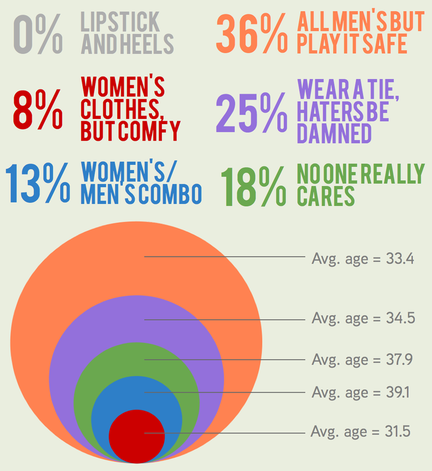 As you can see, I also calculated the average age for each response. For a small survey, these age differences don't matter much, and goodness knows this isn't anything close to a representative sample (of the population overall, of butches, or even of BW readers), but it's interesting to think about. A few numbers that caught my eye, and possible explanations:
And finally, here's a sampling of the write-in comments: 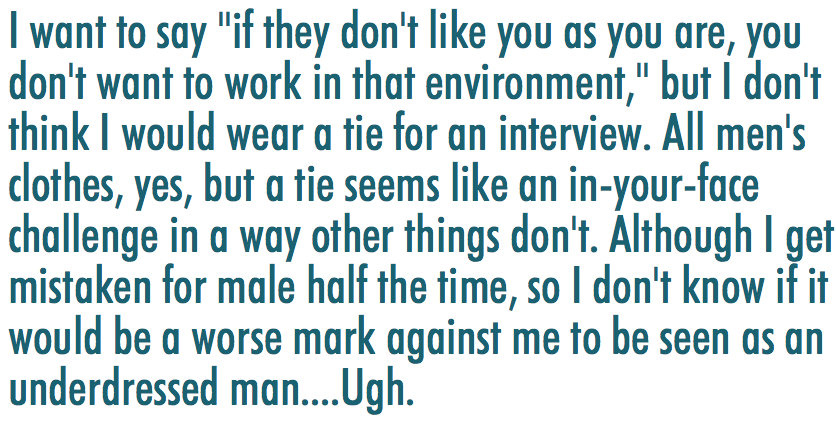 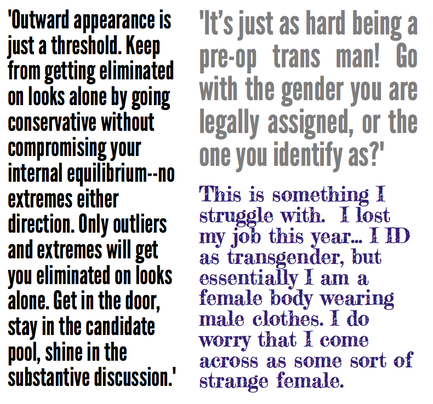 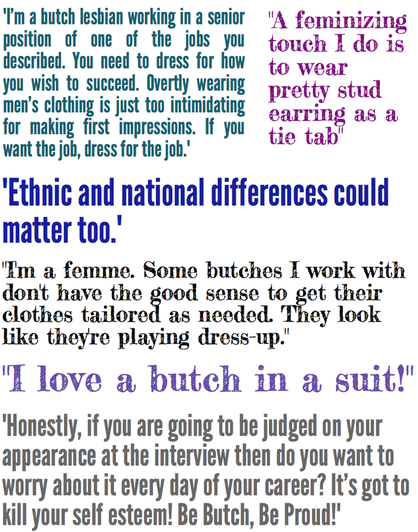 Thanks for these great thoughts. If you're trying to figure out how to break into the profession you want without compromising who you are, you are certainly not alone. A few weeks ago I wrote this article recounting my pseudo-gender-conforming job search. Shortly thereafter, a butch superstar six or seven years ahead of me in my field reached out about the article, and we ended up having coffee and chatting about her experiences. Not only was she even more awesome than I’d hoped, but she had interesting theories about butch clothing selection that are way too interesting not to share.
Said superstar proposed the following:
The bottom line is that Superstar says to go for a men's suit next time—at least, it worked for her. So maybe I will. Or maybe I'll go back and forth, since I like both men's and women's suits that are relatively gender-neutral in appearance (e.g., no cutesy buttons for women's suits, no mega-structured shoulders for men's suits). But I do like wearing ties, which tend to look better with men's suits. Superstar had no major opinion on ties, since she doesn't wear them herself, but since they are THE quintessential "men's" professional clothing item, maybe a tie would be more likely to be looked on unfavorably by prospective hirers. What do you think about Superstar’s theories? Let's unscientifically test one of them! Click here to take a SUPER-quick 2-question quiz. I'll post the results this weekend. |

|
 RSS Feed